

The Book Every American Family Should Own
Premium domains for sale
Freedom Is Back In Style
This article is part of Upstream, The Daily Wire’s new home for culture and lifestyle. Real human insight and human stories — from our featured writers to you.
Freedom Is Back
In Style
Premium domains for sale
***
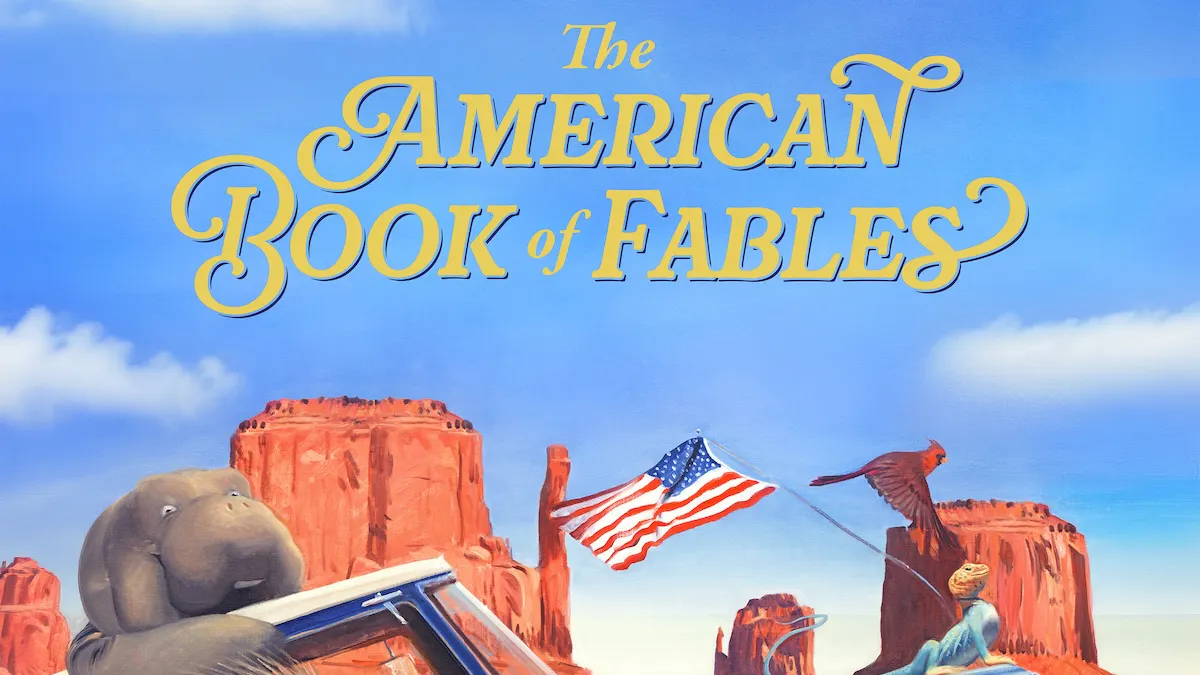
“The American Book of Fables” is unlike anything else in print — or at least, that has been published in the last 200 years. At nearly 400 pages, it’s a tome modeled after much leaner texts, one being “The New England Primer,” an 18th-century textbook with lessons, prayers, and hymns. The book also reflects “The Columbian Orator,” a 19th-century textbook for older readers that influenced both Frederick Douglass and Abraham Lincoln.
It’s an audacious attempt, and author Matthew Mehan isn’t shy about it. “I really am keen to make sure people understand that this is not a children’s book,” he tells The Daily Wire. “This is a family heirloom.”
The book draws on the Western and American literary traditions with nursery rhymes, fables, and primary texts from the Declaration of Independence to the Bible. These sections are divided up for “littles,” “middles,” and “bigs.” When I read excerpts to my four-year-old, he was entranced by the illustrations. Painter John Folley’s detailed, vibrant artwork is scattered throughout, with gorgeous, two-page spreads showing off buffalo, armadillos, and the fruited plains.
Mehan says he’s always been interested in poetry with a civic and humanistic dimension, art that helps people live well. “That attracted me to the fable tradition, which is a very important tradition for self-governing peoples,” he says.
Fables, of course, offer the reader memorable stories with simple takeaways. They are usually vague and fairly universal, meaning they could take place anytime, anywhere. “The American Book of Fables” changes that.
The boy who cried wolf could take place anywhere boys and wolves are found, but Mehan places the story “on Roanoke Island, near the Outer Banks, west of Nag’s Head and South of Kittyhawk, North Carolina.” The boy is hired by the Bodie family (a real family), and there’s a real red wolf preserve nearby.
“The fable tradition is very general and universalistic, and Americans like generalities and universal principles,” Mehan says. “But we also like science and detail, and we have a federal system where we really love our local people and places.”
He credits Homer for the inspiration to add such detail, “carefully and humanely and lovingly naming all of the places and people.” The epic poet took the effort to name dying soldiers on the battlefield.
“I think that is a part of teaching people how to be human and love well the things that are in their care and are part of their community,” Mehan says.
In Mehan’s version of “The Boy Who Cried Wolf,” which he calls “greatly adapted from Aesop,” the boy’s “cries” come from shooting off rockets, which Mehan says is an homage to more American staples: Cape Canaveral, the space race, and Kitty Hawk.
Sophia Institute Press
Fables make for easy, entertaining lessons because they’re full of archetypes. There’s “the irascible badger,” “the languid panda,” “the tyrannical lion,” and “the busy beaver.” Mehan’s beaver is named Nikola, and, yes, that is a Tesla reference. Mehan says he’s meant to represent a passion for technology that wonders whether something can be done and doesn’t stop to determine whether it should. Returning to the theme of self-government, Mehan suggests that such a passion, which is good in moderation, must be governed properly.
The book is rich with allusions to great authors and classic works, as well as its own analogies. One recurring story is that of Humanatee, a “gentle, fat creature” who learns lessons as he traverses the country. One purpose is to challenge the reader to think about the meaning of human nature; if the principles and rights laid out in the Declaration are real, then “you better have a really strong and robust handle on what human nature is,” Mehan says. The Ciceronian conception that Mehan has in mind “has everything to do with self-government and liberty, and treating people right in a way that is just, and fair, and preserves the social bonds.”
This idea is important. “One of the themes of the book is to reintroduce a lot of the really wonderful moral teachings of Cicero, which were profoundly ingrained in our society until the 20th century slowly leached them out mostly by omission,” Mehan adds.
But another theme centers on what it means to be distinctly American, living amid the amber waves of grain and purple mountain majesties.
“The country isn’t just our principles, the country is human nature engaged in a particular history, a particular experience, a particular landscape,” he says. “So an engagement of humanity with all the various animals and regions of the country, was, I thought, a nice expression of the American experience.”
More from this network:
Domains for Sale · GOTPeople.org · TheDSAPlatform · The Truth About Socialism
What's Your Reaction?
 Like
0
Like
0
 Dislike
0
Dislike
0
 Love
0
Love
0
 Funny
0
Funny
0
 Wow
0
Wow
0
 Sad
0
Sad
0
 Angry
0
Angry
0

I am just an average American. My teen years were in the late 70s and I participated in all that that decade offered. Started working young, too young. Then I joined the Army before I graduated High School. I spent 25 years in, mostly in Infantry units. Since then I've worked in information technology positions all at small family owned companies. At this rate I'll never be a tech millionaire. When I was young I rode horses as much as I could. I do believe I should have been a cowboy. I'm getting in the saddle again by taking riding lessons and see where it goes.
Premium domains for sale


















Comments (0)