

America's future is Republican — but not for the reason you may think
Premium domains for sale
Freedom Is Back In Style
America recently turned 250, an impressive achievement for a country that began with an argument over taxes and quickly escalated to gunfire. Americans have been arguing ever since. The more interesting question today isn't whether they'll continue, but which kinds of disagreement a political coalition can actually survive.
Freedom Is Back
In Style
Premium domains for sale
A recent analysis by political scientists Jeremy Pope and Michael Barber at Brigham Young University offers a revealing answer. Using data from the Cooperative Election Study, they examined where Republican and Democrat voters agree with one another — and where the coalitions begin to fracture.
One disagreement is ultimately about numbers. The other concerns who people are, what they believe, and what they owe to one another.
Republicans hold together remarkably well on culture. Whether a GOP voter has a doctorate or left school at 16, Republicans tend to land in roughly the same place on immigration, voter ID, and what children should — and shouldn't — be taught in schools. Where they bicker is on old-school economic questions: taxes, tariffs, government spending, and the size of the federal beast. Those gaps are real, but they are also the kind of fiscal scuffles political movements have been negotiating for generations.
Democrats are closer to the inverse. They display considerably more agreement on economic questions, including federal spending on health care and education. But the moment the conversation pivots to race and identity, the coalition begins to fracture. Most interestingly, Pope and Barber found that this split runs heavily along racial and educational lines. Black Democrats are often considerably more moderate than white, college-educated Democrats on issues including voter ID, policing, and regulation of speech online.
That isn't a minor disagreement. It exposes a potentially serious structural weakness inside the Democrat coalition.
Deal-breakers
The reason is cultural long before it is political. A coalition divided over the marginal tax rate can cut a deal. One faction wants 25%, another wants 30%, and eventually some exhausted politician emerges from a conference room with 27.5% and declares victory. Divide that same coalition over identity, however, and there is much less obvious room for compromise. One disagreement is ultimately about numbers. The other concerns who people are, what they believe, and what they owe to one another.
That helps explain why cultural disputes on the left can become so ferocious. Economic disagreement usually has a natural settlement point. Identity has no equivalent dial. Nobody offers half an identity and calls it a successful compromise. When progressive activists define what constitutes racial justice and significant numbers of black voters disagree, the resulting tension is not merely a disagreement over policy. It raises the uncomfortable question of who actually gets to speak for whom.
The BYU data complicates one of the most persistent assumptions in progressive politics: that minority voters naturally share the cultural politics of the highly educated activist left. Black Democrats are not about to start signing up en masse for the Heritage Foundation, but neither do their views reliably resemble those of white progressives who often claim to speak on behalf of marginalized groups. That tension has no easy fix because it runs directly through the question of coalition ownership.
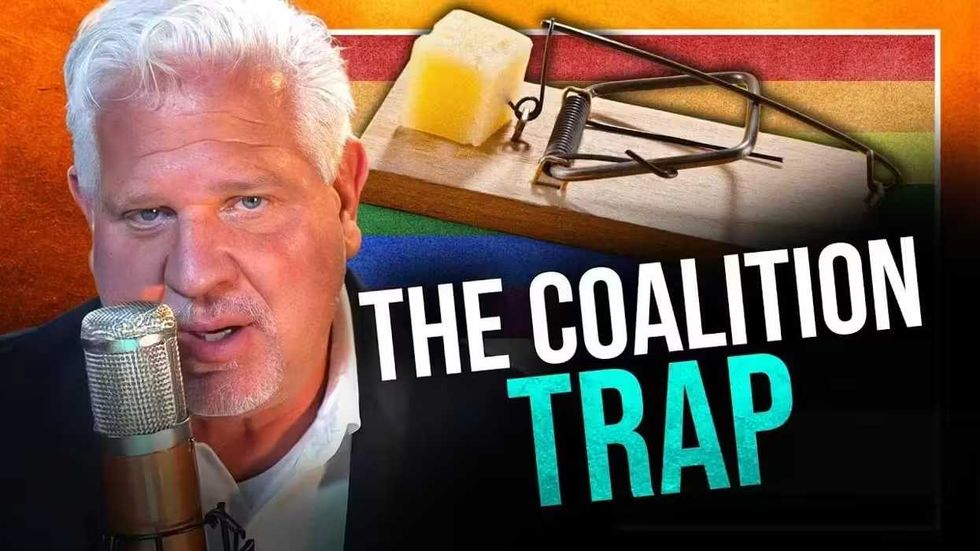
RELATED: ‘Wake up, you’re going to be eaten!’ Glenn Beck warns LGBTQ activists about dangerous Islam alliance
 Blaze Media
Dialing it down
Republicans face a different problem. Their voters show greater cohesion on many cultural questions while divisions emerge more clearly over economics. The MAGA populist who wants tariffs and the traditional free-marketeer who hates them may spend years trying to destroy each other's trade policy, but tariffs can ultimately rise or fall.
Money is inherently negotiable. Tax rates are dials. Spending levels are dials. A faction can lose a budget fight and remain part of the coalition.
None of this means the Republican coalition is indestructible or that cultural agreement automatically translates into electoral success. The GOP has plenty of internal battles over foreign policy, entitlement spending, trade, abortion, and the proper role of government. Nor does the data establish that Democrats are destined to fracture. Political parties routinely absorb contradictions that look impossible from the outside.
Disagreeing to agree
But Pope's and Barber's findings suggest something important about the kinds of contradictions each side is being asked to absorb.
And here the difference matters beyond party politics. Of these two styles of disagreement, one offers a more hopeful model for the future of the country.
Republicans may fight bitterly over tariffs, taxes, spending, and the size of government. But those arguments generally take place within a broader cultural consensus. Money is negotiable. A faction can lose a budget fight and still belong to the coalition.
The Democrat divide described by Pope and Barber is harder to resolve because it reaches into identity itself. When members of a coalition disagree over race, speech, policing, and who has the authority to speak for whom, there is no obvious number to split down the middle.The argument becomes not merely what should we do? but who are we?
Common vision
A republic desperately needs citizens who share a common vision of the country while tolerating dissent within their own ranks. Right now, only one side fits that description, however imperfectly. Beneath the shifting GOP platform are tens of millions of Americans who proudly identify as conservative. They might argue until they’re red in the face about the federal deficit, but they agree on the baseline definition of the nation.
That agreement is everything. A country can actually build a future on shared belonging and open arguments about budgets. It cannot build one on a permanent, paranoid quarrel over who is allowed to speak and who must stay quiet. That fight won't end, because by its very nature, it cannot ever be satisfied.
America has survived 250 years not because Americans agreed, but because for most of that history they possessed enough agreement about basic truths to fight over everything else.
If America is to make it another two and a half centuries, it will not be by inventing new divisions, but by rediscovering the unity that made this great experiment possible in the first place.
More from this network:
Domains for Sale · GOTPeople.org · TheDSAPlatform · The Truth About Socialism
What's Your Reaction?
 Like
0
Like
0
 Dislike
0
Dislike
0
 Love
0
Love
0
 Funny
0
Funny
0
 Wow
0
Wow
0
 Sad
0
Sad
0
 Angry
0
Angry
0

I am just an average American. My teen years were in the late 70s and I participated in all that that decade offered. Started working young, too young. Then I joined the Army before I graduated High School. I spent 25 years in, mostly in Infantry units. Since then I've worked in information technology positions all at small family owned companies. At this rate I'll never be a tech millionaire. When I was young I rode horses as much as I could. I do believe I should have been a cowboy. I'm getting in the saddle again by taking riding lessons and see where it goes.
Premium domains for sale








Comments (0)