

Are Republicans Souring on Data Centers?

Premium domains for sale
Freedom Is Back In Style
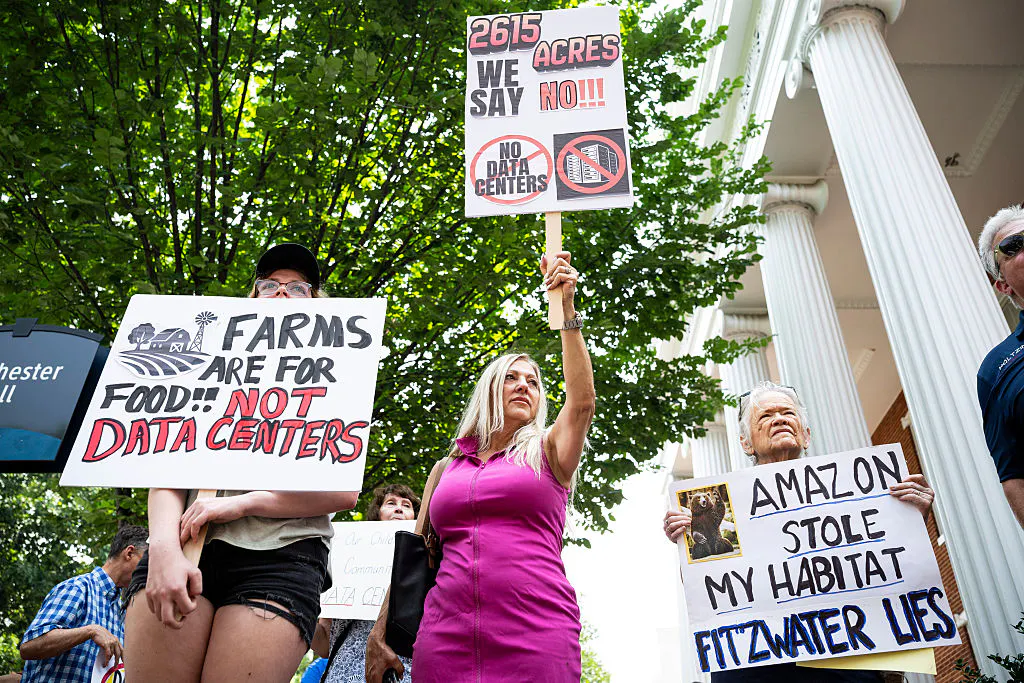
In recent elections, Republican voters have expressed their dissatisfaction with policies responding to the construction of data centers—the rapidly expanding physical infrastructure that supports the internet.
Freedom Is Back
In Style
Premium domains for sale
At the same time, Republican governors are increasingly arguing that their party has to start listening to constituents who are upset with how they believe data centers are affecting their lives, physical environment, and costs.
In the Tuesday primary in Utah, the issue loomed large.
The state’s Republican Senate president, J. Stuart Adams, lost his primary to an opponent, Stephanie Hollist, who targeted him for supporting the construction of the 40,000-acre Stratos data center in Box Elder County. The data center will take up 2.5 times as much area as the New York City borough of Manhattan.
Adams has been a Utah elected official for decades.
Additionally, two Box Elder County commissioners who voted to approve the project in May lost their primaries.
The issue was also present on the federal level.
Rep. Blake Moore, R-Utah, who has served three terms in the House, won the Republican nomination in the state’s redrawn 2nd Congressional District by a roughly 57% to 43% margin over primary challenger Karianne Lisonbee.
Both candidates had to comment on the construction of the Stratos data center in Box Elder County, Utah.
In a statement to Semafor, Lisonbee accused Moore of having “doubled down on his support of the data center.”
Responding to the same outlet, Moore suggested his views on data centers were more nuanced than Lisonbee claimed, saying companies “need to respond to citizens’ feedback, show how they’re going to invest in natural resources, and help lower, not increase, energy prices for impacted areas.”
He added, “We should empower the local areas making these decisions, not attempt to avoid tough conversations.”
Moore also fired back at Lisonbee, accusing her of “trying to distance herself from ‘the process’ when she was a strong supporter of [data center construction] during her time in the state Legislature.”
DeSantis and Abbott Push Back on Data Centers
In both Florida and Texas, Republican governors known for their business-friendly records have begun to call for the Republican Party to rethink its artificial intelligence policies.
“I doubt Democrats will produce good policy re: AI, but Republicans have allowed them to capitalize on public concern about the power and influence of Big Tech by failing to adopt a sensible framework that will protect the public from the very real downsides of the technology,” Gov. Ron DeSantis recently wrote on X.
DeSantis added, “A policy that says transhumanists in Silicon Valley should be able to do what they want is not an acceptable approach, nor is it a politically viable approach.”
The governor signed legislation in May intended to ensure local governments maintain control over projects in their jurisdiction and ensure companies pay the full cost of their energy usage.
In Texas, Republican Gov. Greg Abbott has also pledged to voters to prevent data centers from consuming resources.
“Data centers must bring their own power, they must use their own water, and they must reduce electricity costs for residential customers as well as small business customers. Those are bottom line expectations,” Abbott told News Nation in June.
In June, Abbott penned a letter to the Legislature urging lawmakers to require tech companies to take care of the energy, infrastructure, and water needed to operate their data centers.
Abbott additionally urged the Legislature to eliminate tax breaks and “other outdated or unnecessary incentives for data centers.”
Related Posts



More from this network:
Domains for Sale · GOTPeople.org · TheDSAPlatform · The Truth About Socialism
What's Your Reaction?
 Like
0
Like
0
 Dislike
0
Dislike
0
 Love
0
Love
0
 Funny
0
Funny
0
 Wow
0
Wow
0
 Sad
0
Sad
0
 Angry
0
Angry
0

I am just an average American. My teen years were in the late 70s and I participated in all that that decade offered. Started working young, too young. Then I joined the Army before I graduated High School. I spent 25 years in, mostly in Infantry units. Since then I've worked in information technology positions all at small family owned companies. At this rate I'll never be a tech millionaire. When I was young I rode horses as much as I could. I do believe I should have been a cowboy. I'm getting in the saddle again by taking riding lessons and see where it goes.
Premium domains for sale






















Comments (0)