

As world populations crash, is this Japanese robot city our future?
Premium domains for sale
Freedom Is Back In Style
In September 2025, Toyota officially opened Woven City at the foot of Mount Fuji: a development of streets and residents, robots and cameras, inventors and ordinary people arranged on land formerly occupied by a car factory. The company calls it a “living laboratory.” What Toyota has built is not quite a city and not quite an experiment. The city is a model, staged in domestic architecture, demonstrating that the most important question in technology right now is not whether artificial intelligence can write a poem or pass an examination, but whether it can carry a parcel, assist a frail body, and navigate a loading dock without killing anyone.
Freedom Is Back
In Style
Premium domains for sale
This arrangement is an example of what Japan has begun calling “physical AI.” The term has spread quickly. Two years ago, it appeared mainly in specialist papers. Today it is found in strategy documents, industrial policy, parliamentary testimony, and semiconductor planning. The government has formally pledged, through its Basic Policy on Economic and Fiscal Management, to formulate a strategy for robots equipped with AI and advanced semiconductors. The Ministry of Economy, Trade and Industry illustrates the concept with a warehouse robot that maps its environment, chooses routes dynamically, avoids obstacles, and coordinates with other machines in real time. The Japan Science and Technology Agency's research arm organizes the field around three directions: stronger task execution, better adaptability to diverse environments, and coexistence with humans.
Making machines more like bodies may be more consequential than making them more like minds.
There is a history to the choice of the word “coexistence.” Japan has been making robots for decades, and it has been making stories about robots for even longer. The mechanical dolls of the Edo period, the karakuri ningyo, were clockwork figures that concealed their mechanisms inside appealing social surfaces: a doll that served tea, another that fired an arrow. Japan has long cultivated a public culture in which mechanism and social performance are not antagonists. That inheritance runs through Astro Boy and Waseda University's decades of humanoid research, through every official document that describes robots as a component of public welfare. When METI describes image sensors as the human eye of physical AI, it is drawing on a vocabulary assembled over centuries. Japan keeps remaking a robotics culture, and today’s discussion of physical AI is the latest round of creation.
The urgency, however, is contemporary and specific. Japan is aging at a rapid rate. Caregivers are scarce. Logistics workers are scarce. Regions outside the major cities are emptying. METI launched its RING Project in 2025 to eliminate regional labor shortages through robot deployment. A 2024 revision of government guidelines on long-term care technologies was framed around reducing caregiver burden and supporting elderly self-reliance. The delivery robots now permitted on public roads, under a 2023 legal change, are presented as a practical response to a known shortage.
The technical challenges are not simple. Robot foundation models cannot train on the open internet the way large language models do. Bodies encounter a world that resists transcription. NEDO, the government’s technology-development agency, notes that what is overwhelmingly lacking is data collected in the physical field. The AIROA consortium, established in December 2024, exists largely to build the data infrastructure for generative AI foundation models to work in robots at scale.
RELATED: Shadowy companies are selling access to your smart TV — and its data
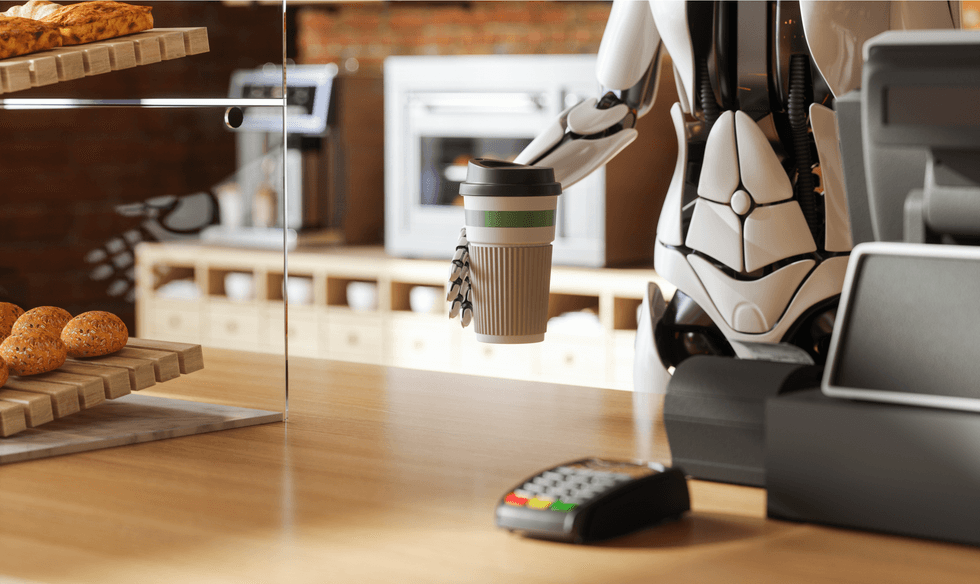
 JDawnInk/Getty Images
The stack that makes physical AI possible includes multimodal perception, state estimation, planning, control, feedback, safety, edge computing, and digital twins. Kajima and Preferred Networks' navigation system for construction sites combines cameras, lidar, and inertial measurement to build maps of an environment that never stays the same from one shift to the next. Mujin’s architecture employs a digital twin running in continuous feedback with a physical warehouse, updating state, re-optimizing motion, and coordinating execution in something close to real time. Getting intelligence into bodies and those bodies into the world is a data-engineering problem of considerable difficulty.
Japan’s Moonshot Goal 3 sets a target of AI robots that allow more than 90% of people to feel comfortable with them by 2030. The target acknowledges that physical AI is, among other things, a social legitimacy problem. Waseda’s AIREC project, developing a care robot for household, welfare, and medical settings, is pointed at the hardest version of this problem: safe bodily interaction with vulnerable humans. The researchers describe tactile sensing, dressing assistance, attention mechanisms, and predictive learning for physical contact. Journalists who have visited the lab tend to describe the same scene: a robot trying to put a shirt on an elderly person without hurting him. That image is instructive; physical AI is most sensitive in close human interaction.
The rhetoric of Japan’s push rests on a claim of human augmentation rather than replacement, technology that reduces burden while preserving self-reliance. Nevertheless, the demographic crisis that makes robots attractive also makes the economics of replacement compelling. One-third of Japanese companies were already using or actively considering AI-powered robots by 2026, while researchers and trade journalists noted the intensifying competition from the United States and China in more autonomous, AI-enabled systems. Japan can use the language of augmentation for now. Whether it can continue to do so through demographic free fall and international competition is a different question.
The Japan Science and Technology Agency has noted that physical AI may address limits inherent in purely software-based intelligence. The assumption is that intelligence without a body is a specific and limited kind of intelligence. Once a system has to carry something, or navigate a construction site, or change an elderly person’s clothing, the problem of being in the world arises. Perception becomes active. Error has weight. Meaning is inseparable from situation. The Japanese know this. What is new is that the country is now wagering its industrial future on the proposition that making machines more like bodies may be more consequential than making them more like minds. At the foot of Mount Fuji, a living laboratory works to settle the bet.
More from this network:
Domains for Sale · GOTPeople.org · TheDSAPlatform · The Truth About Socialism
What's Your Reaction?
 Like
0
Like
0
 Dislike
0
Dislike
0
 Love
0
Love
0
 Funny
0
Funny
0
 Wow
0
Wow
0
 Sad
0
Sad
0
 Angry
0
Angry
0

I am just an average American. My teen years were in the late 70s and I participated in all that that decade offered. Started working young, too young. Then I joined the Army before I graduated High School. I spent 25 years in, mostly in Infantry units. Since then I've worked in information technology positions all at small family owned companies. At this rate I'll never be a tech millionaire. When I was young I rode horses as much as I could. I do believe I should have been a cowboy. I'm getting in the saddle again by taking riding lessons and see where it goes.
Premium domains for sale
















Comments (0)