

California Is So Unlivable That Families Making 300K Are Getting Government Assistance

Premium domains for sale
Freedom Is Back In Style
It wasn’t long ago — just about four years ago, in fact — that most employees at Microsoft thought they were untouchable. They were working a dream job at one of the biggest and most profitable tech companies on the planet.
Freedom Is Back
In Style
Premium domains for sale
They probably assumed, reasonably enough, that they had some job security. In fact, employees at Microsoft were so thrilled by their good fortune that — like so many other wealthy liberals — they felt a need to apologize for their success in a performative and totally meaningless fashion. To that end, Microsoft employees began opening their company meetings by paying homage to the various primitive tribes that used to exist on the land where Microsoft’s campus is currently located.
Now, as we all know, these primitive tribes did not create anything on the level of, say, Windows 95. They didn’t even have any actual windows — as in the kind of windows you open to let light in. That was a level of technological advancement that exceeded their capabilities. They just opened the wood panels in their longhouses when things got too dark inside. Nevertheless, the good men, women, and non-binary folks at Microsoft apparently felt deeply indebted to these so-called “indigenous tribes.” So they put on performances like this one, at major company events that were broadcast to millions of people:
How can any rational mind watch this clip and not realize this is a secular religion? It shares every hallmark of genuine cult behavior.
https://t.co/v6e35Gp91DThis is simply a genuflection.????
https://t.co/joozYSxMYu— Theo Jordan (@Theo_TJ_Jordan) October 11, 2022
She even describes her appearance, just in case any blind members of the Sammamish or Duwamish tribes happen to be listening. It’s all very thoughtful and inclusive — the kind of gesture you make when you have goodwill to spare. It’s the corporate equivalent of throwing an extra $50 in the collection basket because you’ve had a good year. For the 220,000 or so people who work at Microsoft, this was the “company culture.” They had a very good thing going.

Fast-forward just a few years later, and things have changed quite a bit. On Monday, Microsoft announced that they’re offering buyouts to 60,000 of their 220,000 employees — more than a quarter of their global workforce. Yes, a quarter of Microsoft’s workforce just received an offer to leave the company. If for some reason you still don’t believe AI is going to have a massive and very rapid impact on the economy in a short period of time, then this is a story you need to pay attention to:
When you look at the fine print, the deal gets even worse. Employees who accept the buyout will receive Microsoft’s standard severance package, including at least eight weeks of base pay (with more based on tenure). So this is not exactly designed to be a tempting offer for most employees. Sometimes you hear about generous buyouts — this isn’t one of them. If you accept the buyout, you’re basically getting control over the precise timing of your layoff — nothing more (And in the process, you might be signing away your potential unemployment benefits, which is something you always need to keep in mind when you take a buyout).
Admittedly, the timing advantage may end up being quite valuable for these employees. This is all voluntary for the moment, but obviously, the company is looking to cut its costs dramatically. Microsoft clearly doesn’t believe that these workers are essential. Therefore, these buyouts will almost certainly become layoffs before long. There are estimates right now that only around 5 to 10% of Microsoft’s employees are expected to take this buyout, so it’s probably not going to clear enough employees out.
And employees at Microsoft seem to recognize that.
I saw this screenshot posted by an account on X, supposedly leaking some internal Microsoft communications following the big announcement on Monday:
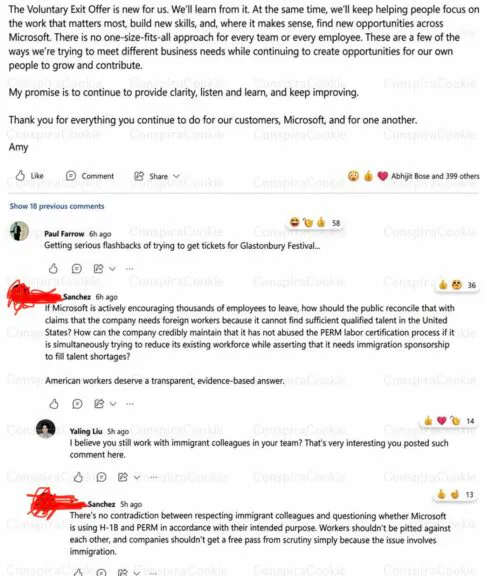
I haven’t authenticated it, though I have no reason to doubt it’s real. But it really doesn’t matter, because the point is a good one. The message reads:
If Microsoft is actively encouraging thousands of employees to leave, how should the public reconcile that with claims that the company needs foreign workers because it cannot find sufficient qualified talent in the United States? How can the company credibly maintain that it has not abused the labor certification process if it is simultaneously trying to reduce its existing workforce while asserting that it needs immigration sponsorship to fill talent shortages?
Then there’s a dismissive HR-type lady reply that reads, “I believe you still work with immigrant colleagues in your team? That’s very interesting you posted such comment here.”
So basically, shut up and don’t ask any questions. It would be very racist to notice that, at the precise moment Microsoft is planning to get rid of a large portion of its workforce, it’s also claiming that it desperately needs to look overseas to find talent.
Let’s take a step back and consider the implications. Microsoft has never done a voluntary buyout on this scale before. Very few other companies have. It’s reminiscent of GM’s massive buyout in 2006, when around 35,000 workers agreed to an early exit. And as far as I can tell, this is the single largest buyout since then.
Overnight, one of the largest companies in the world — a place many college students would kill to work for — just announced it’s happy to get rid of 25% of its workforce. They’re exempting a small number of divisions — including cybersecurity, data centers, and marketing. But for the most part, except for the foreigners, everyone’s potentially on the chopping block. Even vice presidents are getting these buyout offers. And we can only assume the division in charge of land acknowledgements is vulnerable as well.
On some level, it might seem obvious what’s going on here. It’s the same reason Meta cut 10% of its workforce earlier this year, and why Oracle got rid of 21,000 jobs — or 13% of its workforce. It’s why Amazon seems to announce new layoffs every other day. AI has made most of these jobs redundant.
That’s the conclusion most people are drawing here, and it’s probably correct to some degree.
But we also have to acknowledge another possibility I haven’t seen many people point out, with the exception of a tech CEO named Brad Groux.
Microsoft (like so many other companies focusing on AI) may have realized it’s spending a ton of money on AI without anything to show for it. AI is extremely expensive to maintain. As Groux points out, Microsoft has hundreds of billions of dollars of debt on its books due to data center expansion.
All that new construction (which has caused a lot of backlash we’ve covered before) is not cheap. And it’s also not cheap to have millions of people asking AI questions all day long, when most of them are paying nothing at all (or a relatively low monthly subscription fee).
It’s quite possible that Microsoft, like other AI-driven companies including Anthropic, is burning through cash very quickly. Now they’re panicking. And it’s not just the big players. There’s been a lot of investment in AI growth — including investment in smaller companies called “neo clouds” — which are starting to look very dubious right now. And that could mean a much larger market correction is coming.
Either way, from the perspective of young employees, the upshot is clear: Industries that seemed to provide job security are now downsizing at a record pace. And even in the best-case scenario, you have to wonder, at a certain point, who’s going to have any money to spend on all of these AI products if no one has a job. The reason that corporations like Microsoft are worth trillions of dollars is because they’re supposed to generate a lot of future revenue — but it’s not remotely clear right now who’s going to be able to afford whatever they’re selling.
Maybe no city in the country illustrates the coming AI dystopia more than San Francisco (or the Bay Area in general), where so many of these Big Tech companies are headquartered. One of the reasons we spent so much time discussing France last week is that, in many ways, France is a window into what the United States could easily become, if the socialists continue to win elections here. France is a case study in how, no matter how much government spending is provided, socialists will always demand more. No matter how high the taxes are, they’ll always demand more taxes. France is number one in the world when it comes to government spending, and they’re still pretending that the schools don’t get enough money.
By the same token, San Francisco is an illustration of where the so-called “AI boom” could take us, as a society. In terms of its GDP, the Bay Area is dominant. More wealth is generated every year in the Bay Area alone than in all of New England or the Deep South. On a per capita basis, the Bay Area is wealthier than almost every petro-state in the world, including Qatar.
In recent years, because so many Bay Area AI companies (both big and small) have been going public with gigantic IPO’s, these people have become wealthier than ever before. San Francisco also has self-driving taxis, grocery stores that automatically charge you for products you take off the shelf, and robot coffee bars. This is the epicenter of the AI revolution by any metric. So with that in mind, how are things going in San Francisco?
As it turns out, the Left has created such an insane anti-human dystopia in San Francisco that even people making a lot of money — hundreds of thousands of dollars a year — apparently need government subsidies to have kids (and they still aren’t having them). They have more dog daycares than actual daycares. The city is basically billionaires, multi-millionaires, and homeless fentanyl addicts at this point. This article from The New York Times was published just a few days ago:
San Francisco now offers free child care to families of four earning up to $235,000 a year, including [John Marman and Natsumi Makiyama]. The city pays half the cost of child care for families making up to $325,000 a year, an eye-popping level that is more than 3.5 times the country’s median household income. … Rents are higher in San Francisco than in any other large city in the country, according to Apartment List. The median rent for a two-bedroom apartment is now $4,640, the site said. The median cost of a single-family home in the city tops $2 million, a figure that these days would most likely buy a small, basic house in need of work.
You heard that correctly — the city of San Francisco will pay half the cost of child care for families making up to $325,000 per year. This is a household income that, in virtually any other state, would be pretty comfortable. But in San Francisco, making $325,000 a year, you’re on welfare. So let’s break down how exactly this happens. We’re still talking about this same couple, John Marman and that other woman:
Each month, [the couple] pays $6,400 for their home mortgage and $2,200 for two car payments, car insurance and gas, since they are unable to reach their jobs without their vehicles. Cell service and home Wi-Fi is another $300 per month. They put a little each month toward life insurance, their children’s college accounts and retirement. They spend more than $150 each week on groceries and have become coupon clippers who try to make cartons of milk last longer than they used to and who visit different grocery stores on different days scouting for deals. “I don’t want to say we’re rationing, but we’re definitely thinking about not using too much,” Mr. Marman said. “Every grain of rice is eaten, and we make sure there is no food waste. I’m the designated garbage disposal for the kids’ leftovers.
I like the idea that, if you make $235,000 in Alabama or something, then you’re just leaving rice all over the place. There are just piles and piles of totally untouched rice containers, strewn all over the upper-class suburbs of the Deep South. But in San Francisco, every single grain of rice must be consumed, or else they’ll go hungry.
To be clear, this particular couple is not working in the AI industry. One of them is a therapist, and the other is a pediatric nurse. So you might say, well, they’re only poor because they’re not getting any of the AI money yet. But the truth is, even people who have jobs in the industry are complaining about the cost of living in San Francisco:
San Francisco is so pricey, even some people working in the booming A.I. industry get City Hall help. Emma Hare, a legislative aide at City Hall, and her husband, who works at an A.I. start-up related to robotics, bring in just over $300,000 per year and qualify for 50 percent off their son’s child care. … Ms. Hare’s policy brain thinks about whether a city’s role is to “help the median resident or have a really strong social safety net” for the poor, she said. Her mom brain thinks about the opportunities her son will have growing up in San Francisco — the parks, the museums, the culture, the beauty — and has decided the daily stress is worth it.
It reminds me of that meme: “I love New York, where else in the world can you get a sandwich?” People living in these extremely overpriced cities truly believe that no other city has parks, museums, culture, or beauty. And by the way, when they talk about “culture” in San Francisco, they’re talking about gay pride parades featuring children and full-frontal nudity. They’re talking about purchasing wombs, defrauding investors, and giving free needles to drug addicts. To the extent San Francisco has a “unique culture,” it’s not very desirable.
But there’s an amusing element in that paragraph where Emma Hare, the legislative aide, wonders whether it’s appropriate for her to receive welfare when so many people are homeless and unemployed in her city. Her “policy brain” has to really ponder that question. But in the end, shockingly enough, she’s happy to take the money.
All of the Left-wing idealism, and all the concerns about “Wealth inequality” and racial equity or whatever, suddenly go out the window when the government offers to reduce your childcare bill by 50%. Even if you’re making $300,000 a year, you’ll take it. The fentanyl addicts can fend for themselves, I guess. How many of those addicts have children, by the way? Is there any universe in which Emma Hare needs this money more than the children of homeless fentanyl addicts?
Maybe there is. San Francisco, despite all of its wealth, is apparently the kind of place where high-net-worth individuals need welfare. And that’s yet another clear sign, as if we needed it, that the blue-state model has totally failed (And this is without even talking about the rest of California, which is somehow in even worse shape — Los Angeles in particular).
Even former communist countries behind the Iron Curtain, by some metrics, are doing a lot better. Yes, they don’t have anywhere near as much money. But on the bright side, the former Eastern Bloc countries have a homeownership rate that sits above 85%. Poland is around 87%. Romania is around 95%. Hungary and Slovakia are over 90%. And the vast majority of these homeowners have zero mortgage debt. Meanwhile, in San Francisco, the homeownership rate is below 40%, and most of those homeowners have massive debt (and need welfare, apparently).
In terms of crime and violence, it’s not really a contest. Warsaw and Prague are much safer than San Francisco (And they’re dramatically safer than some of the worst neighborhoods in San Francisco, like the Tenderloin). The public schools are safer, too. It’s actually kind of remarkable, when you think about it: Whether they have money or not, Leftists inevitably turn everything they touch into a dystopia. France is poor, and it’s a dystopia where everyone’s on welfare. San Francisco is rich, and it’s still a dystopia where everyone’s on welfare. This is an ideology that’s incapable of producing an ideal outcome no matter how many resources you give it.
We’re seeing the same level of dysfunction in every major American city, all of which are run by the same political party. As The Wall Street Journal reported recently:
The number of children under 18 living in big U.S. cities is down 6% in the past decade, compared with a 1% decline nationwide. The drop is especially stark among families with little kids: The number of children under age 5 in big cities fell 15%, compared with a drop of 7% nationwide. Even cities that are gaining population are losing children. In all, the number of children declined in about two-thirds of the 38 U.S. cities with more than 500,000 residents.
The main self-reported reason this is happening, as you’d expect, is that people think it’s too expensive to have kids. In just the past decade, the percentage of Americans who say raising children is unaffordable has increased by 20%. When The Times did another story on this crisis recently, they found that adults in their 30s all had the same complaints:
Nearly two dozen people in their early 30s said in interviews that the image of adult life that they had been promised turned out to be a sham. … Many work full time and earn enough to cover the cost of basic groceries (even if it means trips to three stores). But their salaries are losing ground to inflation, and their health care costs are skyrocketing. They’re cutting back on salon visits, social activities and fresh fruit runs — and they feel priced out of adulthood. On Thursday, the long-running Harvard Youth Poll found for the first time in its history that more young Americans expect to fall behind, rather than surpass, their parents economically. … “Never trust anybody over 30” was a rallying cry of the ’60s; the lead character of “13 Going on 30” awoke to a thriving career and posh apartment; a pop star even used “30” as a meditation on marriage and motherhood. But so much about the lives of Americans has changed during the last three decades. In 1990, a wedding at 26, a baby shower (or two) by 28 or a first home around 30 was ordinary.
But it’s not ordinary anymore. The point here isn’t to go into a digression about birth rates — that’s an entirely separate topic. Suffice it to say, the trends are very bad. And paying people to have kids, or giving them financial assistance when they do so, isn’t working. It doesn’t work in California, or Hungary, or anywhere else it’s been tried.
We have to be honest about the fact that, as bad as these trends are, AI is likely to make them substantially worse. We’re already well below replacement level, and if these layoffs continue, we’ll be close to an extinction-level event within a century. As even The New York Times has acknowledged, with birth rates this low, the only way Democrats can remain in power is to import foreign voters. And that’s exactly what they’re doing. Again, this is a quote from The New York Times, which would call you racist for talking about “demographic replacement” — even as they acknowledge what’s happening:
The only three of these large states to have lost population since 2020 are the three reliably blue states. And the two biggest red states, Texas and Florida, have experienced population surges. … This is almost entirely about domestic migration. About two and a half million people in total left California, New York and Illinois, and nearly as many arrived from other states in Texas, Florida, Georgia and North Carolina. … To provide more context, California and New York over the past decade have both drawn people from other countries and lost some of their residents to other states. California and New York are the embodiment of the melting pot: Younger people come from around the world and older people leave for the rest of the country.
Yes, “younger people come from around the world, and older people leave for the rest of the country.” That’s the model that Democrat-run states are running.
And as you can see from this chart, that’s exactly what’s happening:
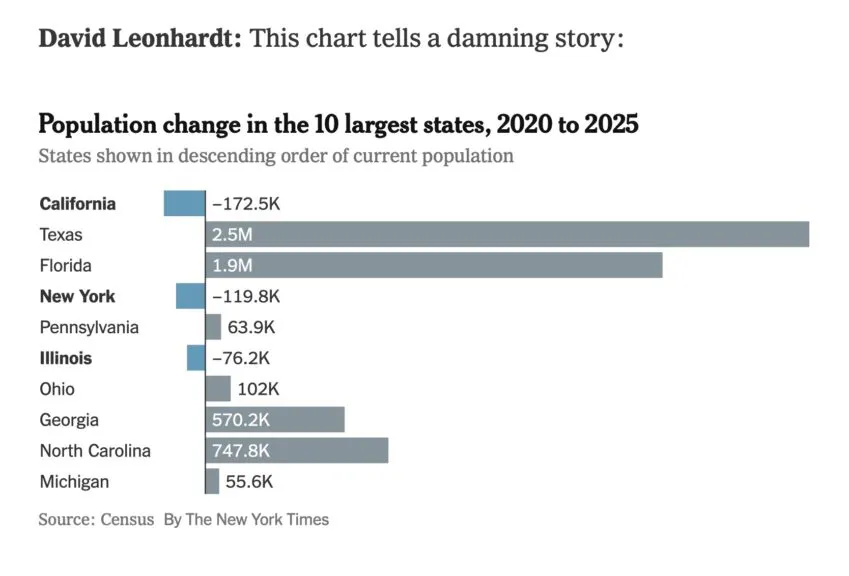
The Republican states like Georgia, Texas, and Florida are the safe haven for liberals fleeing states like New York and California. They’re deliberately driving out as many Americans as possible, and replacing them with foreigners who will vote Democrat in every election.
Everyone who remains — including both the foreigners and the die-hard Leftists who are in love with San Francisco’s “culture” or whatever — is dependent on welfare to survive. And when people are dependent on welfare, they’re going to vote for the party that keeps the welfare checks coming.
Even Leftists making $300,000 a year are happy to take a welfare check — and indeed, it seems like the entire point of the AI economy (in the hands of Leftists) is to make everyone as dependent on the government as these people are. That’s what they’ve done to their most loyal supporters in San Francisco, and it’s what they’re planning for every major city in the country.
In one week, there’s a very real chance that Democrats will get much closer to realizing that goal. It’s not a foregone conclusion, and the polls aren’t always accurate. But at the moment, they’re all trending in the same direction (And regardless, as we just saw in Brazil, the Left has no problem stealing elections anyway).
Given that we’re on the verge of a major economic disruption caused by AI, there’s a real potential for Democrats to use any political victory as an opportunity to remake this country in ways most people can’t even comprehend.
More from this network:
Domains for Sale · GOTPeople.org · TheDSAPlatform · The Truth About Socialism
What's Your Reaction?
 Like
0
 Dislike
0
 Love
0
 Funny
0
 Wow
0
 Sad
0
 Angry
0

I am just an average American. My teen years were in the late 70s and I participated in all that that decade offered. Started working young, too young. Then I joined the Army before I graduated High School. I spent 25 years in, mostly in Infantry units. Since then I've worked in information technology positions all at small family owned companies. At this rate I'll never be a tech millionaire. When I was young I rode horses as much as I could. I do believe I should have been a cowboy. I'm getting in the saddle again by taking riding lessons and see where it goes.
Premium domains for sale

























Comments (0)