

College Football Is Finally Honest About Being Pro
Premium domains for sale
Freedom Is Back In Style
Money ruined college football, you hear endlessly these days. But did it really? Wasn’t college football always about money, for someone? The “boola boola” days, where aging alums sit in the premium seats waving flags for our boys, are long bygone, as far in the historical rearview as naïve tourists setting up picnics to watch Civil War battles take place.
Freedom Is Back
In Style
Premium domains for sale
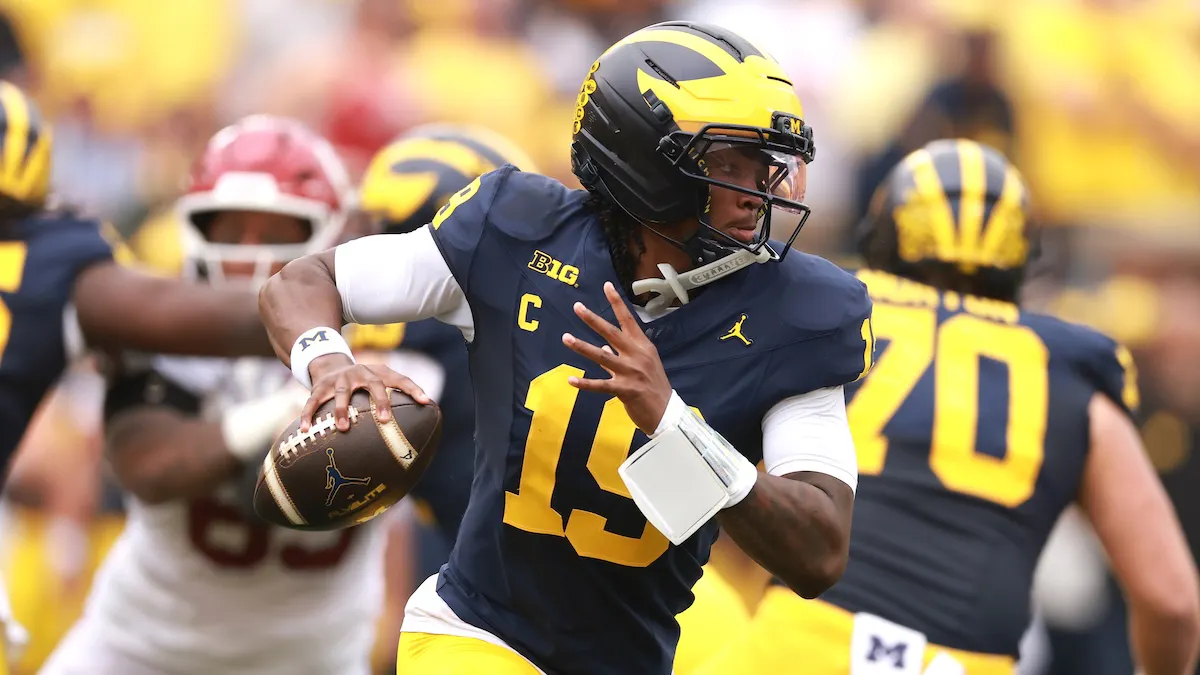
College football became professional decades ago. In 2026, denial of that fact has finally started to evaporate. Football fans may ultimately get a better sport because of it. Finally, schools are starting to bankroll the guys who really Roll Tide.
The 2026 season is the second under a system that would have violated NCAA rules only a few years ago. Now, schools are openly paying players themselves. Under the House v. NCAA settlement, participating Division I schools can distribute up to $21.6 million this academic year directly to athletes. In year two, the system is starting to look less like an experiment and more like an actual professional labor market.
Football programs operating under the settlement have a 105-player roster limit, but the old scholarship ceiling has evaporated. Schools can offer scholarships to everyone on that roster. There’s still third-party sponsor Name, Image, and Likeness (NIL) money, but players must report deals of $600 or more with many reviewed through an NCAA clearinghouse. In July and August alone, the commission cleared more than $227 million in NIL deals.
So now for top players, you have direct school money and endorsement deals. And the rest of the machinery is beginning to resemble a professional labor market. This was the first offseason with one 15-day football transfer window, January 2 to 16, replacing separate winter and spring periods. More than 6,700 Division I players still entered, so it certainly didn’t end free agency. But once the window closed, coaches could at least head into spring having a pretty good idea who would actually be on their eligible roster.
Then this summer the NCAA rewrote eligibility itself, replacing the old redshirt maze with an age-based five-year eligibility period. The system fully takes over for athletes entering college in fall 2027. On top of that, we’re starting to see something resembling contract enforcement. The University of Mississippi sued two players who followed coach Lane Kiffin to Louisiana State University, seeking $550,000 from one and $400,000 from another under early-termination provisions in revenue-sharing agreements.
Meanwhile, LSU spent the opening week of this season fighting with the SEC over whether players who’d actually signed NFL contracts could return to college football. A Louisiana judge sided with the players temporarily. LSU ultimately left them off its roster rather than risk SEC sanctions.
This isn’t your grandpa’s Big Red-themed University of Nebraska basement viewing room. Universities are paying players, signing written agreements with them, suing them when they leave, restricting when they can change teams, and fighting over whether actual former professionals can return. Sounds something like pro sports to me.
The USC Trojan horse started nudging its way out of the barn in 1984 when, in NCAA v. Board of Regents, the Supreme Court ruled that the NCAA’s centralized control of college-football television rights violated antitrust law. That was the beginning of modern college football. TV revenue money could grow outside of the NCAA’s purview.
In 2009, former UCLA basketball star Ed O’Bannon sued because EA Sports hadn’t paid him for his likeness in an NCAA video game. His suit produced a ruling that NCAA restrictions on athlete compensation violated antitrust law. The legal foundation underneath “amateurism” had begun cracking.
The years 2018 to 2021 transformed player movement almost as much as time travel would have. The NCAA launched the transfer portal in 2018, then in 2021 broadly allowed athletes, including football players, to transfer once without sitting out a season. A 2021 Supreme Court ruling NCAA vs. Alston struck down restrictions on education-related benefits when it came to college sports, writing in its majority decision, “When it comes to college sports, there can be little doubt that the market realities have changed significantly since 1984.” Justice Brett Kavanaugh, in a concurring opinion, said “the NCAA is not above the law” and “price-fixing labor is price-fixing labor.”
That same year began the NIL era. But the House settlement has ended the central fiction. Going forward, schools themselves — not boosters or Nike or the local RAM dealer — can directly pay athletes. The first-year cap is $20.5 million, based on some complicated power-conference revenue math. A new College Sports Commission, which we’re sure won’t experience any corruption at all, will police the system.
This direction is actually good for fans. For decades, college football had mammoth television contracts and multimillion-dollar coaches’ salaries, stadiums, and pro recruiting operations and revenues while insisting it employed an amateur labor force of elite athletes. Then NIL produced an absurd uncanny valley of semi-pro compensation. People were brazenly greasing players, but all the athletes had to pretend some random booster with a local business just wanted their Instagram endorsement. Now, college athletes no longer have to fake it to make it.
Once everyone accepts that these are compensated athletes playing a commercial sport, rules that once sounded taboo become sensible. You’ll have written multiyear agreements, defined transfer periods, retention incentives, and eventually some negotiated system governing movement and compensation. That could mean fewer beloved players disappearing every spring, more recognizable rosters, and more continuity from season to season. It will start to look like what it already is, and has been for a long time: professional football. Boola boola.
***
Neal Pollack, “the greatest living American writer,” is the author of 12 semi-bestselling books of fiction and nonfiction and is a three-time “Jeopardy!” champion.
This article is part of Upstream, The Daily Wire’s new home for culture and lifestyle. Real human insight and human stories — from our featured writers to you.
More from this network:
Domains for Sale · GOTPeople.org · TheDSAPlatform · The Truth About Socialism
What's Your Reaction?
 Like
0
Like
0
 Dislike
0
Dislike
0
 Love
0
Love
0
 Funny
0
Funny
0
 Wow
0
Wow
0
 Sad
0
Sad
0
 Angry
0
Angry
0

I am just an average American. My teen years were in the late 70s and I participated in all that that decade offered. Started working young, too young. Then I joined the Army before I graduated High School. I spent 25 years in, mostly in Infantry units. Since then I've worked in information technology positions all at small family owned companies. At this rate I'll never be a tech millionaire. When I was young I rode horses as much as I could. I do believe I should have been a cowboy. I'm getting in the saddle again by taking riding lessons and see where it goes.
Premium domains for sale










Comments (0)