

Canada killed this family's ostriches. One year later, they fight back.
Premium domains for sale
Freedom Is Back In Style
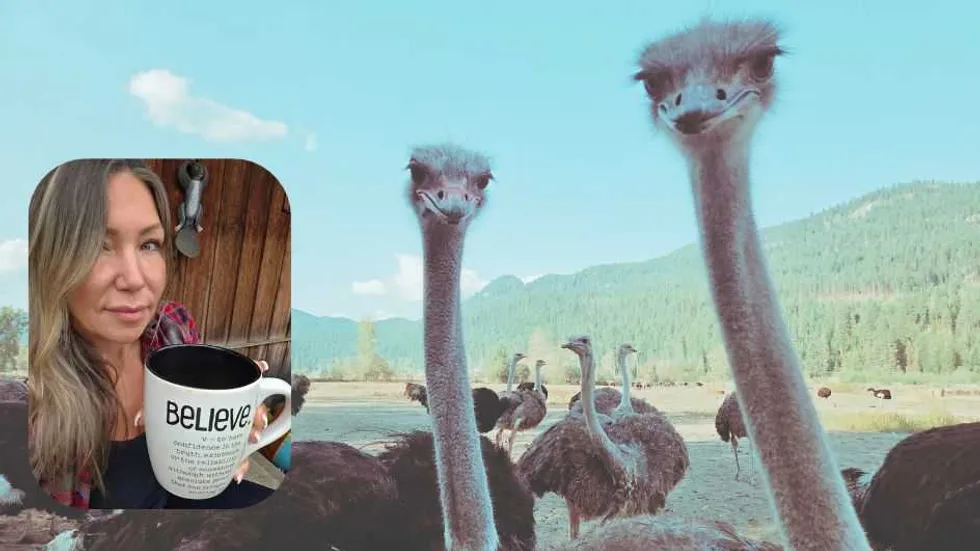
“I do not watch it. I do not look at it,” says Katie Pasitney, spokeswoman for Universal Ostrich Farms, referring to video footage of Canadian government agents killing more than 300 ostriches at the farm one year ago.
Freedom Is Back
In Style
Premium domains for sale
The footage is painful enough. But Pasitney says the harassment she has endured since the killing has taken its own toll.
'Remember how beautiful our birds were today. Remember their names. They had character. They had personality.'
“My home address was leaked. My layout of my home was leaked. I've had people outside of my home, and when I went to the police, nothing was done. So the trauma is so real, and the pain will never go away.”
Grim anniversary
It was a year ago, on November 6, 2025, when the Supreme Court of Canada refused to hear the farm's final appeal to stop the Canadian Food Inspection Agency from killing the ostriches owned by farmer Karen Espersen and her business partner, Dave Bilinski.
The CFIA had ordered the birds destroyed after two ostriches that died during an avian influenza outbreak in late 2024 tested positive for H5N1. But the surviving flock had lived for months without further reported deaths from the disease. The farm insisted that the birds were healthy and demanded further testing before they were killed.
The CFIA refused to exempt the surviving birds from its disease-control policy, and the courts upheld the agency's decision.
The case produced intense media coverage around the world, especially in the United States, where the farm gathered support from Health and Human Services Secretary Robert F. Kennedy Jr., Dr. Mehmet Oz, and businessman John Catsimatidis. The CFIA's subsequent occupation of the farm was marked by repeated allegations of animal cruelty.
Now, one year later, the family is fighting back with a multimillion-dollar lawsuit against the CFIA, the attorney general of Canada, and the Royal Canadian Mounted Police.
The civil suit, filed October 30 in British Columbia Supreme Court, alleges unlawful search and occupation, inadequate compensation, unlawful seizure of ostrich eggs, and property damage and trespass. The plaintiffs are seeking damages and an accounting of birds, eggs, and other property they say were taken or destroyed. The allegations have not been proven in court.
In a statement accompanying the announcement of the lawsuit, Catsimatidis renewed his criticism of the CFIA for refusing offers of assistance from American officials.
“I was disappointed that the CFIA did not have enough respect to allow Secretary Kennedy, Dr. Oz, or the U.S. Food and Drug Administration, one of the world's leading health agencies, to test the ostriches as they had requested,” he said.
Pasitney, Espersen's daughter and a familiar face to everyone who followed the ostrich farm saga, spoke to Blaze Lifestyle about the past year and the emotional cost of the family's battle with Ottawa.
'The pain will never go away'
Pasitney says she has gone to hell and back over what happened at the farm.
She was able to leave and resume some semblance of normal life. Her mother, however, still lives with the reminders every day.
“My mom wakes up every day with her overalls hanging that she used to do chores, and her purpose was destroyed,” Pasitney told Align. “She has to witness the field that has been left a mess, a bloody straw mess, where there once was decades of life that pounded the ground and they boomed their song.”
“I got to leave,” she continued.
“I've felt the effects of the trauma more, where my mom is still in fight or flight.”
The experience has also given Pasitney a new appreciation for the mental health struggles facing Canadian farmers.
“I feel honored to be able to understand the mental health problem that this causes, the mental health effects of what the Canadian Food Inspection Agency is doing to our farms, our families,” she said.
She described some of her own darkest moments in recent months, including thoughts that it might be easier if she were no longer alive.
Part of the strain, she says, has come from the hatred directed at her online.
“I always made a promise to everybody. I said, ‘You will never see my name under any of those negative comments, unless there was something I really needed to speak out on.’ I will not play into the rhetoric, into the hate, and into the insanity. But it does creep up on you.”
Public health and safety?
Pasitney is still floored by the fact that people continue to defend the government's decision to kill the ostriches as a necessary measure to protect public health and safety.
“Even if you believed we had the most virulent threat of avian influenza on our farm, and we were a public safety and health risk ... would you have said yes if you ever thought that they would have been gunned down in the middle of the night in the pouring rain, running for their lives?”
Pasitney also questions the CFIA's handling of biosecurity during and after the operation. She alleges that agents failed to follow proper protocols, drove through contaminated areas, and left bloody straw behind after the shooting.
“Why did the Canadian Food Inspection Agency never step foot on our farm again since the day that they left?” she asked. “Would you not want to test our soil? Would you not want to test our water? Would you not want to test all that blood in that straw? Would you not want to make sure that you were protecting Canadians? Why did they never come back?”
The CFIA has maintained that the cull was necessary under its policy for controlling highly pathogenic avian influenza. The agency has also disputed allegations about its care of the animals during its occupation, saying it provided feed, water, bedding, and veterinary oversight.
But Pasitney says the agency's actions on the night of November 6 remain impossible to reconcile with its stated concern for the birds' welfare.
She remembers hearing gunshots through the windows of the family home. She says there was no warning that the shooting was about to begin and that gunfire could still be heard the following morning.
“After they were all gone, the clouds broke, and this big, beautiful beam of sunshine shone right down in their kill pen,” she recalled.
RELATED: Can political dissent be classified as harassment? One Canadian city says yes.
 Toronto Star/Getty Images
'Remember how beautiful the birds were'
Pasitney says the ordeal has taught her a lesson she will never forget.
“As humans, we need to make sure that this never happens again to anybody, and more so that it never happens to any animal that is decades old,” she said.
She remains grateful for the international support the farm received and especially for the prayers that poured in during the battle to save the flock.
“Everybody thought we were asking for money,” she said.
“I don't think you've ever heard me ask for money. I asked for a prayer.”
And she wants people to remember the birds themselves, not simply the controversy surrounding their deaths.
“Remember how beautiful our birds were today. Remember their names. They had character. They had personality. And remember the majestic animals that we've lost due to culling, due to forgetting science.”
“Please remember that our ostriches were heroes. They are the heroes of today, and they can't be heard any more. But remember they're booming in the fields. Remember they're dancing when they were happy.”
“They were loved for three decades, but they knew that they were here to create change. We didn't know, but now we have to do the work to make sure that their legacy moves forward in hope and that we can create a better Canada and secure our agricultural industry and protect the farmers as the heroes that they are.”
More from this network:
Domains for Sale · GOTPeople.org · TheDSAPlatform · The Truth About Socialism
What's Your Reaction?
 Like
0
 Dislike
0
 Love
0
 Funny
0
 Wow
0
 Sad
0
 Angry
0

I am just an average American. My teen years were in the late 70s and I participated in all that that decade offered. Started working young, too young. Then I joined the Army before I graduated High School. I spent 25 years in, mostly in Infantry units. Since then I've worked in information technology positions all at small family owned companies. At this rate I'll never be a tech millionaire. When I was young I rode horses as much as I could. I do believe I should have been a cowboy. I'm getting in the saddle again by taking riding lessons and see where it goes.
Premium domains for sale























Comments (0)