

Did Harvard Create The Unabomber?
Premium domains for sale
Freedom Is Back In Style
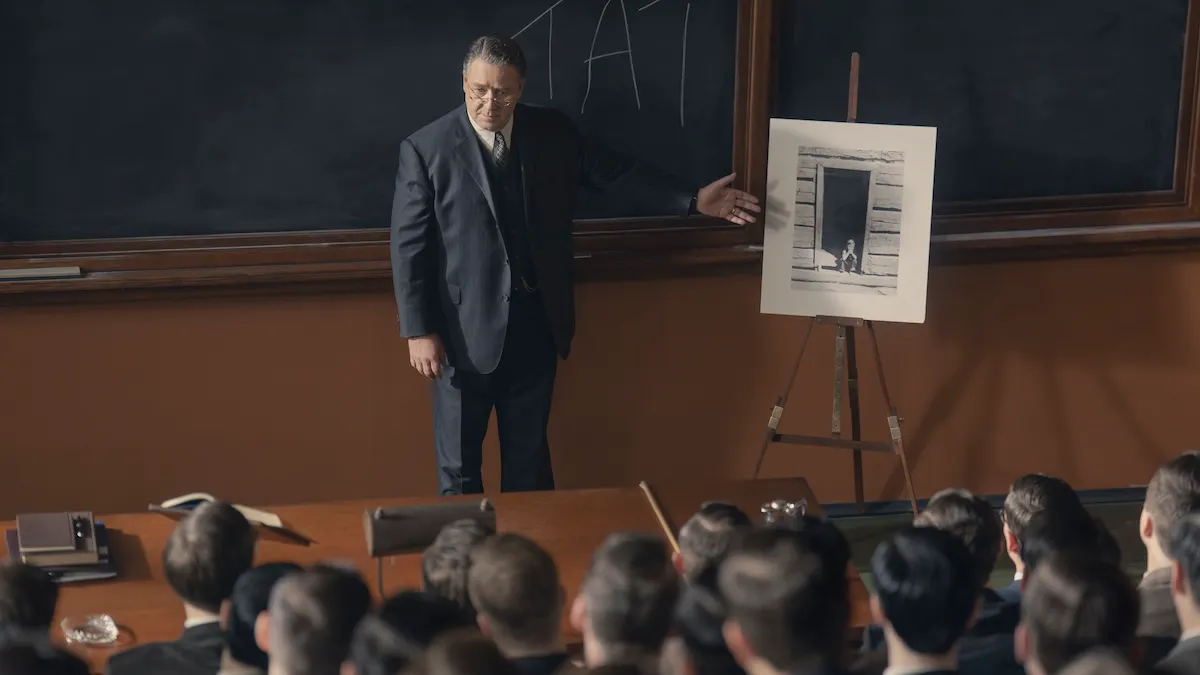
A movie about Ted Kaczynski, the infamous domestic terrorist who killed three people and injured more than 20 others with 16 homemade bombs over the course of 17 years, has just dropped on Netflix. Entitled “Unabomber” after the nickname the FBI gave him (shorthand for “University and Airline Bomber”), the film switches between two timelines: the months leading up to Kaczynski’s discovery in a remote cabin in the Montana wilderness and subsequent arrest in April 1996, and a formative period while Kaczynski was a teenage undergraduate at Harvard in the late 1950s.
Freedom Is Back
In Style
Premium domains for sale
Shailene Woodley stars as Joanne Miller, a fictional member of the FBI Unabomber task force which — acting on a tip by Kaczynski’s actual brother, David — identified and arrested him. But the dramatic focus of the movie is on the period from 1958, when young “Teddy” Kaczynski, played by Jacob Tremblay, falls under the sway of Harvard psychology professor Henry A. Murray, played with scene-stealing charisma by Russell Crowe.
Theodore (Teddy) Kaczynski was an academic prodigy from a working-class Polish immigrant family in Chicago who won a scholarship at age 16 to study mathematics at Harvard. Here, he came under the influence of psychology professor Henry Murray. A brilliant but narcissistic New England aristocrat (he was a direct descendant of John Murray, the fourth Earl of Dunmore), Murray had published a famous academic book, “Explorations in Personality,” in 1938 and was interested in, as he put it: “the branch of psychology which concerns itself with the study of human lives and the factors that influence their course.” Along with his academic collaborator and lover, Christiana Morgan, Murray devised the so-called “Thematic Apperception Test,” which he claimed allowed him to classify different personalities. The film depicts Murray inviting young undergraduates into what was presented as a study of personality development and the formation of beliefs. Participants were asked to write detailed accounts of their deepest convictions and aspirations, ostensibly for academic analysis.
What the students could not appreciate was that their confessions would become ammunition in a program of sustained psychological stress. Murray’s team subjected them to deliberately hostile interrogations, attacking their most cherished beliefs in what Murray himself described as “vehement, sweeping and personally abusive” confrontations, while their reactions were monitored, filmed, and later replayed to them. The experiment, widely regarded today as deeply unethical, sought to discover how individuals responded when their intellectual and emotional defenses were systematically dismantled. It is a painful irony, given what we know about Kaczynski’s later life, that the codename Murray gave him during the experiments was “Lawful.”
I found parts of the movie hard to watch. The vulnerable — and at this point, completely innocent — Teddy squirms and suffers under dazzling lights while being tied to a chair and bullied, mocked, and humiliated by a far older student. Kaczynski himself later described the experiments as “a highly unpleasant experience.”
This study, we learn, was devised in collaboration with the CIA, which wished to improve its techniques of interrogation at the height of the Cold War, and which knew Murray from his work with the Office of Strategic Services (the precursor to the CIA) during World War II. The Henry A. Murray Research Archive still exists at Harvard, though after this movie one wonders whether it will now receive the Sackler treatment. (Once the link between the billionaire Sackler family and its unethical promotion of OxyContin became publicized, universities and museums quietly removed the family name from websites, buildings, and public materials.)
More information on Murray’s experiments can be found in a book written by a contemporary of Kaczynski at Harvard, and later a professor of philosophy himself, Alston Chase. After reading Chase’s book, “Harvard and the Unabomber: The Education of an American Terrorist,” it struck me that Netflix was pulling its punches; the full story is much darker. Far from the distinguished and sober academics portrayed by Crowe and Annabelle Wallis as Morgan, the real Murray and Morgan were addicted to amphetamines and LSD, Murray’s long-time assistant describing them both as being “on a weird combination of sedative and pepper-up pills.” Though married to other people, Morgan and Murray would partake in sadomasochistic sexual “experiments” during their 40-year-long affair. Morgan drowned while on vacation with Murray in 1967, and at least one acquaintance held him responsible for her death.
The Netflix movie depicts Kaczynski’s parents balking at signing the consent form for Murray’s program, which the resourceful Teddy gets around by forging his mother’s signature. However, the memoir penned by Kaczynski’s younger brother, David, “Every Last Tie,” tells a different story. David recounts his mother willingly signing the form, adding: “Mom’s implicit faith in the university prevented her from asking questions.” David continues that their mother knew Teddy “had adjustment issues and hoped these nice psychologists might help him.” How, one might ask, could Harvard permit such reckless and drug-addicted university academics to have so much power and influence over their impressionable young students? And why did Kaczynski’s mother have such blind faith in Harvard in the first place? Sadly, I think we know the answer to both those questions.
Yet Harvard has another case to answer in the sorry story of Teddy Kaczynski’s metamorphosis from super-bright but socially awkward young man to someone who could dispassionately log his various murders as numbered “experiments.” Both Netflix’s “Unabomber” and the 2017 TV series, “Manhunt: Unabomber” — which trod similar ground in pointing the finger of blame at Murray’s psychological experiments — depict Kaczynski’s sudden personality shift during the Murray experiments as a sort of Dr Jekyll-to-Mr Hyde transformation in a rather sensationalist way. Yet as Alston Chase argues in his book, a more subtle yet toxic permission structure was also being absorbed by Kaczynski while at Harvard in the form of a since-discredited philosophy called “logical positivism,” which was all the rage in mid-century academia.
As an undergraduate, Kaczynski would almost certainly have encountered logical positivism’s central claim: that meaningful statements must either be empirically verifiable or logically true by definition (bear with me, here). Because moral statements — like “killing is wrong” — cannot be scientifically tested, positivists dismissed them as mere emotional preference, not to be taken seriously on their own merits. This worldview essentially treated morality itself as an unscientific illusion.
The exposure to logical positivism coincided with Harvard’s ambitious postwar General Education curriculum, creating a deep intellectual contradiction for impressionable students. Designed to foster responsible democratic citizens, the “Gen Ed” program exposed undergraduates to classic literary works exploring moral accountability, such as the novels of Dostoevsky. Yet alongside these texts, the academic ethos elevated scientific empiricism and logical positivism as the supreme arbiters of truth. Kaczynski and his peers were caught in a paradox: while the humanities presented grand moral frameworks, the prevailing philosophical worldview taught them to dismantle them as unscientific nonsense.
This flawed philosophy was eventually torn apart by critics who exposed its fatal error. The claim that “only empirically testable statements are meaningful” is itself impossible to test empirically. By its own definition, logical positivism was meaningless. Furthermore, Christian thinkers such as C.S. Lewis and Elizabeth Anscombe argued that rejecting objective moral truth destroyed the very basis of human reason.
It is impossible to know to what degree Harvard’s philosophy curriculum contributed to Kaczynski’s later development, and no serious observer would claim that logical positivism turns students into terrorists. Yet ideas matter, especially when they are presented beneath the imposing authority of an institution that claims to educate future leaders in a responsible way.
The parallel with today’s universities is not that they are breeding future Unabombers. It is that they continue to promote fashionable and irresponsible moral assumptions while cloaking them in institutional legitimacy. Today’s reigning orthodoxy is no longer logical positivism but a different doctrine that reaches a similar destination: moral relativism, in which moral claims are treated as products of culture, identity, power, or historical circumstance rather than as statements about objective reality. Once moral judgment is replaced by morally neutral explanations, atrocities can no longer be condemned simply because they are atrocities. They must be interpreted through the lenses of oppression and resistance, privilege and marginalization, colonizer and colonized. The result is the moral confusion on display after Oct. 7, 2023, for example, when many academics appeared less interested in the horrific murder of Israelis than in rationalizing and excusing the actions of their aggressors.
This current intellectual fad in academia may be subtly different from the one that shaped Kaczynski, but the underlying pattern is similar. The result is a university culture that teaches students to distrust millennia-old moral intuitions, promoting instead modern, speculative, and crucially untested theories. Universities rarely manufacture monsters. Their danger lies in something subtler: lending the prestige of institutional authority to ideas that teach clever but impressionable young people to stop being able to distinguish right from wrong.
***
Bridget Riley studied modern history at Oxford and completed a Ph.D. in medieval history at the University of Reading. She writes on history, culture, and the philosophy of religion.
This article is part of Upstream, The Daily Wire’s new home for culture and lifestyle. Real human insight and human stories — from our featured writers to you.
More from this network:
Domains for Sale · GOTPeople.org · TheDSAPlatform · The Truth About Socialism
What's Your Reaction?
 Like
0
Like
0
 Dislike
0
Dislike
0
 Love
0
Love
0
 Funny
0
Funny
0
 Wow
0
Wow
0
 Sad
0
Sad
0
 Angry
0
Angry
0

I am just an average American. My teen years were in the late 70s and I participated in all that that decade offered. Started working young, too young. Then I joined the Army before I graduated High School. I spent 25 years in, mostly in Infantry units. Since then I've worked in information technology positions all at small family owned companies. At this rate I'll never be a tech millionaire. When I was young I rode horses as much as I could. I do believe I should have been a cowboy. I'm getting in the saddle again by taking riding lessons and see where it goes.
Premium domains for sale













Comments (0)