

How Abdul El-Sayed Wants To Recreate Trudeau’s Canadian Failures
Premium domains for sale
Freedom Is Back In Style
This piece is part of MI x DW, a collaboration that brings Daily Wire readers exclusive commentary and research from the Manhattan Institute’s world-class team of scholars.
Freedom Is Back
In Style
Premium domains for sale
***
Before Americans take Abdul El-Sayed’s advice about moving to Canada, they might ask Canadians how the experiment worked out.
In remarks recently reported by the New York Post, the Michigan Democratic Senate candidate declared, “If you want to achieve the American dream, well, you should move to Canada.” He was speaking on his podcast in May 2023, nearly eight years into Justin Trudeau’s rather disastrous prime ministership.
Canada was then in the midst of a lost decade. Its economy was falling further behind America’s, while reckless immigration policies brought in newcomers faster than the country could accommodate. Trudeau’s postnational experiment was straining the shared sense of belonging that held the country together.
Click here for more Manhattan Institute content.
For American progressives, his government offered an unusually favorable testing ground. Canada’s parliamentary system gave him far more freedom to enact his agenda than an American president typically enjoys. He began with a parliamentary majority and later relied on parties to his Left.
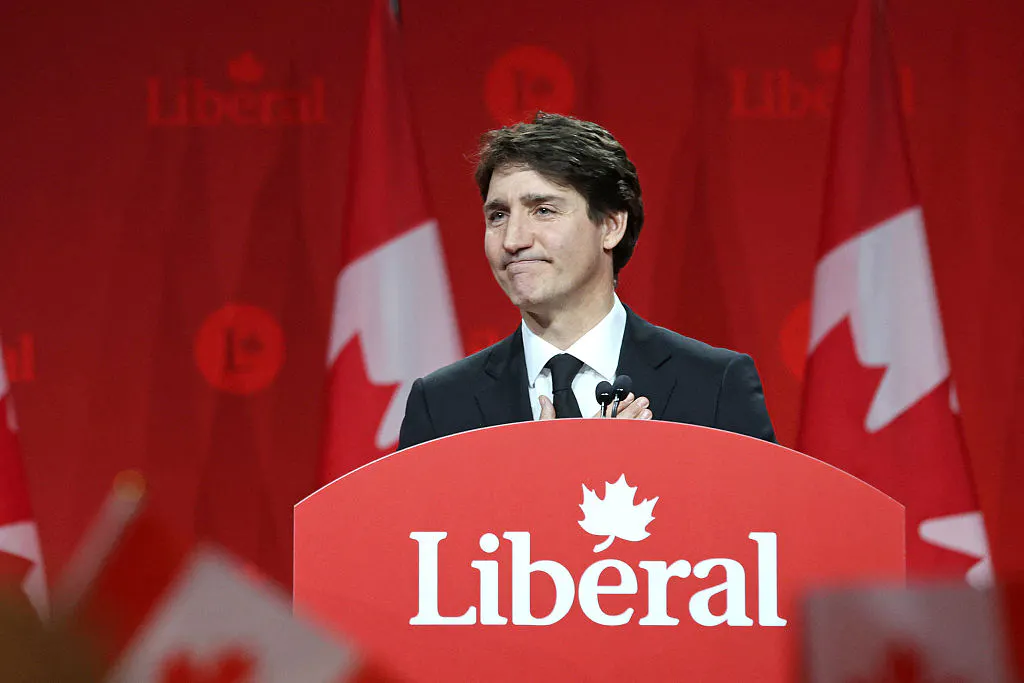
Trudeau gave the project a name in a 2015 interview with New York Times Magazine. Canada, he said, was the “first postnational state,” with “no core identity, no mainstream.”
According to this vision, national identity would increasingly give way to the politics of group identity, while expanding welfarism would provide the solidarity that common citizenship once supplied. Canada would show the world how a progressive society could leave older attachments and ideas behind.
The Trudeau government’s economic strategy combined deficit-financed redistribution with state capitalism. It established new unfunded entitlements for child care, dental care, and national drug coverage. And Ottawa and its provincial partners committed tens of billions of Canadian dollars to electric-vehicle battery subsidies alone.
The results were dismal. According to World Bank data, real GDP per person rose about 3.4% in Canada between 2015 and 2024, compared with 17.6% in the U.S. By 2024, Canada’s real output per person was still slightly below its 2019 level. The latest figures put Canada’s GDP per person at roughly $66,700, compared with $90,000 in the U.S., adjusted for purchasing power — a gap of about 26%.
Immigration exposed the practical limits of this worldview. Between July 2019 and July 2024, Canada added 3.6 million people, nearly the same number it added over the preceding decade. Its population growth in 2022-23 alone placed Canada among the world’s top 20, with almost all faster-growing countries in Africa.
The number of temporary residents grew from 1.36 million in July 2021 to 3.15 million in October 2024, doubling their share of the population from 3.6% to 7.6%. Housing pressure became so severe that the Trudeau government belatedly scaled back its immigration targets.
Public support for immigration suffered along the way. By 2024, 58% of Canadians said immigration was too high, the first majority in a quarter-century. Trudeau had squandered a broad consensus for orderly, meritocratic immigration that earlier governments had spent decades sustaining.
His government also gave separatists fresh grievances. In Alberta, anger over federal energy policies helped revive separatist sentiment. In Quebec, the Parti Québécois, an avowed separatist party that may form government after October’s provincial elections, has argued that independence is necessary to regain control over immigration. The country that was supposed to move beyond nationalism found itself contending with more of it.
El-Sayed chose this Canada as his example of a country fulfilling the American dream. His own agenda helps explain the attraction. He supports Medicare for All and a wealth tax, and his campaign boasts that he has favored abolishing ICE since 2018. What Canadians experienced as a failed experiment, El-Sayed sees as a blueprint for America.
Trudeau’s postnationalism helps explain the connection. It joined an expansive view of government’s economic responsibilities to a diminished view of the nation’s claims on its citizens. Government would do more to provide for people, while asking less of them to sustain a common national identity. El-Sayed’s enthusiasm for redistribution and hostility to immigration enforcement point in the same direction.
The American dream holds that people from any background can build a better life through their own efforts and become part of a common national story. It asks something of those who come to share in it. Becoming American carries obligations as well as opportunities.
The Canadian model that El-Sayed admires would change both sides of that bargain. Government provision would become more central to the promise of a better life, while becoming part of the nation would carry less weight. The appeal extends well beyond a larger welfare state. It offers a way to remake America’s understanding of itself.
Canadians have had a chance to test that proposition. An expanding welfare state failed to deliver the promised prosperity, and the attempt to transcend national identity aggravated divisions within the country.
Canadians have already paid for the experiment. Americans needn’t buy it twice.
***
Sean Speer is a Technical Writer at the Manhattan Institute and former adviser to Canadian Prime Minister Stephen Harper.
More from this network:
Domains for Sale · GOTPeople.org · TheDSAPlatform · The Truth About Socialism
What's Your Reaction?
 Like
0
Like
0
 Dislike
0
Dislike
0
 Love
0
Love
0
 Funny
0
Funny
0
 Wow
0
Wow
0
 Sad
0
Sad
0
 Angry
0
Angry
0

I am just an average American. My teen years were in the late 70s and I participated in all that that decade offered. Started working young, too young. Then I joined the Army before I graduated High School. I spent 25 years in, mostly in Infantry units. Since then I've worked in information technology positions all at small family owned companies. At this rate I'll never be a tech millionaire. When I was young I rode horses as much as I could. I do believe I should have been a cowboy. I'm getting in the saddle again by taking riding lessons and see where it goes.
Premium domains for sale














Comments (0)