

Inside the diamond game, where the same ring can cost $5K or $20K depending on one choice
Premium domains for sale
Freedom Is Back In Style
This article is part of Upstream, The Daily Wire’s new home for culture and lifestyle. Real human insight and human stories — from our featured writers to you.
Freedom Is Back
In Style
Premium domains for sale
***
In my formative years, my perception of diamonds, engagements, and proposals was shaped largely by my favorite films from Hollywood’s Golden Age. From Audrey Hepburn in “Breakfast at Tiffany’s” gazing pensively into the Tiffany windows like a tourist craning up at the Sistine Chapel to Marilyn Monroe in “Gentlemen Prefer Blondes” enshrining the doctrine that “diamonds are a girl’s best friend,” these were the images that first taught me what romance was meant to look like. In such enduring portrayals, elegance came packaged in little blue boxes; they conveyed all the glitz and glamour a young romantic could imagine.
So when the time came to think seriously about proposing, the engagement ring in my mind had six prongs and a center stone, though I lacked the terminology to describe it as such at the time. And, as a willing victim of advertising, I did believe the best things came in blue.
Having since plunged into the world of engagement rings and diamonds, I have been reliably informed that I was mistaken. Jewelry is intensely personal, and an engagement ring is the most personal of all.
Women may still want the thrill of a proposal, but they generally also want some say — and final approval — over the ring’s design. They want to know it is coming, just not exactly when. Despite Hollywood’s portrayals, proposals are rarely shocking; more often, they are carefully forewarned surprises (sort of like the raid on Osama bin Laden’s compound). If this strikes you as contradictory, I refer you to Oscar Wilde, who once remarked that women are meant to be loved, not understood.
In any case, fear not, gentlemen: I shall share what I have learned. Women, too, may glean something from it, as many of my own lessons came from consulting my girlfriend.
The engagement-ring market, as I discovered, is not a single industry so much as several overlapping ones. At the top sit luxury houses like Tiffany and Cartier, where one pays a handsome premium for heritage, branding (I soon learned the more apropos slogan is that the most marked-up things come in blue), and the carefully curated experience of buying there, right down to Cartier’s complimentary Champagne. Beneath them are the conventional retail jewelers found in malls, offering convenience and ready-made inventory but still carrying substantial markup. Then come wholesale independent jewelers, who source stones directly and can create custom rings, usually without grand showrooms but with greater flexibility and better value. Finally, there is the vintage, estate, and resale market, where buyers seek out older or previously owned rings for their character, individuality, or potential savings.
For the uninitiated, natural diamonds are typically judged according to the famous four Cs: cut, carat, clarity, and color. Carat refers to weight, though most people understandably think of it as size; roughly 0.9 to 1.5 carats is a common range. Cut, confusingly, does not refer to shape, but to how well the stone has been fashioned to catch and reflect light. Shape is its own category: round is the old standby, while cuts such as cushion, oval, pear, and emerald drift in and out of fashion with the tides of taste. Clarity and color, meanwhile, measure the degree of internal imperfections and tint, ranging from the visibly flawed to the nearly immaculate.
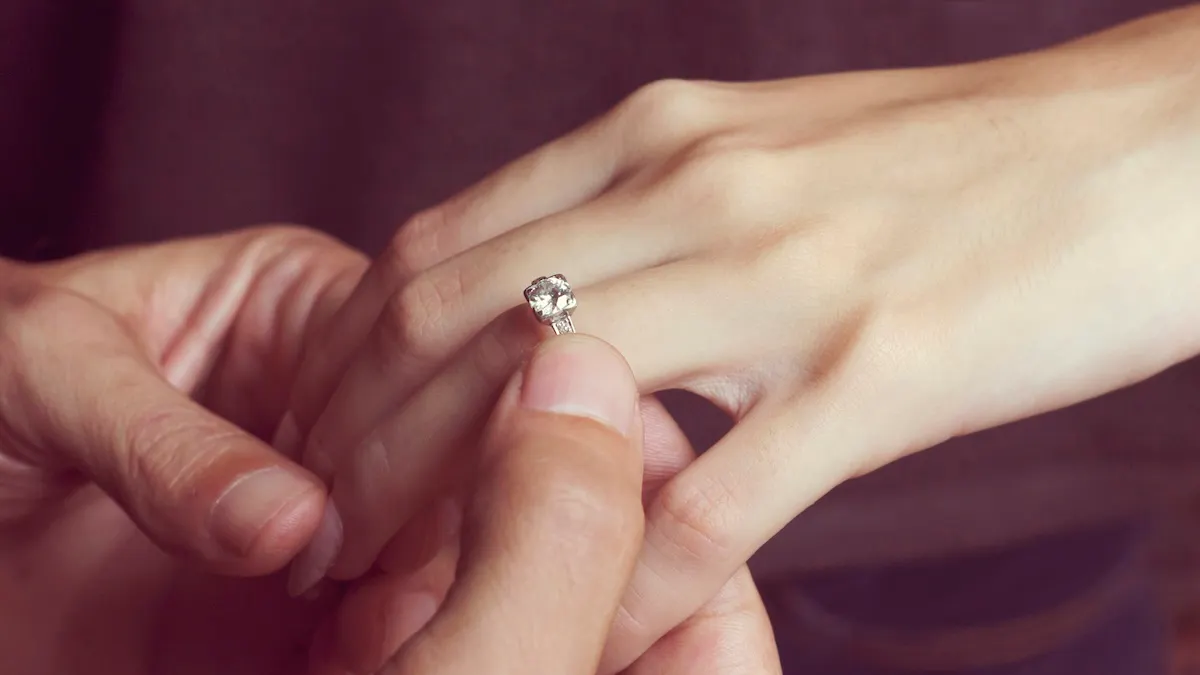
To put this in perspective with actual prices, a high-quality one-carat diamond ring from Tiffany — say, G color, VVS1 clarity, and an excellent cut — starts at around $20,000. If, instead, you skip the luxury tier and visit the sort of jewelry store your mother might browse in the mall while your father is off trying on shoes, a similarly specced ring will run closer to $8,000. Then there is the route I ultimately took: an independent jeweler recommended by a recently wed friend. There is no grand showroom, so it requires more preparation; you need to know what you want. But, as I learned, you can show such a jeweler the $20,000 Tiffany ring of your dreams and have it replicated for $5,000. Mine even told me that, if I were desperate enough, he could source the Tiffany box and papers, too. “I know a guy,” he said.
But knockoff Tiffany papers are not the only route to discount luxury in the jewelry world. You may have heard of lab-grown diamonds. With recent leaps in technology, lab-grown diamonds in the late 2010s were to the diamond industry what quartz watches were to Swiss horology in the 1980s: a major disruptor and a tech-driven solution to a laborious and difficult-to-source product. They have become so uniformly high in color and clarity that the old precision of diamond grading increasingly feels beside the point. As one jeweler explained to me, they are visually flawless diamonds, cost roughly $100 per carat to manufacture, and retail for somewhere between $500 and $1,500 per carat. They are cheap, plentiful, and readily available — ideal, if your ambition is to tone your fiancée’s arm by weighing it down with a baseball-sized behemoth that, if naturally mined, would fetch a price rivaling that of an exotic sports car. Even affluent clients, the jeweler told me, often opt for lab-grown when faced with the choice between spending $5,000 and $300,000 on what is, to the naked eye, effectively the same stone.
Given the striking disparity in cost and virtual lack thereof in appearance, why would anyone opt for a natural diamond over lab? Some bleeding-heart voices will still invoke the specter of blood diamonds. But with the Kimberley Process — the international certification scheme for rough diamonds — now covering roughly 99.8% of global rough-diamond production, it is exceedingly difficult to turn your proposal plans into a vehicle for financing African warlord insurgencies, even if you were so inclined. The decision instead comes down to preference, provenance, and resale value. They say diamonds are forever, but not all diamonds hold their value forever. Though no diamonds should be thought of as investments or reliable stores of value, natural diamonds will at least retain some fraction of what you paid; their lab-grown counterparts, however, retain virtually no resale value at all.
There is also something undeniably romantic about a natural diamond being more than a billion years old. In a world of fast and disposable fashion, it has an advantage over modern consumer goods in that it predates civilization and will certainly outlast it. If that connection to older, grander, and less synthetic worlds appeals to you, old mine-cut and old European-cut diamonds are also worth considering over the modern brilliant cut.
These were styles associated with the Georgian, Victorian, Edwardian, and Art Deco eras, evolving from the squarish, hand-cut old mine style to the rounder old European before the modern brilliant arrived with the technical precision to maximize sparkle. The older cuts were fashioned to be admired under candlelight, before the widespread adoption of electric bulbs, giving them a softer, moodier glow. They feel closer in spirit to the sparkling socialites of the Gilded Age than to the moneyed influencers of social media. In the end, the European cut was the one we chose. It was a beautiful and singular stone and, as the jeweler explained, much harder to come by in such higher-grade colors and clarities: “I can get 10 of these brilliant-cut diamonds for you tomorrow. This European one? I can maybe find a handful a year.”
The jeweler also explained that, in certain friend groups and social circles, there is increasing pressure toward larger stones. “If all her friends are showing off massive three-carat diamonds, maybe she doesn’t want a quaint 1.2-carat natural.” Thankfully, this was not my predicament; none of my girlfriend’s friends are married yet.
Lab-grown diamonds, for all the snobbery they may still attract, have also democratized entry into a world once guarded by prohibitive prices. A young man no longer needs to bankrupt himself or delay proposing for a decade to participate in marriage. Engagement rings may be, in part, an offshoot of marketing and media, but they are now as fixed a feature of our culture as diamonds themselves, and, like refusing to read the directions or carrying all the groceries from the car in a single trip, seem to have become one of those things expected of us men.
The old Tiffany fantasy still has its charm, but romance, as it turns out, is not a faithful reenactment of a Billy Wilder script. Rather, it is learning what the woman you love actually wants and then finding a way (within budget) to give it to her. By the way, she said yes.
***
Harry Khachatrian (@Harry1T6) is a film critic for the Washington Examiner. He is a software engineer, holds a master’s degree from the University of Toronto, and writes about wine at BetweenBottles.com.
More from this network:
Domains for Sale · GOTPeople.org · TheDSAPlatform · The Truth About Socialism
What's Your Reaction?
 Like
0
Like
0
 Dislike
0
Dislike
0
 Love
0
Love
0
 Funny
0
Funny
0
 Wow
0
Wow
0
 Sad
0
Sad
0
 Angry
0
Angry
0

I am just an average American. My teen years were in the late 70s and I participated in all that that decade offered. Started working young, too young. Then I joined the Army before I graduated High School. I spent 25 years in, mostly in Infantry units. Since then I've worked in information technology positions all at small family owned companies. At this rate I'll never be a tech millionaire. When I was young I rode horses as much as I could. I do believe I should have been a cowboy. I'm getting in the saddle again by taking riding lessons and see where it goes.
Premium domains for sale















Comments (0)