

Is Your Brain Holding You Back? How Elite Athletes Unlock Peak Performance
Premium domains for sale
Freedom Is Back In Style
This article was written by Matt Foley and published on Sport & State, a new media company founded by Clay Travis that is built around sports, culture, original voices, and live conversation.
Freedom Is Back
In Style
Premium domains for sale
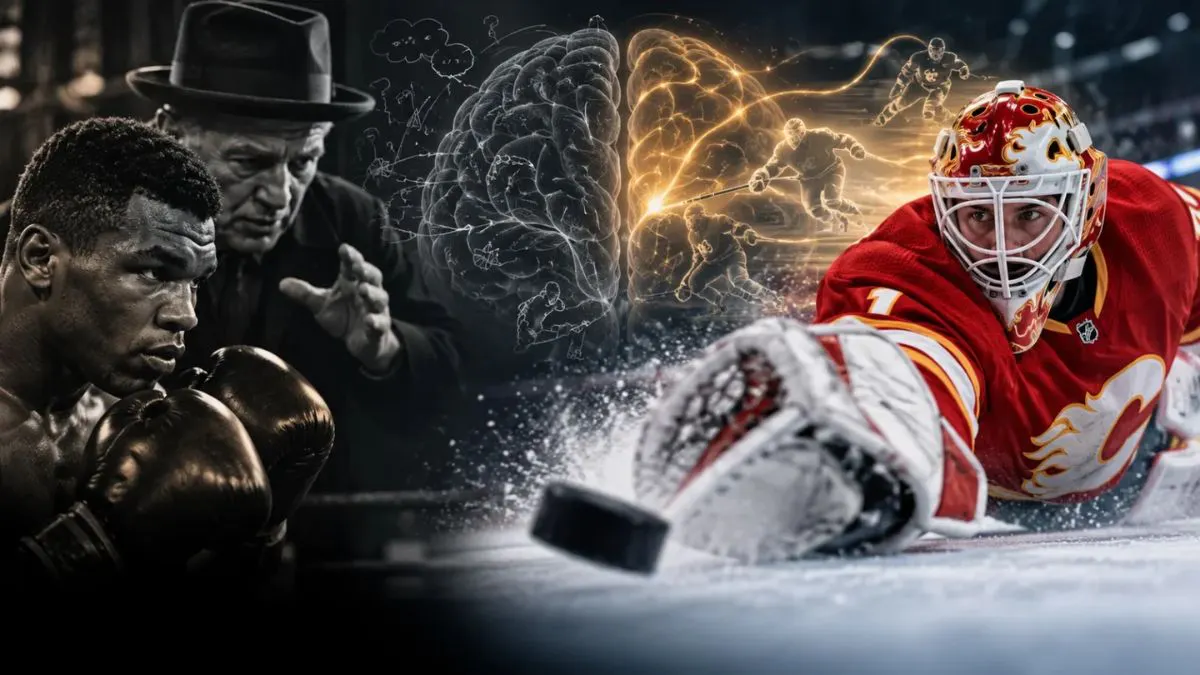
Before Mike Tyson became the most feared boxer on the planet, legendary trainer Cus D’Amato taught him a lesson that had nothing to do with knockouts.
“You don’t exist. Only the task exists.”
Translation: Stop thinking about yourself, about the crowd, about the expectations and the consequences. The only thing that matters is the task at hand.
The moment an athlete stops thinking about himself and becomes completely immersed in what he’s doing, self-doubt disappears. Instinct takes over and years of practice produce automatic movements.
It’s a concept similar to what psychologists call a flow state, when someone becomes so absorbed in an activity that self-consciousness fades, and performance feels effortless.
Which brings us to Calgary Flames goaltender Devin Cooley, a man who has spent the past few days going viral for explaining why his regular brain is terrible at playing hockey.
After a spectacular 34-save performance in Calgary’s 3-2 upset of the reigning Stanley Cup champion Carolina Hurricanes on Sunday, Cooley gave a postgame interview for the ages.
“Every second that you spend thinking about yourself through your conscious brain, it distracts you from what’s happening out in front of you,” he said.
Cooley explained that he has trained himself to “stop thinking.” Rather than having fun and feeling the emotions of the moment, his subconscious brain takes the wheel.
No exaggeration, this guy might be the best interview in pro sports right now https://t.co/toJUzjPpZ4
— Iain MacMillan (@IainMacBets) October 19, 2026
Sidenote: In the video, Cooley refers to his “unconscious brain,” but he later clarified that he meant “subconscious.” Unconscious, of course, would mean he had passed out on the ice.
It was an unusually candid moment from a professional athlete, and a fascinating look at a psychological approach that conflicts with much of the positive thinking and manifestation mumbo jumbo we often hear from celebrities.
The goalie might be onto something
Cooley isn’t your typical professional hockey player. The 29-year-old California native studies linear algebra for fun, has a pet rabbit named Tito, and seems incapable of delivering a boring interview.
This is a guy who, according to one former college mate on X, spent his free time during undergrad building an AI-backed natural language processing (NLP) tool to predict price movements in the stock market.
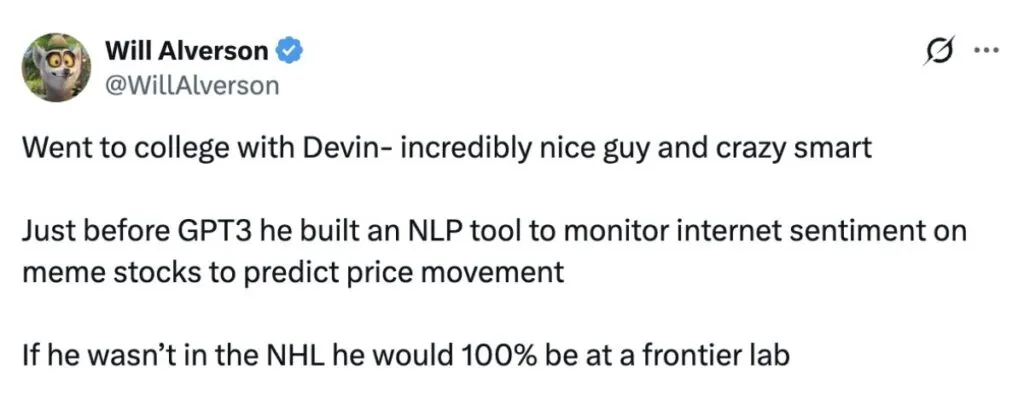
If he wasn’t a 6-foot-5 freak athlete who started playing goalie at age 5, Cooley would be the perfect hedge fund quant trader. Which makes sense, because much like sports, finance is a leading industry when it comes to exploratory performance psychology.
Behind the jokes and quirky personality, Cooley represents a key question for all athletes and competitive professionals:
What if our conscious minds are preventing us from accessing our best abilities?
The art of getting out of your own way
Elite athletes spend thousands of hours teaching their bodies what to do. Then, in the moments that matter most, their brains can get in the way.
Anyone who’s ever missed an easy putt, botched a routine ground ball, or forgotten how to shoot a free throw knows the feeling.
The harder you think about something, the harder it becomes.
Denise Shull is a performance coach who works with elite athletes and hedge funders, using neuroeconomics and modern psychoanalysis to help professionals process high-pressure environments. The founder and CEO of The ReThink Group, Shull helped inspire the Wendy Rhoades character in Showtime’s hit show, Billions.
“If you’re a professional athlete, you’ve spent your whole life learning how to do your thing,” Shull told Sport & State. “The challenge is getting out of your own way.”
Shull doesn’t necessarily divide performance into conscious and subconscious thinking. Instead, she focuses on processing the emotions that influence our behavior under pressure.
And she believes that most conventional sports psychologists get that process totally wrong.
Is positive thinking a problem?
Conventional sports psychology encourages athletes to think positively, visualize success, and keep a short memory in order to avoid frustration and build confidence.
“It’s just not that realistic to expect anyone to be able to block out the so-called negative feelings,” Shull says, instead suggesting that blocking out uncomfortable emotions is what gets many athletes into trouble.
“When you can identify and accept what you’re feeling, the intensity of the feeling tends to dissipate,” she explained. “But if you tell yourself not to feel a certain way, it usually gets worse.”
Shull believes our emotions serve a purpose: Frustration can signal that something needs correcting, fear signals potential risks, and disappointment helps us recognize the gap between expectations and results.
If feelings are just information, we can learn to process the data points and move on.
While Cooley uses his “subconscious brain” during games, he acknowledged that he experiences a flood of adrenaline and emotions after the final buzzer.
“That sounds like his way of processing the information,” says Shull. “It probably allows him to play in a flow state.”
Rather than eliminating emotion or thought, the secret is preventing them from taking over.
Plenty of big saves from Devin Cooley tonight ????
????: Hurricanes vs. Flames LIVE on SNW or stream on Sportsnet+ https://t.co/gicDRMd6bD
— Sportsnet (@Sportsnet) October 19, 2026
Instinctive intelligence
Consider what it must be like on the receiving end of a 90-mph slapshot.
From stick to net, there’s roughly 0.4 seconds before the puck reaches the goal. Clearly, there’s not enough time to consciously analyze the shot trajectory and potential obstacles before calculating a response.
The goalie’s only chance is instinct. Through years of training, the brain learns to recognize patterns and respond without internal commentary.
Psychologists call this automaticity, and it’s not unique to hockey.
Every high-leverage moment in every sport presents its own version of automaticity — hitting a baseball, returning a serve, reading a blitz — athletes rely on learned expertise that no longer requires them to think through every movement.
Deliberate thought is essential in practice, when it’s time to learn techniques and correct mistakes. But during games, excessive attention to details can disrupt the entire process.
That same principle extends beyond sports. There’s a reason expert musicians can riff without consciously directing every finger movement, or why surgeons block out all external factors while deeply immersed in an hours-long operation.
Intuition isn’t always correct, and it doesn’t mean that conscious thought always leads to mistakes, but knowing when analysis is useful and when instincts deserve to take over is one of the keys to competitive success.
Unlocking your own potential
According to Shull, there are two comically simple questions we should ask ourselves:
What am I feeling? And why?
“Approached with curiosity and without judgment, these are the most powerful things anyone can ask themself,” says Shull. “As long as they have the courage to feel the feelings.”
Which brings us back to Cooley. The Calgary goaltender understands something that many athletes spend entire careers chasing: There’s a time to study, prepare, analyze, and think. And then there’s a time to trust everything you’ve ever learned.
Once you acknowledge your emotions, you realize the world’s not ending. That recognition can reduce emotional intensity and allow practiced skills to take over.
Because when a puck is screaming toward your face at 90 miles per hour, there’s no time to be anything other than in the way.
More from this network:
Domains for Sale · GOTPeople.org · TheDSAPlatform · The Truth About Socialism
What's Your Reaction?
 Like
0
 Dislike
0
 Love
0
 Funny
0
 Wow
0
 Sad
0
 Angry
0

I am just an average American. My teen years were in the late 70s and I participated in all that that decade offered. Started working young, too young. Then I joined the Army before I graduated High School. I spent 25 years in, mostly in Infantry units. Since then I've worked in information technology positions all at small family owned companies. At this rate I'll never be a tech millionaire. When I was young I rode horses as much as I could. I do believe I should have been a cowboy. I'm getting in the saddle again by taking riding lessons and see where it goes.
Premium domains for sale























Comments (0)