

Justice Alito Slams Colleagues Over ‘Speechifying’ In The Court
Premium domains for sale
Freedom Is Back In Style
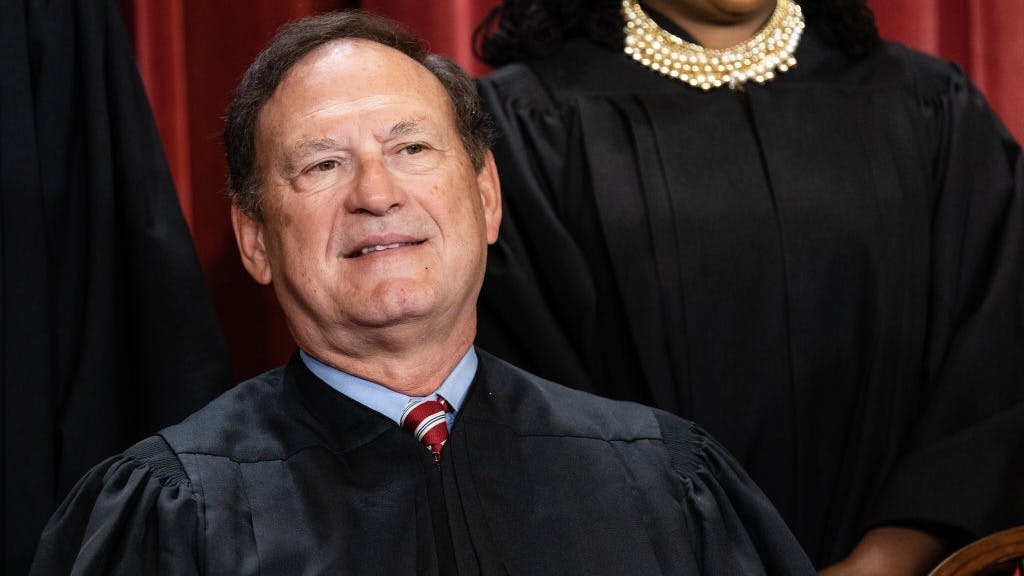
Supreme Court Justice Samuel Alito has spent an unusual amount of time in the public eye ahead of the Court’s new term, sitting for a series of interviews about his judicial philosophy, his future on the bench, and the increasingly public disagreements surrounding the nation’s highest Court.
Freedom Is Back
In Style
Premium domains for sale
In his latest interview with The Wall Street Journal released on Tuesday, Alito offered a pointed critique of one change he has noticed inside the courtroom: justices are increasingly giving speeches during oral arguments rather than simply asking questions.
“When I was arguing cases in the 1980s, the justices were not only asking fewer questions, but they were asking questions,” Alito said. “It was a sentence with a question mark at the end, or maybe two sentences with a question mark at the end, but not a big speech.”
“Now, maybe as a result of live streaming, we’re getting speeches,” he continued. “We’re getting speeches by lawyers that seem to be aimed not necessarily at convincing us, but playing to some constituency, and we’re getting a lot of speechifying by the justices.” Alito’s comments came as he discussed changes to oral arguments following the COVID-19 pandemic. Arguments have generally become longer, and the audio from Court’s proceedings is now livestreamed and transcribed with individual justices identified by name.
The justice may have had one colleague in mind when making his comments. According to a SCOTUSBlog analysis of the 2025-2026 session through the March sitting, Justice Ketanji Brown Jackson led the court in words spoken in oral arguments by nearly 20,000 words. Jackson’s verbosity was followed by the rest of her liberal cohort: Jackson spoke 53,299 words; Justice Sonia Sotomayor spoke 34,967 words; and Justice Elena Kagan spoke 30,606 words. Among the top 10 most long-winded arguments in the sample Jackson orated six, while Justice Brett Kavanaugh had two, and Justices Amy Coney Barrett and Sotomayor uttered one each.
Alito said some of those changes have been beneficial. He specifically praised Justice Clarence Thomas’ increased participation in oral arguments, saying that it allows the public to see that Thomas “is a brilliant jurist and is fully engaged with the intricacies of every opinion of every case.”
But Alito said other changes have not improved the Court’s deliberations. “I would be happy to hear oral arguments for days on end if I thought that all of that argument would contribute to better decisions,” he said. “But I think that in many instances … many of the arguments are going on far beyond the point at which the additional arguing is making a contribution.”
The criticism fits with a broader argument Alito has made about the way the Supreme Court is perceived by the public. He said there is too much tendency to view the Court through a political lens, reducing decisions to victories or defeats for whichever president happens to be in office.
“I think a lot of people believe that we are just making policy decisions,” Alito told the Journal. “There is a tendency to think that we’re making policy decisions, and also a tendency to think that there is a partisan element to that. There is not.”
Alito similarly pushed back in his CBS News interview against portrayals of the justices as political actors. “We are not part of any political movement. And we are not attempting to further any political agenda,” he said. “We are trying to interpret the Constitution as best we can and apply it in the cases that come before us.”
The 76-year-old justice also addressed the possibility of retirement, a subject that has followed him into the new term. Alito acknowledged to CBS that he had considered retiring earlier this year but decided to remain on the Court because he believed he could still provide insight.
“I think I can still make a contribution,” Alito said. “And it’s hard to give up the opportunity to do something that I think will be good for the Constitution and good for the country as long as I’m able to do it.”
He subsequently told Bloomberg Law that he intends to remain on the Court through the current term, which runs through next June. That has not eliminated speculation about his eventual departure. Alito said he expects to reconsider the question of retirement each year, noting that “somebody at my age has to think about” it each term.
For now, however, Alito is beginning another term on a Court facing a docket that includes disputes over immigration, voting rules, gun regulations, religious liberty, and other consequential questions.
More from this network:
Domains for Sale · GOTPeople.org · TheDSAPlatform · The Truth About Socialism
What's Your Reaction?
 Like
0
Like
0
 Dislike
0
Dislike
0
 Love
0
Love
0
 Funny
0
Funny
0
 Wow
0
Wow
0
 Sad
0
Sad
0
 Angry
0
Angry
0

I am just an average American. My teen years were in the late 70s and I participated in all that that decade offered. Started working young, too young. Then I joined the Army before I graduated High School. I spent 25 years in, mostly in Infantry units. Since then I've worked in information technology positions all at small family owned companies. At this rate I'll never be a tech millionaire. When I was young I rode horses as much as I could. I do believe I should have been a cowboy. I'm getting in the saddle again by taking riding lessons and see where it goes.
Premium domains for sale















Comments (0)