

Pensacola Council, Escambia County Commission, and Escambia County School Board Maps Likely Unconstitutional
Premium domains for sale
Freedom Is Back In Style
Summary
Freedom Is Back
In Style
Premium domains for sale
- The Supreme Court decided Louisiana v. Callais on April 29, 2026, holding Louisiana’s congressional map was an unconstitutional racial gerrymander.
- Pensacola and Escambia County officials said during 2021 redistricting that preserving majority-minority districts was an explicit goal.
- The ruling raises new questions about local district lines and Escambia County’s decades-old single-member-district system.
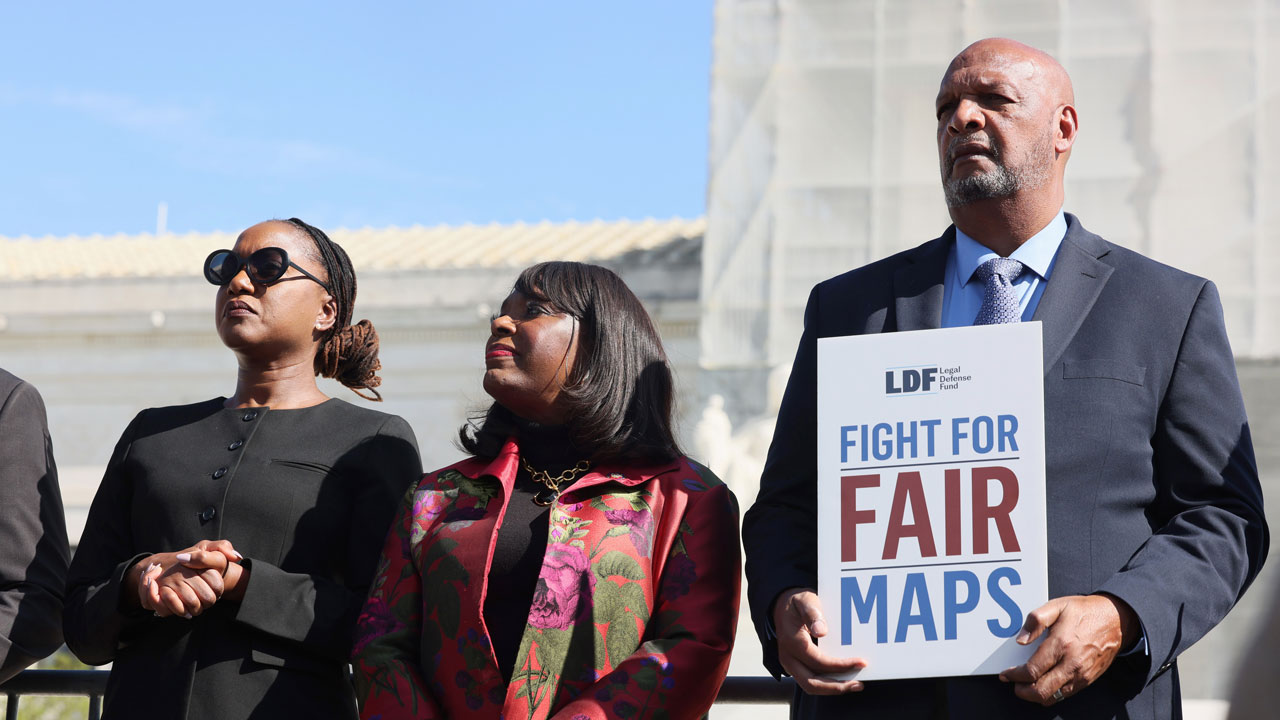
Treating people differently based on race is bad. And it’s unconstitutional.
After all, the U.S. Constitution requires that all citizens receive “equal protection”—and deserve equal treatment—under the law.
But for too many years, federal courts created an exception when it came to how citizens choose their own elected representatives.
These courts put state and local governments between a rock-and-a-hard-place by misinterpreting Section 2 of the Voting Rights Act to be in tension with the Fourteenth Amendment’s Equal Protection Clause. They wrongly required state and local governments to explicitly consider race when drawing council and legislative districts. (Never mind the untrue underlying assumption that everyone of a particular race thinks and votes the same way.)
But if the problems with that practice weren’t clear before, they are now after the U.S. Supreme Court’s Louisiana v. Callais decision, where the Court found that Louisiana’s congressional map violated the Constitution because the Louisiana Legislature explicitly relied on race to create majority-minority districts. In other words, the Legislature categorized citizens based on their races. (Though it did so because of a now-overturned lower federal court order).
Therein lie the problems for cities and counties across America, including Pensacola and Escambia County. No matter how noble their intentions, those who drew and adopted the city’s and the county’s maps did the same thing—often under the threat of litigation based on now-bad prior precedent: They relied on race to draw the districts.
Start with the city. When Pensacola last redrew its council districts in 2021, the Pensacola News Journal reported that “One of the biggest goals of the [redistricting] commission is to ensure two minority-majority districts in District 5 and District 7.” Diane Mack, who chaired the commission, said, “It is something I believe we discussed at the outset . . . And that is definitely the goal. That is what we must achieve.” And yet, that’s what the U.S. Supreme Court just made clear violates the Constitution.
Now turn to the county and the school board. (The two entities have coextensive districts.)
Like the city, those drawing and adopting these maps “had the simultaneous goal of . . . keeping District 3 a majority-minority district among voting-age population.” And further reports made clear that “the commissioners and school board members went on to divide the borders of District 3 to ensure it remained a minority-majority district” per one commissioner’s request. That same commissioner added that “it’s very important to get these districts a minority-majority district.”
But why does Escambia County use single-member districts in the first place? Other Florida counties and municipalities use at-large elections where all or a certain number of council or commission members are chosen by all voters in the city or the county.
It goes back to a federal court decision from the 1980s, McMillan v. Escambia County. This case, which made its way all the way to the U.S. Supreme Court, ended with a court-ordered requirement that Escambia County abandon at-large elections and shift to single-member districts with an eye toward creating at least one majority-minority district.
As the Escambia County attorney pointed out when the county most recently redrew its districts, that court order has long expired. And more importantly now, the legal reasoning used to support it can’t stand after the Callais case.
This means that the city, the county, and the school board must, at a minimum, redraw their current single-member districts so that none are drawn explicitly based on race. And they may also, but don’t necessarily need to, consider whether to adopt at-large electoral systems.
The city, the county, and the school board must fix these constitutional problems before future elections.
If they do not, they will certainly face legal liability.
But even worse, a failure to act would force voters to use districts tainted by unconstitutional, racially discriminatory considerations.
And all voters—regardless of race—deserve better than that.
More from this network:
Domains for Sale · GOTPeople.org · TheDSAPlatform · The Truth About Socialism
What's Your Reaction?
 Like
0
 Dislike
0
 Love
0
 Funny
0
 Wow
0
 Sad
0
 Angry
0

I am just an average American. My teen years were in the late 70s and I participated in all that that decade offered. Started working young, too young. Then I joined the Army before I graduated High School. I spent 25 years in, mostly in Infantry units. Since then I've worked in information technology positions all at small family owned companies. At this rate I'll never be a tech millionaire. When I was young I rode horses as much as I could. I do believe I should have been a cowboy. I'm getting in the saddle again by taking riding lessons and see where it goes.
Premium domains for sale
























Comments (0)