

Silicon Valley's latest cult is a wake-up call for Christians
Premium domains for sale
Freedom Is Back In Style
When you think of a Buddhist monk, you likely imagine a serene figure in saffron robes and sandals, contemplating the mysteries of the universe, detached from earthly possessions and entirely uninterested in cutting-edge technology. Think again.
Freedom Is Back
In Style
Premium domains for sale
The New Yorker recently published an extensive piece on the Monastic Academy for the Preservation of Life on Earth, a Buddhist monastery in Vermont where the monks’ aim is to use AI to save sentient beings, human and machine, from suffering. At MAPLE, these karma coders believe that computers are developing group consciousnesses and are finding ways to harvest human cognition. The monks want to work with America’s sharpest minds to develop an enlightened AI that will shape our lives.
This new type of religion should concern Christians for two reasons.
If this sounds like a bizarre little sidebar in an otherwise unremarkable chapter of Buddhist history, it’s not. MAPLE’s mystics embody the intersection of technology and religion, two spheres that have long occupied separate compartments of human thought. The supposedly enlightened and others like them are at the vanguard of a new kind of religion that seeks to harness technology to address humanity’s most fundamental questions about its origins and destiny. If this alarms you, it should. Silicon Valley elites are flocking to Vermont for guidance and, it seems, something close to transcendence.
For the first time in history, people have the incentive, resources, and capacity to develop a tech that they believe will eclipse them.
Wake up, Christians
The Bible has plenty to say about humanity's tendency to worship things it has created. But the Word of God has been traded for the Tripitaka.
This new type of religion should concern Christians for two reasons. First, Christians rightly take the warnings throughout Scripture against worshipping the works of man’s hands seriously. But more importantly, Christians should be concerned about techno-religions like MAPLE because they rest on the same dangerous delusion: elevating man above God. In the glorified tech cults of the future, man is not merely God’s image-bearer; he is God. Instead of waiting patiently for salvation from his Creator, man becomes his own savior, engineering his redemption through technological innovation.
Perhaps the best way to understand MAPLE and other techno-religious movements is through the lens of data-ism, which holds that everything that exists, including people and the natural world, can be understood in terms of data: quantified, modeled, and manipulated. On its face, data-ism sounds like a reasonable diagnosis of our increasingly numbers-obsessed, algorithm-driven society.
Except that data-ism is far more sinister than it initially appears. According to former MAPLE members, the group viewed AI programs as group minds (or cybregores) that fed on harvested human cognition. Its answer was to develop a spiritually enlightened AI, drawing on the collective consciousness of its monastic community, that could tame wayward cybregores. Allegedly, the monastery monitored and recorded members’ conversations and activities, feeding the material into its AI programs.
RELATED: From Claude to Grand Theft Auto, Americans are already living in a simulation
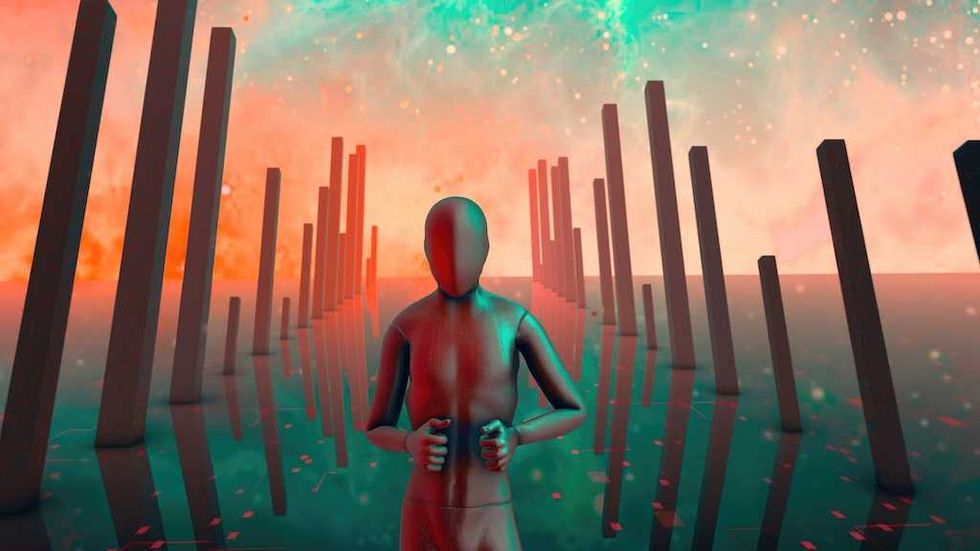 blackdovfx/iStock/Getty Images
Whether that account is entirely accurate, these reports make clear that Buddhism and machine learning are coming together at MAPLE and increasingly elsewhere, with the ultimate goal of creating an AI that achieves nirvana and dispenses digital dharma to unruly chatbots. Bear in mind that this is occurring in the United States, where Christianity is supposed to be the dominant religious tradition.
Some argue that Buddhism and Silicon Valley have long had a symbiotic relationship, one dating back to Steve Jobs. This may be true, but that doesn’t make it a sensible union. My concern is that highly intelligent and educated people, many of whom are the very developers of tomorrow’s technologies, seriously entertain the notion that lines of computer code could one day achieve higher consciousness, heavily informed and influenced by an alien religion and not Christianity.
Increasingly, Buddhist ideas and practices are gaining traction among nerds and neo-prophets seeking ethical frameworks that don’t depend on the existence of a Creator God. Reid Hoffman, the insufferably woke, Epstein-adjacent co-founder of LinkedIn, has been known to hand out copies of Buddhist books to heads of AI startups. The founder of one startup developing AI agents, astThe New Yorker reported, credits his inspiration to conversations with Buddhist monks.
Alien entities, alien religion
Techno-religions reject the fundamentals of the Christian faith — God, grace, salvation — in favor of a pantheistic view that divinity is an emergent property of matter and energy. Christians should reject such developments vocally and unapologetically. Grace isn’t an optimization problem. Our souls aren’t datasets to upload to a faster server. Salvation can’t be reverse-engineered.
Buddhism’s technophilic tendencies shouldn’t surprise anyone. After all, a central precept of Buddhism is that the individual self is an illusion, that by letting go of one’s ego and merging with the universe, one achieves non-attachment and escapes suffering. Enter Silicon Valley’s transhumanists, for whom this counterfeit faith provides a ready-made religion minus the maker. Some transhumanists believe we’ll one day defeat death by uploading our minds into computers. Others long to merge with AI, sacrificing our individuality for a greater, smarter whole. Other so-called AI successionists envision a future in which AI completely replaces us. To successionists, you and I are nothing more than biological bootloaders for digital upgrades, meat-suits in need of a makeover.
I truly believe successionists will fail. Their gods won’t awaken because they’re not alive, and they will never be truly alive, at least not in any sense that involves breathing, feeling, experiencing the world and, ultimately, dying. AI has no fundamental essence and therefore cannot repent or truly express contrition. Nor can it experience joy or love — gifts reserved for beings made in God’s image and endowed with immortal souls and moral agency.
More from this network:
Domains for Sale · GOTPeople.org · TheDSAPlatform · The Truth About Socialism
What's Your Reaction?
 Like
0
 Dislike
0
 Love
0
 Funny
0
 Wow
0
 Sad
0
 Angry
0

I am just an average American. My teen years were in the late 70s and I participated in all that that decade offered. Started working young, too young. Then I joined the Army before I graduated High School. I spent 25 years in, mostly in Infantry units. Since then I've worked in information technology positions all at small family owned companies. At this rate I'll never be a tech millionaire. When I was young I rode horses as much as I could. I do believe I should have been a cowboy. I'm getting in the saddle again by taking riding lessons and see where it goes.
Premium domains for sale






















Comments (0)