

Swift assurances from officials after wave of nationwide outages raises questions, expert says

Premium domains for sale
Freedom Is Back In Style
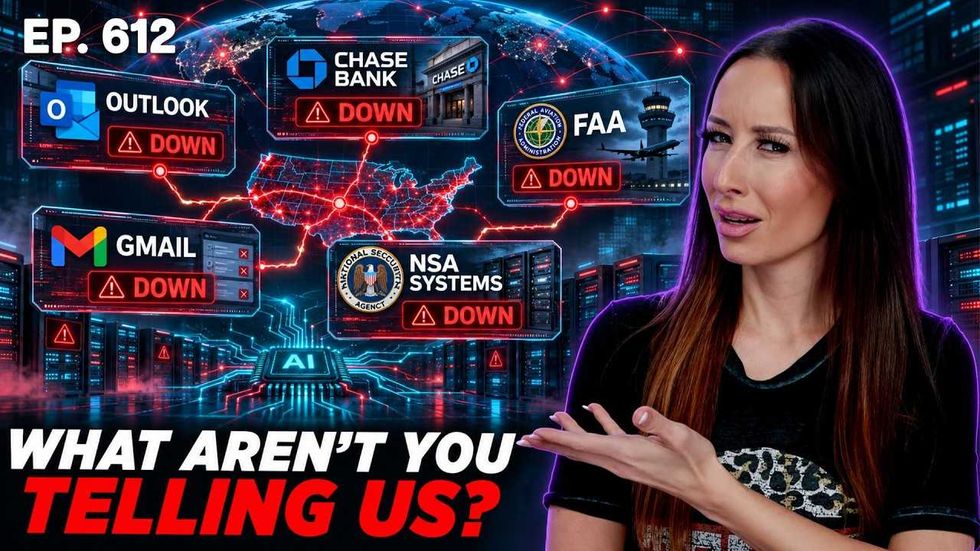
Amid a slew of high-profile disruptions that struck major pillars of American life over the past week, including a nationwide ground stop that halted air travel, banking outages at JPMorgan Chase and other lenders, and a service disruption at Microsoft, officials were quick to reassure the public that nothing nefarious was behind the failures.
Freedom Is Back
In Style
Premium domains for sale
During the ground stop, Homeland Security Secretary Markwayne Mullin said the homeland and the banking system remained secure, insisting that the disruptions showed no signs of a cyberattack or malicious activity.
Director of National Intelligence Jay Clayton similarly stated that officials saw no evidence of a coordinated or state-sponsored attack, pointing instead to routine patching and system upgrades.
DHS CHIEF TELLS AMERICANS TO 'BREATHE' AMID TECH OUTAGES, INSISTS HOMELAND IS 'SECURE'
"Based on what we know today … these are separate service outages associated with maintenance and technical changes," Clayton told the House Homeland Security Committee on Wednesday. "They are not a coordinated or state-sponsored attack."
Major companies, including Microsoft and JPMorgan Chase, also attributed the disruptions to internal technical issues or software bugs rather than malicious intrusions.
To Danny Cooper, CEO of critical infrastructure security firm SMET, the speed with which those assurances were issued poses a problem.
"A blanket statement like 'there's no malicious activity associated with any of the outages' is almost impossible from a probability perspective," Cooper told Fox News Digital.
THE OUTAGES AMERICA HAS SUFFERED WEREN'T AN ATTACK, BUT THE NEXT FAILURE COULD BE
Public anxiety tends to spike around a single question in the aftermath of a major disruption: Was it a coincidence or an attack? Public skepticism is understandable given how many critical systems stumbled within a five-to-six-day window, Cooper said.
"How plausible is it that all these pillars or whatever all suffered major independent technical failures within a five- or six-day window?" Cooper asked. "I think highly improbable. And I understand why the American public is calling this into question and deeply empathize with that. The pattern recognition is there."
Even when officials point to routine maintenance or aging hardware, Cooper argued that ruling out foul play too quickly skips investigative steps that take time to execute properly, which could potentially undermine efforts to fix vulnerabilities and prevent future incidents.
"If a company or the government is making a statement that is as bold as 'we are certain there is no malicious activity here' without having the time to actually do an appropriate investigation, in the case of this sort of cyber domain, some cyber forensics and a full audit of what transpired, that's not quite how it works," she said.
PERPETUAL PARALYSIS: WHY EVERYTHING IS GRINDING TO A HALT
"On the physical side, being able to fully interrogate what has happened in the environment, who was there, and so on about what is happening in the periphery and what led up to that moment in time, those things take time."
An instant "nothing to see here" message can also deepen public suspicion, Cooper said, particularly when multiple institutions and agencies echo that conclusion before audits can be completed.
JOIN THE CHAT: RECENT TECH OUTAGES LOOM OVER MULLIN TESTIMONY ON WORLDWIDE THREATS
The Democratic National Committee (DNC) also sounded the alarm over conflicting statements coming from the Trump administration.
"The administration has repeatedly offered conflicting statements about the causes of the outages," DNC Deputy Communications Director Kendall Witmer said in a statement. "Homeland Security Secretary Markwayne Mullin suggested that SI – Trump’s preferred name for Artificial Intelligence (AI) – is responsible for the multiple outages that have occurred in recent days, according to a "very smart" tech guy he talked to. Then, yesterday, Secretary of State Marco Rubio contradicted Mullin and would not attribute the outages to AI."
MICROSOFT’S MASSIVE OUTAGE OFFERS A LESSON IN HOW TO BRING THE WORLD BACK ONLINE
Much of the official explanation surrounding the November disruptions centered on software updates and system upgrades. Organizations frequently schedule maintenance and can experience downtime when rolling out changes at scale, especially if teams move too quickly, Cooper noted.
However, those windows are what sophisticated adversaries watch closely, she warned.
"If companies are disproportionately moving to execute these sorts of upgrades en masse, then yes, it's possible that you would have a higher number of downtime or outages," she said.
"But it's also quite possible that, particularly given the sophistication of cyber adversaries, whether it's hackers, whether it's non-state entities, whether it's nation-state entities, it's also possible that they are using those software updates or upgrades or patches and in those moments actually injecting malware and exploits and so on."
More from this network:
Domains for Sale · GOTPeople.org · TheDSAPlatform · The Truth About Socialism
What's Your Reaction?
 Like
0
 Dislike
0
 Love
0
 Funny
0
 Wow
0
 Sad
0
 Angry
0

I am just an average American. My teen years were in the late 70s and I participated in all that that decade offered. Started working young, too young. Then I joined the Army before I graduated High School. I spent 25 years in, mostly in Infantry units. Since then I've worked in information technology positions all at small family owned companies. At this rate I'll never be a tech millionaire. When I was young I rode horses as much as I could. I do believe I should have been a cowboy. I'm getting in the saddle again by taking riding lessons and see where it goes.
Premium domains for sale












Comments (0)