

Televised poker is blowing the cover of its best players — on purpose

Premium domains for sale
Freedom Is Back In Style
The World Series of poker is returning and bringing with it an experimental AI to allow television viewers in on the secrets of body language and facial tics. The move generally invades the once hallowed ground of the proverbial "poker face."
Freedom Is Back
In Style
Premium domains for sale
Will fans embrace or reject this great disenchantment? And does it even work?
Facial recognition leading to pre-cognitive services will be big business.
First, some history. The recent heyday of the World Series of poker is now a fading memory. To reverse its decline, Omaha Productions has expanded its live production slate to re-establish lost verve and recapture audiences.
Helmed by former quarterback Peyton Manning, the odd-duck production studio “stands as a trusted expert in the dynamic world of live events," according to its website. "Our social content creation from these events ensure they have life outside the room as well. F*%$ it, we’ll do it live!”
Or if not live, then adjusted, via the latest in AI control features designed to further leverage the distance between what viewers want and what they are willing to try to understand in the thick of their media experience.
Blowing the cover of the industry's best poker faces seems like a last-ditch effort to spice up the activity of, yes, watching other people on a screen who are watching each other and looking at cards on a table — proof of the great interiority of human experience if there ever was one.
This is where the fetid polycule marriage of social media, Hollywood dissolution, and AI entertainment tools is heading.
So what's in the box?
The tech is made by one Luke Geel, according to LinkedIn a graduate of Johns Hopkins who describes himself as interested in poker, chess, and … augmented reality.
Geel’s so-far nameless AI tracks facial tics, blinks, gestures, and the like and subsequently weighs these against its prior training to deduce some semblance of “read” on body language and intention. This writer couldn't find much evidence of the AI actually working.
But Geel posted a video to his LinkedIn three months ago (it shows up again in the various Omaha announcements) that depicts the overlay of various visual graphic effects on some footage of pro poker players. It leaves a lot to the imagination and appears to be little more than a low-rent "Minority Report" simulacrum. Check it for yourself.
Already it’s become clear to many once-wide-eyed denizens of the internet that their wondrous world wide web has been reduced to something nearer to a virtual late-night TV ad carousel.
RELATED: Can this robot give you the cure for loneliness?
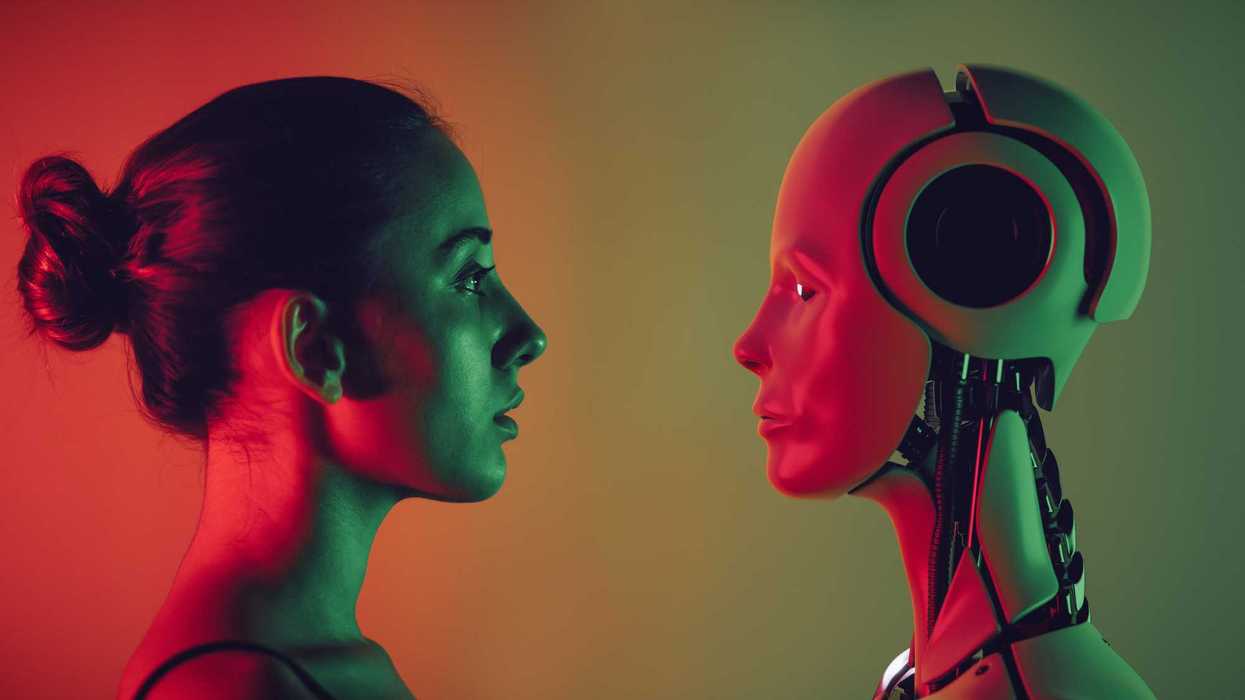 imaginima/Getty Images
But it's not quite right to think of the process as one of degradation. From the internet's origins at the Stanford Research Institute to its crescendo amid the string of high-tech company offices along North First Street in today's San Jose, the internet (like virtually all digital technology) is derived from, and keeps advancing, advanced weapons and varieties of weaponization. Surveillance, reconnaissance, cognitive and psychological operations — the list is long.
Weapons and worship
The laundry list of devices blurs the line between the excellent and the bogus. This too is a form of weaponizing. To take one example, the polygraph, despite continuous use in the application of federal and state security clearances, has never been made admissible in courts because it’s unreliable. The “science” doesn’t work. Nonetheless, the power of the “lie detector” is in its existence, in the fact that it can be wielded here but not there, understood only by a select few. The threat of it someday crossing over into some category of unimpeachable fact wires its anti-human element deep into the human environment.
We exist already in strange relationship with sacralized machines. If and when AI facial recognition software becomes standard, normalized like the polygraph, it will simply reify the tensions between the true, the false, and the unmentionable. Facial recognition leading to pre-cognitive actuarial services will be big business. It may even, like the proverbial broken clock, work sometimes. But it will never represent reality, because humans possess spontaneity. Absolute, human, emotional realities aren’t fixed into a grid. They simply cannot be predicted by men or their machines.
And yet we can be near-certain that efficient, accurate AI facial recognition is coming soon. In many places, whether we know it or not, it's safe to say it's already here.
So isn’t it just a few beats until we see the mainstream arrival of pre-cog, pre-crime, and every other possible preemptive measure of corralling the human being? Ironically, the advance of such things, and the acceptance and apathy that will doubtless often greet it, seem to suggest that their arrival won’t make much difference — because the behavioral “corrections” they are ostensibly deployed to achieve will already have been made. Why not act as if they're already here if their arrival is inevitable?
That's the logic, anyway. With little more than a graphic to prove it, we’re told no one can hide any longer behind his poker face. Are we willing to believe — and pay the price of that belief?
More from this network:
Domains for Sale · GOTPeople.org · TheDSAPlatform · The Truth About Socialism
What's Your Reaction?
 Like
0
Like
0
 Dislike
0
Dislike
0
 Love
0
Love
0
 Funny
0
Funny
0
 Wow
0
Wow
0
 Sad
0
Sad
0
 Angry
0
Angry
0

I am just an average American. My teen years were in the late 70s and I participated in all that that decade offered. Started working young, too young. Then I joined the Army before I graduated High School. I spent 25 years in, mostly in Infantry units. Since then I've worked in information technology positions all at small family owned companies. At this rate I'll never be a tech millionaire. When I was young I rode horses as much as I could. I do believe I should have been a cowboy. I'm getting in the saddle again by taking riding lessons and see where it goes.
Premium domains for sale

















Comments (0)