

The ‘Big One’ Is Coming: Is California Ready for the Next Major Earthquake?
Premium domains for sale
Freedom Is Back In Style
Sunny skies, blue oceans, and palm trees are hallmarks of Southern California, but beneath the picturesque landscape lies a network of faults capable of turning deadly in a matter of seconds.
Freedom Is Back
In Style
Premium domains for sale
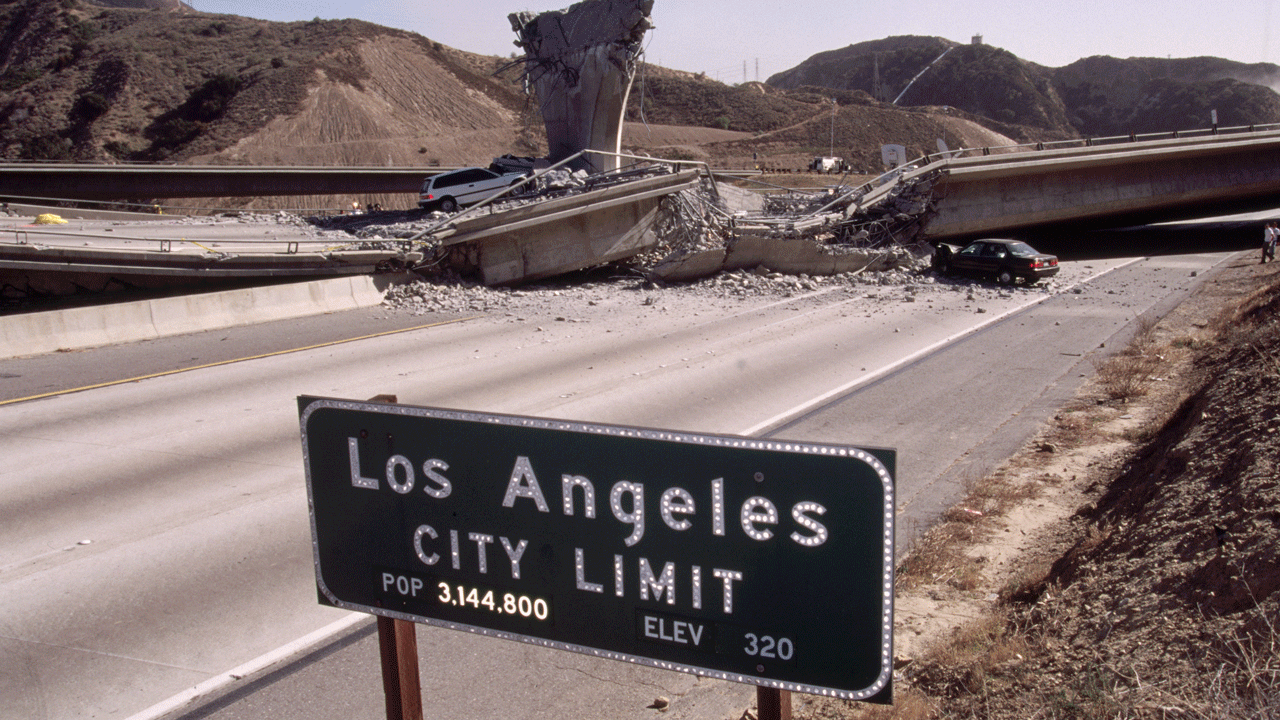
Los Angeles saw that threat firsthand in 1994, when the magnitude 6.7 Northridge earthquake struck the San Fernando Valley, killing dozens of people, injuring thousands, and causing billions of dollars in damage.
More than three decades later, the question remains: Is Los Angeles ready for the next major earthquake?
California officials say yes.
“California is ready to respond when a major earthquake strikes,” a spokesperson for the California Governor’s Office of Emergency Services told the Daily Signal.
“The state has made sustained investments to protect communities, including more than $125 million for earthquake early warning, grants to help communities reduce seismic risks, and increased emergency response staffing,” the spokesperson said.
The Office of Emergency Services also pointed to investments in seismic retrofits, critical infrastructure, roads and bridges, upgraded communications, and specialized search-and-rescue capabilities.
But experts who spoke with the Daily Signal say being prepared does not mean California will escape widespread damage.
Caltech seismologist Allen Husker said the region is better prepared than it once was and praised efforts to prepare first responders, but he cautioned that the location and severity of an earthquake could overwhelm even extensive preparations.
“Definitely it’s more prepared than it has been, and it’s slowly getting more and more prepared over time,” he said.
“Earthquakes, depending upon how they occur and where they occur … will still probably cause significant damage,” Husker said.
“Just as we saw with the LA fires … you can prepare a lot and still things go awry.”
Aging Water Infrastructure Another Vulnerability
Edward Ring, director of water and energy policy at the California Policy Center, pointed to the city’s aging water system as another potential vulnerability, saying some of the city’s water infrastructure is approaching the end of its useful life.
“The very idea that we’re … delivering water under pressure through pipes that are 100 years old—sooner or later, they have to be replaced or they’re going to fail,” Ring told the Daily Signal.
According to the Los Angeles Department of Water and Power’s 2025-26 Water Infrastructure Plan, more than 30% of the city’s roughly 6,800 miles of distribution mainlines are over 80 years old.
“What we’ve got is a system that’s aging to the point where we’re going to see increasing failures,” Ring said.
Water mains are a major concern during an earthquake, particularly because earthquakes can spark fires, creating an even greater problem if damaged pipes disrupt the water needed to fight them.
The State’s Fault System
But the earthquake Los Angeles needs to prepare for may not necessarily be the massive San Andreas Fault event Californians commonly envision as “the Big One.”
California has more than 700 named recently active faults, with more than 300 in Southern California capable of producing a magnitude 6 or larger earthquake.
While the San Andreas is the state’s longest fault system, the destruction an earthquake causes also depends on where it strikes and how close the shaking is to densely populated communities.
“Everybody always talks about San Andreas,” Husker said. “The other thing is just that there’s kind of faults everywhere. There’s a lot of them, and so it’s not just the San Andreas.”
Northridge itself demonstrated that danger.
Husker noted that the 6.7 earthquake caused extensive damage in part because it occurred directly beneath a populated portion of the Los Angeles area.
“The distance makes such a huge difference,” Husker said. “So even smaller earthquakes, if they’re right under the city, can cause a lot of damage.”
Another challenge is what happens to Los Angeles after the shaking stops.
Husker noted concerns that building codes can allow structures to survive an earthquake without necessarily ensuring that they remain usable afterward, meaning California would potentially have billions in repairs on its hands.
This was noted in a report by the San Francisco Chronicle, which estimated the destruction from a magnitude 7.8 earthquake could amount to $1 trillion.
The California Governor’s Office of Emergency Services acknowledged that the scale of a catastrophic earthquake remains California’s greatest challenge, with transportation, utilities, communications, housing, and other essential systems having the potential to be disrupted simultaneously across a large region.
Ring, however, said that the reality of a major earthquake makes complete preparedness nearly impossible.
“I think it would be unfair to claim that California hasn’t done much,” Ring said.
“The real question is … what’s a reasonable amount of preparation and have we done that?”
For now, California continues preparing for a disaster it knows will eventually come. Whether those preparations are enough won’t truly be known until the ground starts shaking.
More from this network:
Domains for Sale · GOTPeople.org · TheDSAPlatform · The Truth About Socialism
What's Your Reaction?
 Like
0
Like
0
 Dislike
0
Dislike
0
 Love
0
Love
0
 Funny
0
Funny
0
 Wow
0
Wow
0
 Sad
0
Sad
0
 Angry
0
Angry
0

I am just an average American. My teen years were in the late 70s and I participated in all that that decade offered. Started working young, too young. Then I joined the Army before I graduated High School. I spent 25 years in, mostly in Infantry units. Since then I've worked in information technology positions all at small family owned companies. At this rate I'll never be a tech millionaire. When I was young I rode horses as much as I could. I do believe I should have been a cowboy. I'm getting in the saddle again by taking riding lessons and see where it goes.
Premium domains for sale
























Comments (0)