

The Days Of Bad Calls Deciding Baseball Games May Be Over
Premium domains for sale
Freedom Is Back In Style
This article is part of Upstream, The Daily Wire’s new home for culture and lifestyle. Real human insight and human stories — from our featured writers to you.
Freedom Is Back
In Style
Premium domains for sale
***
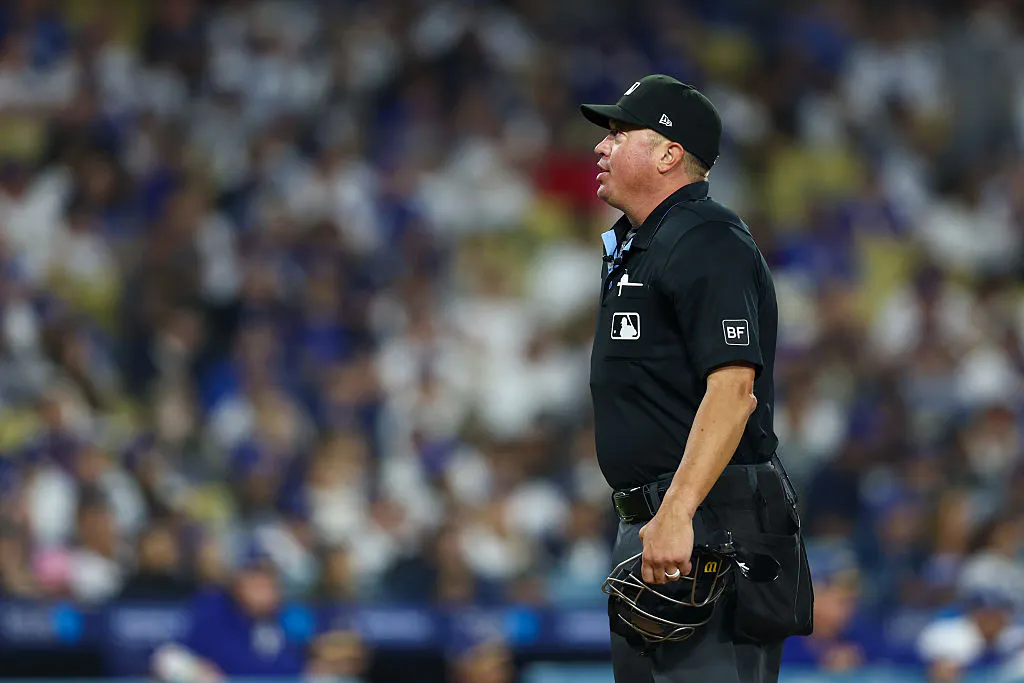
One of the most important moments in baseball history occurred on Saturday, in the 6th inning of a closely contested but otherwise ordinary early-season game between the Cincinnati Reds and the Boston Red Sox.
With two outs and the bases loaded, with the Reds up 5-3, C.B. Bucknor, one of the worst home-plate umpires in Major League Baseball, rung up Reds third baseman Eugenio Suarez on a called strike three. Suarez immediately tapped his helmet, indicating he was disputing the call. This activated the computerized ABS, Automated Balls and Strikes system, which the MLB is officially implementing this year after several years of trial and error.
TV viewers immediately saw the pitch, as did people in the Reds home stadium. The computer animation showed that Bucknor was wrong. It was a ball. The crowd roared. Any true baseball fan — and the Reds have a passionate and well-informed fan base — knows that Bucknor has long been a problem for the sport, an out-of-control, marginally-competent egomaniac who often gets calls wrong in key situations, imposing his will, deciding games in inappropriate situations.
On the very next pitch, Bucknor rung up Suarez again. Again, Suarez challenged, and again, Bucknor was wrong. It was a ball. The stadium reacted like the Reds had just won the World Series. The Reds announcers remarked that it was the loudest cheer on a day where the Reds had already hit two home runs.
On the next pitch after that, Suarez grounded out to end the inning. But even though the Reds ended up walking off the game in the 11th with a single, winning a 6-5 thriller, the real headline was the gauntlet that this new technology laid down to the home-plate umpire’s authority. The Red Sox and Reds challenged Bucknor eight times. And they were right six of those times. Tensions boiled over so extremely that Bucknor ended up ejecting Red Sox manager Alex Cora in the eighth inning. But that was the desperate act of exactly the type of professionally doomed person that the ABS means to expose. The game will never be the same.
One of baseball’s most beautiful features is that it’s always changing. It used to take nine balls to draw a walk. Black players had a separate league. There were no night games. People rooted for players with names like “Dizzy” and “Dazzy” and “Moose.” And the game today, though basically the same as the one I knew as a kid, also has some significant differences. The Houston Astros used to be in the National League. The Milwaukee Brewers were in the American League. There were no Wild Card teams until 1995. There were no divisions until 1969. The introduction of in-season interleague play seemed like a dumb idea, and it remains a dumb idea, but there’s absolutely nothing we can do about it now. When the MLB added the designated hitter to the National League, it was a violation of all that’s holy. But that was before Shohei Ohtani signed with my beloved Dodgers. Now I like the DH.
There was also a time when we couldn’t even conceive of robot umps, except on an episode of Futurama, but now they feel like they’ve always been inevitable. Fans used to have a lot of fun when fat old managers roared out of the dugout to scream at fat old umpires over ball-strike calls. But that was decades ago, when the calls were guesswork for everyone involved, fans, players, managers, and umpires alike. After TV broadcasts introduced pitch-tracking technology in 2008 and StatCast in 2015, suddenly everyone could see exactly what the umps were getting wrong. The era of “YER BLIND, UMP!” ended. It stopped being amusing and started just feeling pathetic.
MLB first tried out the ABS system in the minor leagues and then last season in Spring Training. The system uses 12 Hawk-Eye cameras and T-Mobile’s 5G network to track pitches within one-sixth of an inch of accuracy. It takes the guesswork out of the way, removing the last major bone of contention that teams have with umpires.
If a pitcher, catcher, or batter thinks an umpire has missed a strike call, they can “challenge.” This triggers an automatic robot review. If the challenger is right, the call is overturned. But the challenger can also be wrong, which allows the game to retain an element of human error. From Thursday through Sunday, roughly 54% of all challenged calls were overturned, which means that players were right slightly more often than umpires.
Umpires are often right, but the bad ones can no longer take charge of a game behind the plate through bad calls, briefly becoming the main character when the focus should be on the players. Also, the ABS mostly gets rid of “pitch-framing,” a sub-skill among certain catchers where they can micro-jerk their mitts into the strike zone, sleight-of-hand fooling umpires into making the wrong call. It’s going to get a lot harder for catchers to pull a rabbit out of that hat, just like it’s going to get a lot harder for batters to throw temper tantrums when they think the umpire has done them dirty. The rational ABS will quickly dump ice water on those hotheads.
Most importantly, it will be a lot harder for a missed ball-strike call to determine a game’s outcome. We saw perhaps the last instance of this in modern history in the 9th inning of the World Baseball Classic semifinal between the USA and the Dominican Republic. The WBC didn’t use the ABS, and it sure showed. With the 2-1 game on the line and a runner on third with a three-ball and two-strike count, U.S. pitcher Mason Miller threw a low slider to the DR’s Geraldo Perdomo. It was clearly a ball. Perdomo didn’t swing. Umpire Cory Blaser called it a strike anyway, and that was ballgame.
Cory Blaser may be the last umpire ever to crush a national fan base’s dreams. The ABS cannot make a mistake like that. It sees all.
Over the weekend, the Baltimore Orioles successfully challenged two separate pitches in the 9th inning against the Minnesota Twins, turning a potential walk into a strikeout to nail down an 8-6 win. We’ve yet to see a dramatic game-ending ABS overturn, but it’s coming, and the stadium will go nuts like a stadium has never gone nuts before. Because the robot umps are here to save baseball.
***
Neal Pollack, “the greatest living American writer,” is the author of 12 semi-bestselling books of fiction and nonfiction and is a three-time “Jeopardy!” champion.
More from this network:
Domains for Sale · GOTPeople.org · TheDSAPlatform · The Truth About Socialism
What's Your Reaction?
 Like
0
Like
0
 Dislike
0
Dislike
0
 Love
0
Love
0
 Funny
0
Funny
0
 Wow
0
Wow
0
 Sad
0
Sad
0
 Angry
0
Angry
0

I am just an average American. My teen years were in the late 70s and I participated in all that that decade offered. Started working young, too young. Then I joined the Army before I graduated High School. I spent 25 years in, mostly in Infantry units. Since then I've worked in information technology positions all at small family owned companies. At this rate I'll never be a tech millionaire. When I was young I rode horses as much as I could. I do believe I should have been a cowboy. I'm getting in the saddle again by taking riding lessons and see where it goes.
Premium domains for sale
















Comments (0)