

Three Unlikely Films That Carry Surprising Christian Themes
Premium domains for sale
Freedom Is Back In Style
What makes a movie Christian? Some reviewers have argued Christopher Nolan’s “Odyssey” was shaped by Christian themes. Daily Wire host Michael Knowles has called both the horror film “Mother!” and the coming-of-age story “Lady Bird” Christian, though neither film purported to be. Can a film be Christian if it doesn’t explicitly mention God, and even if it depicts behavior that Christians find objectionable?
Freedom Is Back
In Style
Premium domains for sale
I was listening to a podcast recently when the topic of “Christian” movies came up. Not titles that explicitly depict the life of Christ, such as “The Passion of the Christ” or the show “The Chosen,” but movies which one might group under the umbrella term of “Christian.” Leadership coach Russ De Vos said his favorite movie, and the one which pointed him toward Jesus, was the 1995 blockbuster “Braveheart” starring Mel Gibson as William Wallace.
This choice surprised me, though it turns out it should not have. “Braveheart” apparently routinely ranks high, if not at the top, on lists of people’s favorite “Christian” movies, especially among men, who find in its depiction of William Wallace an example of heroic and sacrificial manliness. Yet this got me thinking: What do we mean when we describe a movie as not just inspiring, but as “Christian”?
I don’t have a definitive answer, but I can tell you why “Braveheart” doesn’t make the cut for me. It is unquestionably a rousing, beautiful film, and a good piece of dramatic art. But it fails my “Christian” test because, gratuitous violence aside, it is unabashedly historically inaccurate.
All historical movies take a degree of historical license; essentially, they have to. Verifiable facts about the historical past are so sparse, especially when it comes to 13th-century Scotland, that anyone wishing to dramatize the story must embellish certain details and invent others simply to fill in the missing pieces of the historical jigsaw puzzle. Yet surely a line should be drawn at inserting details that we know for sure could never have happened. And “Braveheart” is full of such inventions, some of which are laughable, some defamatory.
One of Christianity’s claims to truth concerns its rigorous historical accuracy. The New Testament does not introduce the Incarnation, that moment when Christians believe that God entered into the historical timeline as a man, in a vague way — as in, “A long time ago in a galaxy far, far away…” — but with a historical precision that is worth noting. Indeed, distinguished Cambridge philosopher James Orr came to Christian faith precisely because he recognized the historical accuracy of biblical accounts of the birth of Christ. Therefore, if historical accuracy mattered to the writers of the New Testament, then any movie that merits the term “Christian” must display a similar respect for historical truth.
For some, a “Christian” movie encapsulates wholesome content: no sex, no swearing, minimal violence, and no lauding of illegal acts. Think of the kind of movie you can show to your church youth group without concern. There is an obvious logic to this viewpoint. A “Christian” movie is one that Christians will choose to watch, that aligns with their values, and resonates with the kind of lives they are trying to lead. Such a movie might typically show people praying, quoting the Bible, making right moral choices, and seeing the fruits of these choices in greater blessing and flourishing in their lives. Examples of this kind of movie could be the classic 1981 British movie “Chariots of Fire,” or the more recent 2015 sleeper hit “War Room,” and its 2024 spin-off, “The Forge,” co-written by brothers Alex and Stephen Kendrick, both of whom are also pastors.
As popularity for such faith-based movies grows, the big studios have taken notice. The Christian movie company Affirm Films was set up in 2007 as a subsidiary of Sony, with its stated mission to produce content that “inspires, uplifts, challenges and captivates.” This brings up the question of what is meant by faith-based content, and who the target and actual audiences are for such openly Christian movies. Is it people who already believe, or people who are not sure and need a vision of what the Christian life looks like in real life? If the latter, how accurately can the fictional medium of storytelling replicate reality?
It is routine for movies with a direct Christian message to be challenged by mainstream movie critics as “preachy.” Another criticism is that they are formulaic and use clichéd tropes. Essentially, critics find such wholesome stories to be boring and unoriginal. It is worth noting that if one did classify as “Christian” only those movies with no bad language, sex, or violence, and which were safe for a church youth group, then the astonishing “Dead Man Walking,” which explores extreme sin, repentance, and atonement, probably would not qualify.
Another faith-based studio, Angel Studios, which started in 2013 under the name VidAngel, operates independently of an established studio format, preferring to crowdfund its movies. Its breakout film was 2023’s “Sound of Freedom,” based on a true story and starring Jim Caviezel, who played Jesus in “The Passion of the Christ.” Yet the success of that movie led to Angel Studios getting sucked into the culture wars, receiving criticism that likened the plot to a QAnon fever dream. Controversy notwithstanding, that film’s healthy box office receipts have allowed Angel Studios to break into mainstream movie making. The studio now routinely attracts well-known actors, and its upcoming movie “Runner” features action man of the moment Alan Ritchson with Owen Wilson as the comic relief.
Amid the rise of films for Christian audiences, there is no definitive answer to what qualifies as a “Christian” movie. Unlike, say, action movies or rom-coms, which must follow a generic plot line, what makes a movie “Christian” is surely more personal. For those interested in outside-the-box contenders, though, I have a few.
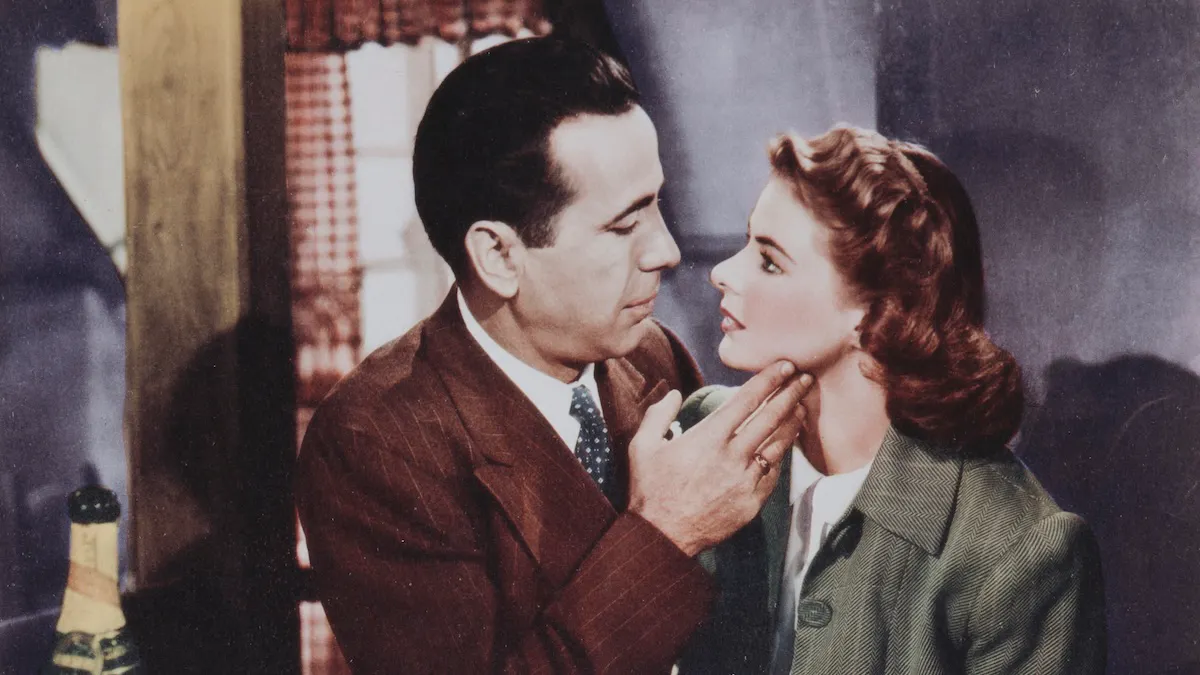
For starters, “Casablanca.” Yes, the previous love affair between Rick and Ilsa was adulterous, but neither knew it at the time, so that must surely count for something. Plus, once they realized the truth of the situation, they refused to rekindle their passion. Their selfless choices at the end of the movie — which seem to be pretty accurate depictions of the Pauline concept of “dying to self” — lead to them both having happier and more fulfilled futures than had they furtively run away together. If you are still skeptical, compare “Casablanca” to its hedonistic doppelgänger, “The English Patient,” in which the lovers choose each other over “doing the right thing,” and everyone dies. Horribly.
Another movie that gets my “Christian” rating is “The Painted Veil.” Again, adultery is the plot twist, but here the selfishness, immaturity, and infatuation that caused it are burned up in a crucible of suffering, leading to our hero and heroine gaining a genuine knowledge of and love for each other, which in turn leads to profound repentance, self-sacrifice, and ultimately self-fulfillment.
A very different movie that also qualifies is the strange but brilliant “Moon,” directed by the late David Bowie’s son, Duncan Jones, and starring Sam Rockwell alone in a space station on the Moon. Spoiler alert: Rockwell’s character gradually realizes he is not the human he believes himself to be, but a clone whose function is to supervise the robots and harvesting machines on the space station, which are mining the Moon’s rare minerals and sending them back to Earth. He discovers he can only live for three years before starting to physically degrade, whereupon he will be euthanized and replaced by an identical and equally oblivious clone, who will supervise the mining colony before similarly starting to decompose.
Now why is this one “Christian?” Because just as C.S. Lewis used the artistic medium of sci-fi in his adult fiction series, “The Space Trilogy,” to explore man’s relationship to the divine, “Moon” shines a spotlight on the wonder of our human uniqueness. It reminds us that each person is a created being and designed to be fully autonomous, not an anonymous commodity fabricated in a lab for commercial profit. Each time I watch “Moon,” my response is to thank God for giving us humans true freedom, which is something I guess William Wallace from “Braveheart” could understand.
So now, over to you. What do you think makes a movie “Christian,” and what is at the top of your list?
***
Bridget Riley studied modern history at Oxford and completed a Ph.D. in medieval history at the University of Reading. She writes on history, culture, and the philosophy of religion.
This article is part of Upstream, The Daily Wire’s new home for culture and lifestyle. Real human insight and human stories — from our featured writers to you.
More from this network:
Domains for Sale · GOTPeople.org · TheDSAPlatform · The Truth About Socialism
What's Your Reaction?
 Like
0
Like
0
 Dislike
0
Dislike
0
 Love
0
Love
0
 Funny
0
Funny
0
 Wow
0
Wow
0
 Sad
0
Sad
0
 Angry
0
Angry
0

I am just an average American. My teen years were in the late 70s and I participated in all that that decade offered. Started working young, too young. Then I joined the Army before I graduated High School. I spent 25 years in, mostly in Infantry units. Since then I've worked in information technology positions all at small family owned companies. At this rate I'll never be a tech millionaire. When I was young I rode horses as much as I could. I do believe I should have been a cowboy. I'm getting in the saddle again by taking riding lessons and see where it goes.
Premium domains for sale




















Comments (0)