

Tim Sheehy Is A One-Man Wrecking Crew Out To Save America’s Forests From Environmental Madness
Premium domains for sale
Freedom Is Back In Style
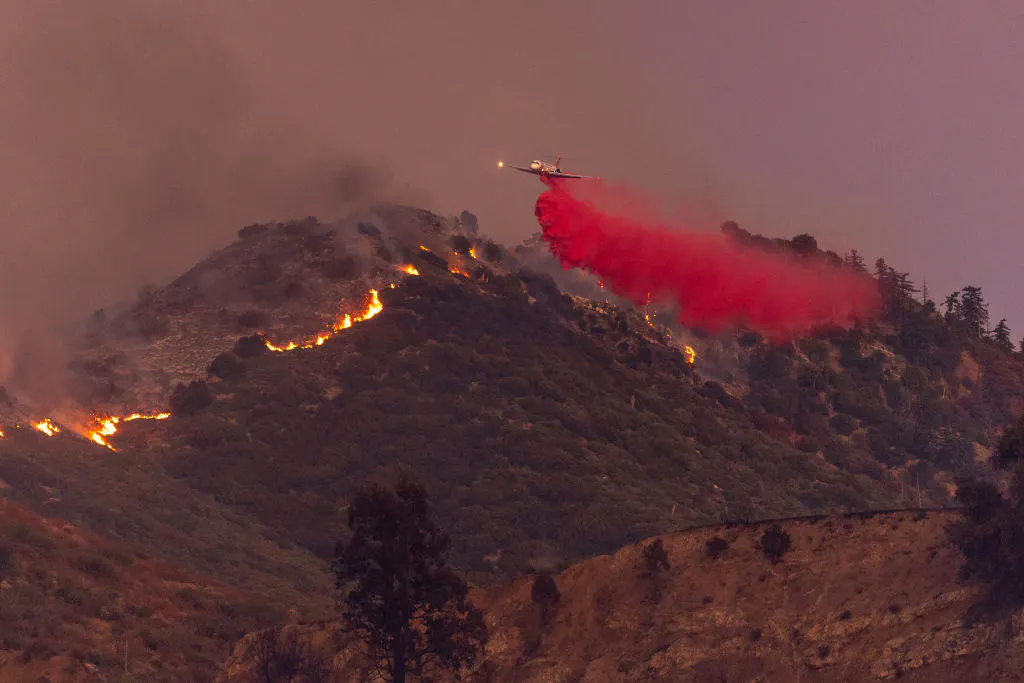
We’re in the middle of another catastrophic wildfire season: a record 7.4 million acres have burned across the US, and firefighter “entrapments” — which is when they’re trapped by the wildfire in a life-threatening manner — have hit a 20-year high.
Freedom Is Back
In Style
Premium domains for sale
As we discussed in a far-reaching interview, U.S. Senator Tim Sheehy, a former Navy SEAL and aerial firefighter, has an unusual diagnosis of the problem: we are choosing to let this happen, and not because of our gas-guzzling pickup trucks.
For other major disasters — tornadoes, hurricanes, mudslides, terrorist attacks — accountability is expected from the government, he told us. (No expense is spared to evacuate the Gulf Coast for a hurricane.) The approach is usually coordinated, prompt, funded, and effective. When it’s not: “We have an investigation. We ask questions.” As a result, there are generally very few deaths or injuries, and the economic impact is mitigated.
But when wildfires wipe entire towns off the map, or kill 30,000 Americans each year from smoke inhalation (200-500 directly), or, in the case of LA last year, destroy 15,000 homes and roughly $250 billion in value, making it among the most expensive disasters in US history… blob media will circle the same factors: high temperatures, historically low snowpack, decades of drought, Trump’s cuts to the US Forest Service, climate change. Shrug.
“Their response is, ‘This is a fait accompli. We can’t stop these fires from happening. We’ve just got to accept that our cities are going to burn down. And oh, by the way, if you happen to live in a wildfire prone area, shame on you. You shouldn’t have lived there in the first place.’” Sheehy added: “It’s a total inversion of responsibility.”
Sheehy’s diagnosis is less fatalistic: we know how to stop communities and forests from burning down; we’ve simply built a system that doesn’t allow people to do their jobs.
“It’s incredibly frustrating to me to see this ‘business as usual’ approach every time we have these cataclysmic disasters, whether it’s Texas, whether it’s New Jersey, whether it’s Florida, whether it’s California,” he said. “And the truth is we can fight these fires. The truth is we can prevent these fires. The truth is we can better protect our communities. We have chosen not to. And that’s what I’m trying to change here. That’s why I’ve been leading the wildfire reform effort because it’s so overdue. We are betraying and abandoning our communities.”
Sheehy fell into firefighting by accident.
As a kid, his neighbor, a Navy veteran, taught him how to fly. Later, after graduating from the U.S. Naval Academy (as the first midshipman to graduate from Army Ranger School), he became a Navy SEAL team leader and oversaw special operations in Iraq and Afghanistan.
After earning a Purple Heart and Bronze Star with Valor, Sheehy “medically separated” from the military in 2014 — the senator still has a bullet lodged in his arm somewhere — and proceeded to face some of the most dangerous work of his career.
Moved by the 2013 Yarnell Hill Fire in Arizona, which burned nineteen firefighters alive, Sheehy founded two aerial firefighting companies, one of which produced “the first drone ever to be used on an active wildfire.” For the next decade, he served as a waterbomber pilot (scooping and dropping water) as well as an air attack pilot (directing the broader firefighting effort) while actively serving as CEO.
Prior to getting recruited by the Republican Party to run for Senate in Montana, those years on the frontlines served as one giant lesson in the unnecessary bureaucratic, civic, and moral dysfunction worsening our wildfires.
“As I learned more, every layer I went deeper, it was kind of like, ‘There’s no way this is actually what’s going on.’ Every time I went a layer deeper, the worse it got, the worse it got, the worse it got.”
As he sees it, these are some of the major problems.
First: we’re fighting fires with dirt and shovels
In general, the farther away you get from the fire, the more sophisticated the tech becomes (we recently launched fire-detecting AI satellites into space).
But on the frontlines, we are still pretty much sending young men and women to fight these giant forces of heat and destruction with “a grease pencil and a shovel,” as Sheehy put it.
Literally, hotshot crews — those that specialize in the most challenging, remote firefighting operations — rely on axes and shovels to chop and scrape away vegetation, sometimes literally throwing dirt on the fire to put it out. Nothing close to the tech and real-time information he was privy to as a SEAL team leader in combat, he said.
In fact: “An average cop driving down the street has more technology and capability in that car and on their belt than an entire task force of wildland firefighters has.”
What’s more, wildfire fighters often work seasonally, for very little money and benefits. That, combined with the deadly nature of fighting massive fires with actual dirt, paints a depressing picture of the occupation:
“Right now, if you send a Marine overseas to go fight a war against America’s adversary, he’s got radios, he’s got guns. If he gets killed, his family gets a $400,000 service member group life insurance plan. He’s got healthcare. If he gets injured, he’s got VA benefits,” Sheehy said. “Let’s say he’s got a twin brother, and he goes out to fight a wildfire out West. And he gets hurt? He’s got no life insurance, no health insurance. He’s got no pay if he gets injured, no pension like the VA. He’s got gear that is from the Vietnam era instead of from modern day. He doesn’t have the same communication suite. He’s not given the same level of equivalent weapon system technology he would get in the Marine Corps.”
Therefore: “The guy going out to fight wildfire is more at risk than the one we’re sending overseas. And that’s unacceptable.”
In fact, forget the Marine. In some respects, firefighters are less resourced than Panda Express employees, he said:
“I know in Bozeman, Montana, we have a Panda Express that pays more and has better benefits than a wildland firefighter who’s going to parachute out of an airplane. I’m f*cking dead serious. You get treated better at a Panda Express scooping Kung Pao f*cking chicken than you do parachuting to fight a fire.”
Second: we are preventing professional forest managers from managing the forest
When we settled the West, we interrupted the natural cycle of fires that kept the forests sort of thinned out in accordance with mother nature’s design.
“A healthy forest fire burns through the underbush, burns out the new saplings, rejuvenates the soil, clears out the dead fall and basically makes the forest floor healthy again for the next generation of growth,” Sheehy said, adding: “Six months later, you’ll see the charring on the tree trunks; the forest floor will be clear; and there won’t be any branches below about eight feet. And that’s how the forest is supposed to look.”
Now, when fires start, they have vastly more fuel in the form of trees and undergrowth.
We could mimic the natural cycle with proper management — namely, through prescribed fires and timber harvesting. But we don’t. At least, not as much as we should. Per Sheehy, largely thanks to the environmental movement, our forest management took a nose dive decades ago.
“Our forest management basically collapsed 30 years ago and it’s only gone downhill since — because the unholy alliance of progressive litigators, of environmental nonprofits, and activist judges has come together to halt any and all forest thinning, timber harvesting and lumber projects in America.”
At risk of stating the obvious, the U.S. Forest Service is tasked with managing the national forests, harmoniously balancing different priorities, from mineral- and timber-use to outdoor recreation and preservation. “Treating” the forests, which involves removing dead trees, cutting down some alive ones (timber harvesting), and then burning the area — is therefore an important part of their mandate.
But they’re hardly able to do it: 63 million acres of national forest land face “high or very high wildfire hazard potential,” while the agency is only treating a few million a year (far less than the ~7 million acres affected by this season’s wildfires). A variety of factors are responsible, from funding and manpower to weather and terrain challenges. But one of the main constraints, as Sheehy noted, is the exhaustive regulatory apparatus.
Suppose the Forest Service makes a bid to treat 5,000 acres of forest. First, there’s a detailed operational design. Then, there’s a review in accordance with the National Environmental Policy Act (1970). Then, like say if the area contains northern spotted owls, there’s more reviews in accordance with the Endangered Species Act (1973). Then, if the project has the potential to affect things like Native American “rock art,” there’s an archaeological review required by the National Historic Preservation Act. Then, permits (potentially triggering Clean Water Act requirements). Then, public notice and comment. Then, administrative objections, authorization, and — finally — lawsuits! After, possibly, years of reviews, groups like the Sierra Club can sue to block treatments, arguing the Forest Service violated the aforementioned laws. Then, if the project clears the courts — and the wind, humidity, temperature, fuel moisture, and smoke dispersion are just right; and the project is in compliance with local air quality regulations — the Forest Service may light a single twig on fire.
The irony is that, by that point, the area and its northern spotted owls and Native American rock art and 15,000 homes may have already been destroyed by a mega wildfire fueled by the undergrowth that the agency wanted to treat.
“Even if you, tomorrow, said, ‘I got 600 goats, I’m going to graze them on the mountain side behind Hollywood to do fire prevention and I’ll do it for free,’ you’d still have to get a permit, and they would take you to court and say, ‘No, you’re going to chew on the iceberg lettuce plant that’s endangered and the Eurasian salamander — that’s his habitat. You haven’t conducted a study on what your goats will do,’” Sheehy said.
“They’ll be like, ‘The goat’s going to sh*t on the salamander’s house and that will affect his quality of life and we’re going to sue you for it.’”
Sheehy said he’s experienced this firsthand as a water bomber. Once, he was flying a plane toward a lake to scoop out water for a nearby fire: “Smoke’s in the air, flames everywhere, people evacuating.” Then — “boom” — at the last minute, the fire’s Forest Service commander said he couldn’t use the water. “What?” he recalled thinking. A flurry of possibilities crossed his mind. Were they about to hit critical infrastructure?
But no, the commander says: “The lake’s got invasive Eurasian mussels, and we don’t want you to spread them to the next lake,” Sheehy recalled. “And I’m like, ‘Guys, there’s literally a town burning down next to us. People are running out with their belongings… And you won’t let us scoop the water to go fight the fire because of a Eurasian invasive water species? Guys, where are our priorities?’”
He continued: “I’m worried about making sure these people’s home doesn’t burn down and they don’t burn alive with their children in the back of their car, like has happened many times. And you’re worried about mussels and invasive species from the lake.”
“And that’s an extreme illustration,” he added, “but it’s not uncommon where they’re prioritizing these very obscure environmentalist radical concerns. And that is preventing us from common sense forest management, common sense fire prevention, and common sense firefighting techniques and tactics that should be saving lives.”
Ultimately, this mess of regulations have helped create “a massive pile of fire kindling that we are unable to manage because timber harvesting has basically been made illegal in America,” Sheehy said.
Large swaths of California’s Sierra Nevada and Cascades, many of which haven’t seen fire in decades, are now up to 10 times denser than they were roughly a century ago. That overcrowding weakens trees, invites catastrophic beetle outbreaks, drains limited soil moisture and snowpack runoff, and, alongside climate change and droughts, leads to recordbreakingly destructive fires. The 2020 Castle Fire, for example, destroyed a tenth of the world’s mature giant sequoias in one fell swoop. These were old-growth trees, thousands of years old, hardened for fire. In fact, fire is a vital part of their reproduction. But the fires we’re creating are too powerful even for them.
“You look at a normal national forest now, there’s eight feet of dead trees laying on the ground, you can’t walk off the trail, and the whole forest is overgrown,” Sheehy said. “And when that burns, it destroys the ecosystem. It burns all the trees, kills all the animals, and the whole ecosystem is wiped out. And we’ve done that intentionally in the last 30 years because we’ve allowed conservation to be confused with stewardship and we decided to lock our forests up from common sense management.”
I am a radical environmentalist and here is why I support this:
My family used to have a cabin bordering national forest in California. The loggers built and maintained an extensive dirt road network that you could ride a quad on for 60 miles and never see anyone else. The… https://t.co/EmWLQDfZQv
— Dr. Ben Braddock (@GraduatedBen) August 18, 2026
Third: responsibility is too decentralized
Furthermore, several federal agencies — with different budgets, policies, bosses — all share the responsibility of fighting fires, per Sheehy: “It’s not like the DoD where they all eventually funnel up to Pete Hegseth.”
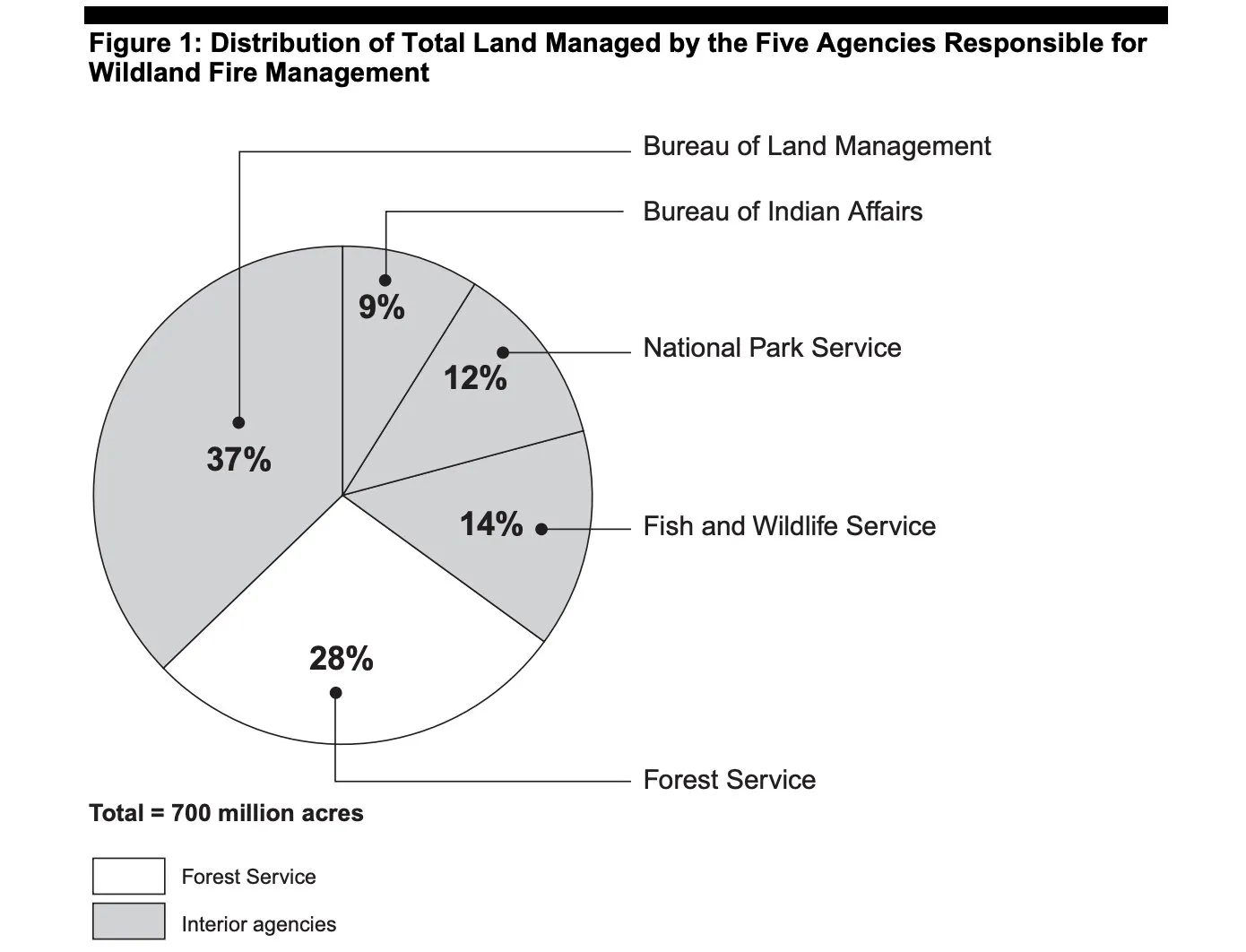
Source: Forest Service and Interior data compiled by the U.S. Government Accountability Office
One of those federal agencies is the National Park Service, which Sheehy finds irksome:
“That’s like if you have a SWAT team in your city and they have them answer to the guys that clean your playgrounds. That’s literally what it is. Historically, an organization whose job is to fly giant planes through burning mountains and parachute out of planes and fight fire — that’s an emergency response mission. It’s a first responder mission. It’s a life and death mission. And we’ve put those people under the command of the Parks Department.”
But more to the point, the distributed responsibility can cause confusion, not least because the American West is one giant checkerboard of overlapping federal land.
“Oftentimes, you’ll have 600 acres of Forest Service that’s next to 600 acres of National Park that’s next to 600 acres of Bureau Land Management that’s next to 600 acres of state land that’s next to 600 acres of private land. And all those different parcels have different policies about their management.”
Each of those parcels, in the case of wildfire management, produces cascading opportunities for humans to disagree about what to do.
Take, for instance, the Cerro Grande fire in 2000. The fire started as a prescribed burn, in this case run by the Park Service, inside Bandelier National Monument, a national reserve in northern New Mexico. It escaped containment (which happens less than 1% of the time), burned roughly 48,000 acres, destroyed hundreds of homes, and caused about $1 billion in estimated damages.
The failure, per a GAO report, was complicated. For one, the agency didn’t have enough firefighting resources on-site because the way it assessed burn complexity was systematically wrong. But also, “valuable time was lost in getting additional resources to the site” because of the relevant agencies’ “interpretation” of policy:
The Park Service staff believed that once they had confirmed the availability of the contingency resources identified in the prescribed burn plan, the resources would be available if and when they requested them. However, the Forest Service dispatching officer and officials at the regional coordinating center did not agree with the Park Service’s view. Instead, they told us their interpretation of the policy was that contingency resources are only to be made available when a prescribed fire becomes a wildfire. As a result of this confusion, valuable time was lost in getting additional resources to the site. It was not until 7 to 9 hours after a Park Service official first requested contingency resources that they began to arrive at the burn site. Even then, the resources arrived only after the Forest Service dispatcher circumvented the regional policy by diverting the resources from another wildfire to Bandelier. (GAO)
Furthermore, the fragmentation exists beyond federal lands. Because fire responsibility historically followed land ownership and jurisdiction, we’ve left managing fires up to cities, counties, tribes, and so on. Basically “whoever the hell feels like dealing with it,” Sheehy said.
That worked, for a century or so.
“Well, we’re in a different spot now,” he said.
All the different bosses up and down the chain means there is… no plan for how to deal with fires systematically, even at the state level.
“So first of all, you’re correct, there is no plan,” Sheehy said.
But the situation is escalating to the point where home insurers have been retreating from wildfire-prone areas. In some cases, the monthly premiums are eclipsing mortgage payments and could eventually, as Sheehy told us, trigger the next housing crisis.
“If you can’t get home insurance, you can’t get a mortgage. You can’t get a mortgage, you can’t buy a house because everyone needs a fucking mortgage. And the reality is the next housing crisis could very well be caused by an insurance market tightening caused by a wildfire. Pacific Palisades literally directly put a huge strain on homeowner’s insurance all over the mountain West.”
“And that’s why this is a national issue,” he continued. “It’s not a regional, it’s not a local, it’s not a city, it’s not a county issue.”
Enter: a plan
Last year, Senator Sheehy sponsored a bipartisan bill laying out a plan to replace this disjointed, high-risk system by consolidating our wildland firefighting programs under one roof. The bill died in committee, but the Trump administration revived the plan as an Executive Order to consolidate firefighting services “to the maximum extent practicable” under a singular agency with one commander.
The new Wildland Fire Service (WFS) is housed in the Department of Interior, and already merged the Department’s four fire programs, Office of Aviation Services, and the Office of Wildland Fire, under one roof. America’s first Fire Chief is Brian Fennessy, who once led more than 1,800 firefighters and other personnel as head of the Orange County Fire Authority.
As Sheehy sees it, the critical next step is moving the Forest Service out of the USDA — which is an agriculture organization focused on ag policy subsidies and global trade (“it is not focused on land management or emergency response”) — and into the Department of Interior to align those missions more closely.
While there are no active legislative attempts to formalize the move, 2027 budget proposals reveal a quiet campaign to do just this. Besides $6.91 billion in funds (including roughly $2.8 billion shifted from the Forest Service), the WFS is seeking control of the Forest Service’s wildland-fire operations and thousands of its employees.
But all that is constrained by a management “feasibility study” mandated by Congress.
Yet another case of government-mandated studies preventing us from effectively fighting wildfires. How about that.
In the meantime, Senator Sheehy is trying to pass two bipartisan bills through congress: the Wildfire Response and Preparedness Act would set strict standards for wildfire response time; and the Fix Our Forests Act would “bring back common sense forest management,” as he put it.
“We have to be very active in going after this,” Sheehy said. “So that’s why the Fix Our Forest Act is bipartisan because after the LA fires, even the Democrats realize, ‘Holy sh*t, we got a problem on our hands. We have let these forests get out of control.’”
The Fix Our Forests Act, introduced by Representatives Bruce Westerman (Republican; Arkansas) and Scott Peters (Democrat; California) passed the House in January 2025 with bipartisan support. A Senate version was later introduced by a bipartisan group of Western senators, including Sheehy and Alex Padilla (Democrat; California). It cleared committee last fall but has yet to receive a full Senate vote, which is disappointing given how rare it is to have multiple California Democrats on board for really anything to happen in the physical world.
“I’m a guy from California who has mostly voted for Democrats — yet here I am cheering for Republicans like Bruce Westerman and Tim Sheehy (alongside Democrats like Alex Padilla and George Whitesides) because of their determination to get FOFA passed,” Bill Clerico, head of Convective Capital, a firm that invests in wildfire prevention and resilience, told Pirate Wires. “It’s a critical cut to the red tape that prevents forest management — and it’s bipartisan and long overdue.”
For example, under the current system, forests projects aiming to “treat” 3,000 acres or less can qualify for streamlined review; FOFA, however, would raise that threshold to 10,000. The bill also expands Good Neighbor Authority, allowing states, counties, and tribes to do restoration and land management work on federal lands. It also centralizes wildfire data and decision support under one interagency hub, and reinforces casualty assistance for wildland firefighters and their families.
These are small incremental steps, given the scope of the problem. But they are much better than the fatalistic sigh of “climate change” when we let fires kill our neighbors and destroy our Redwoods.
“Americans are dying, communities are being wiped out, and it’s idiotic,” Sheehy said. “I can talk about this for hours, as you can tell.”
***
This is republished courtesy of Pirate Wires. The original can be found here.
Blake Dodge is a writer covering technology and the weird at Pirate Wires. Hunter Ryerson is a writer at Pirate Wires.
To share a tip about wildfire dysfunction, please reach Blake (+1 252-241-3117) and Hunter (+1 650-696-0724) via the encrypted app Signal.
More from this network:
Domains for Sale · GOTPeople.org · TheDSAPlatform · The Truth About Socialism
What's Your Reaction?
 Like
0
Like
0
 Dislike
0
Dislike
0
 Love
0
Love
0
 Funny
0
Funny
0
 Wow
0
Wow
0
 Sad
0
Sad
0
 Angry
0
Angry
0

I am just an average American. My teen years were in the late 70s and I participated in all that that decade offered. Started working young, too young. Then I joined the Army before I graduated High School. I spent 25 years in, mostly in Infantry units. Since then I've worked in information technology positions all at small family owned companies. At this rate I'll never be a tech millionaire. When I was young I rode horses as much as I could. I do believe I should have been a cowboy. I'm getting in the saddle again by taking riding lessons and see where it goes.
Premium domains for sale
















Comments (0)