

Victor Davis Hanson: ‘Inclusive’ Stanford University Caught Red-Handed Using AI to Race Swap Student
Premium domains for sale
Freedom Is Back In Style
Editor’s note: This is a lightly edited transcript of “Victor Davis Hanson: In His Own Words” from Daily Signal senior contributor Victor Davis Hanson. Subscribe to Victor Davis Hanson’s own YouTube channel to watch past episodes.
Freedom Is Back
In Style
Premium domains for sale
Jack Fowler: Victor, let’s talk about—you ever heard of Stanford University, Victor?
Victor Davis Hanson: I have some recollection of it.
Jack Fowler: Yeah. The controversy. Stanford, about using AI, race-swapping advertising. Here’s the story. Stanford Residential and Dining Enterprises recently used AI to change the races of students it included in its advertisement. AI was also used to notably slim down and alter students’ faces.
On his journey to campus, Stanford student Billy Ramirez, 27, was sent an image he recalled a Stanford photographer taking. Upon closer examination, he noticed that he had been removed from the photo and replaced by an AI-generated Black woman.
The Review spoke to Ramirez, who stated, quote, “I was driving to school from my hometown when my friend sent me the images comparing the banner to the original photos, and I was immediately baffled. At first, I found it hilarious that they had used AI to completely change our appearances, including my race and gender. But after looking at the comparison, I was also upset because I don’t agree with Stanford making those choices about how we are represented,” etc., etc. He goes on. It’s a longer quote.
But anyway, Victor, imagine if—you can do the imagining.
Victor Davis Hanson: I can tell you what it was. Some 51 years ago, I enrolled in Stanford as a graduate student in the Ph.D. program, and I can tell you, in 1975, it was mostly white, 90%. There were just starting to see a lot of Chinese immigrants, but not very many. And I can tell you—but when I say mostly, I would say 10% of the student body was Hispanic or black.
What would have happened if they were appealing to some, you know, reactionary, crazy people that were big donors, and they had a picture of the Stanford students, and they had two black people and eight white people, and then they decided, well, let’s just get rid of those black people and turn them into white people?
People would get very, very angry, and that’s what they’re doing. They are trying to create a racial hierarchy, and the racial hierarchy they feel is DEI, and by that they mean we are so racially obsessed in every aspect of Stanford University, race comes first.
And what do I mean by that? If you wanna graduate, we’re gonna try to peg you. You go to the Chicano graduation, you go to the black—the Asian graduation, the gay—you go to one of those. Except, you know, you’re not gonna go to a European or white. That would be racist if you had a separate one.
If you wanna go to your dorm, we’re gonna call it a theme house, not a racially segregated—just like we’re gonna call a graduation adjacent graduation ceremonies. And if you’re black, you go to a black dorm, Chicano, da, da, da.
And what if you don’t feel safe on campus? You can go to a racially segregated safe space. At least you could, I suppose, until recently.
And now we learn that even though they—I guess it wasn’t enough, Jack, after George Floyd to let in 9% of the incoming class, white males. That was about 190 people. Think about that. 190 out of about 2,000 entries were white males.
And then you have—you’re right next to Silicon Valley with $14 trillion of market capitalization, where there’s about 500 white males that are the children of the wealthiest, most powerful people in the world, and they all wanna go to Stanford.
And then you’ve got probably 500 administrators whose kids wanna go to Stanford, another 500 faculty [00:04:00] grandees that want their kids to go, and maybe 400 athletes. What you’re basically saying is there’s not going to be one working-class white kid who lives in Podunk or Selma, California, or Fresno who has a straight-A average and a perfect SAT, ’cause we’re not gonna—we don’t want that person. Just doesn’t—we don’t want him.
We only want white people who can pay 10 million bucks or who are famous or can help our athletic program. And that’s what it’s become.
And then the weirdest thing about it, you cloak the whole thing, all of this pre-civilizational tribalism, with diversity, equity, inclusion. We’re caring people. We’re inclusive people. We’re so inclusive that if we see that we don’t have the proper percentage, we’re gonna airbrush it away ’cause that’s what we do. We’re Stanford and we’re nice people.
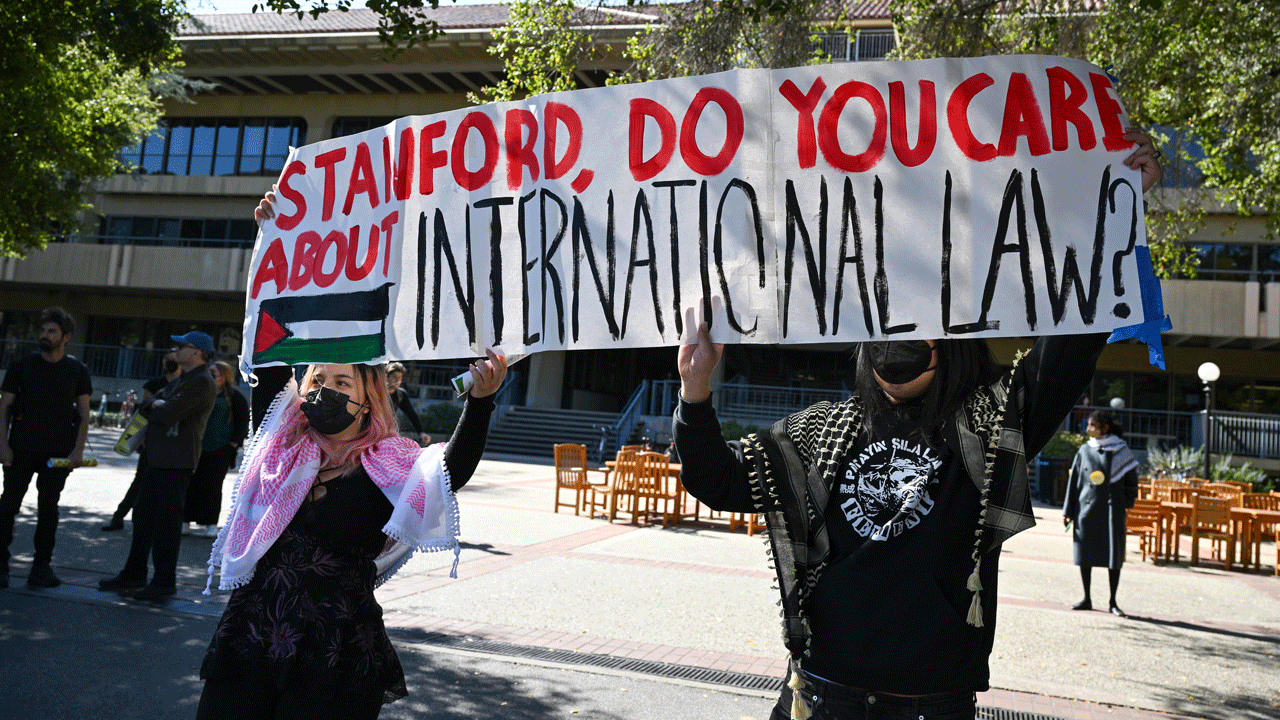
And we’re inclusive. And if we have a free speech area, and we say you can—well, you have to be gone out at 24 hours, and if you wanna take over that free speech area, and you want to camp for four months and every single day basically call for the extermination of Jews in Israel from the river to the sea, we’re not gonna judge you. That’s part of the cultural richness of Stanford.
And that’s what’s so scary about higher education today. It’s really bankrupt morally.
Yeah. I didn’t think they would stoop to that, though.
Jack Fowler: Hmm.
Victor Davis Hanson: And this was not the school paper. This was not—this was the university that did this.
Jack Fowler: And it’s interesting. It’s Billy Ramirez. It’s not Billy O’Reilly. I wonder what this also says about the perception of Hispanics.
Victor Davis Hanson: Well, they have a big problem with that because most Hispanics on census, at least, don’t identify as Hispanic, they identify as white. And I can tell you that, you know, we have a lot of indigenous people that are coming up to California from Mexico, but the prior cycles of immigration were largely from northern Mexico.
And I can tell you the people I grew up with, if I looked at my senior picture of 240 people, there were probably 30% white, and I said, that person is—we’re gonna call that person Italian, that person Greek, that person dark-haired—you wouldn’t know the difference.
So Billy Ramirez might be mistaken as an Italian kid because they didn’t know his last name. It shows you what we’re dealing in. We’re talking about abject racism, that we are so obsessed, we’re afraid that Billy Ramirez didn’t make it on this intersectionality pecking order, so we have to—
The other thing they did, this is very strange because we are told the Left, and it is Left, has a—what’s the word they use for overweight people, obese? Obesity rights, that it’s body shaming.
Jack Fowler: Fat shaming.
Because I think fat shaming is now a responsible term.
Victor Davis Hanson: Yes.
And they didn’t just AI out Billy Ramirez and turn him into an African American. They also took the two other politically correct people. I think one was Asian.
Jack Fowler: It was an Asian, it was an Asian girl with a roundish face, not—
Pre-AI, she had a roundish face, yeah.
Victor Davis Hanson: Yeah. But what was really sick about it was she wasn’t that obese. She wasn’t that—
Jack Fowler: No.
Victor Davis Hanson: She was very attractive—nice girl, and they made her thinner. And that plays into every one of the Left’s criticisms of the right. Oh, they’re just interested in looks, and they’re—this idea of, you know, teenage girls throwing up and being forced to be thin, and they’re nervous, and all of this stuff is just pressures on this cheap, crass culture that has ideal weights.
And then here Stanford University sees a girl who probably is maybe five pounds more than the recommended rate, and they have to, I don’t know, you have to transform her into somebody who’s thin and fits their idea, not mine, not your—their idea of what beauty is.
And so, it’s pretty sickening.
We publish a variety of perspectives. Nothing written here is to be construed as representing the views of the Daily Signal.
More from this network:
Domains for Sale · GOTPeople.org · TheDSAPlatform · The Truth About Socialism
What's Your Reaction?
 Like
0
Like
0
 Dislike
0
Dislike
0
 Love
0
Love
0
 Funny
0
Funny
0
 Wow
0
Wow
0
 Sad
0
Sad
0
 Angry
0
Angry
0

I am just an average American. My teen years were in the late 70s and I participated in all that that decade offered. Started working young, too young. Then I joined the Army before I graduated High School. I spent 25 years in, mostly in Infantry units. Since then I've worked in information technology positions all at small family owned companies. At this rate I'll never be a tech millionaire. When I was young I rode horses as much as I could. I do believe I should have been a cowboy. I'm getting in the saddle again by taking riding lessons and see where it goes.
Premium domains for sale



















Comments (0)