

Victor Davis Hanson: The Truth About Jason Arday’s Death
Premium domains for sale
Freedom Is Back In Style
Editor’s note: This is a lightly edited transcript of today’s video from Daily Signal senior contributor Victor Davis Hanson. Subscribe to our YouTube channel to see more of his videos.
Freedom Is Back
In Style
Premium domains for sale
Hello, this is Victor Davis Hanson for the Daily Signal.
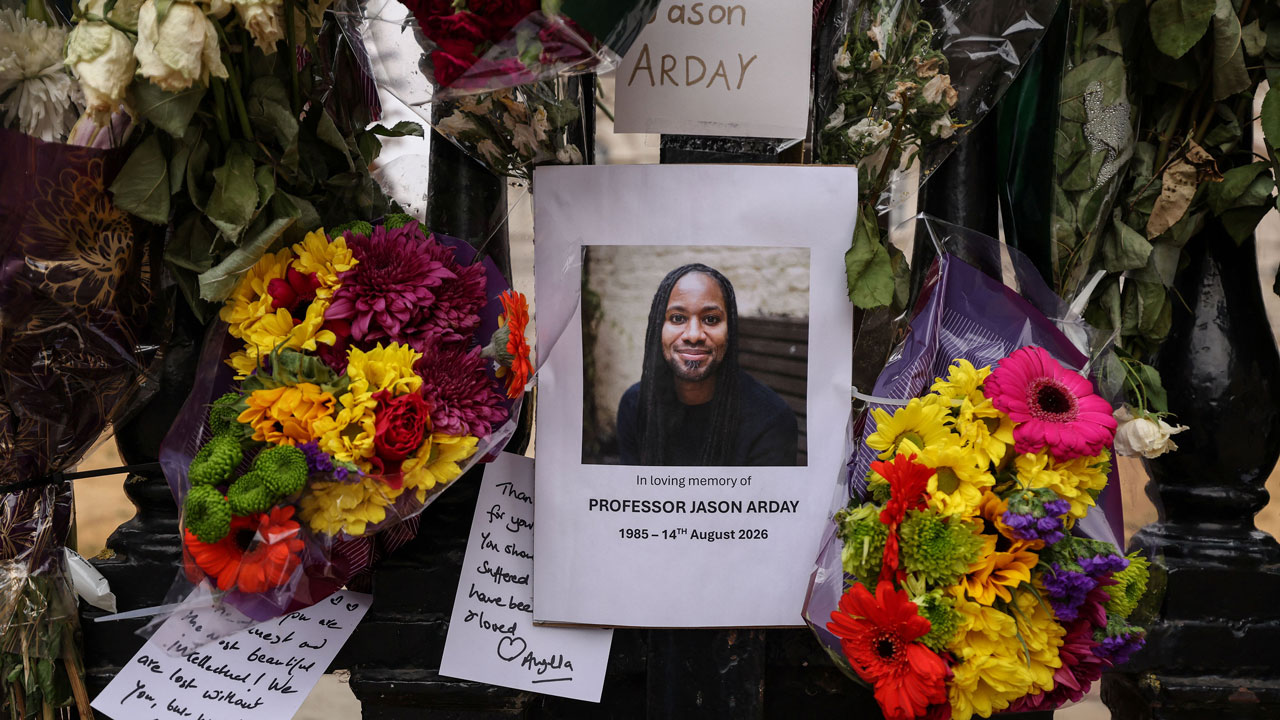
What or who killed Jason Arday? That’s the question that’s being asked in the English-speaking intellectual, academic, university world.
Jason Arday was a 41-year-old British subject of African descent who obtained a very rare, prestigious professorship, donship at Cambridge University in the U.K., which, along with Oxford, are the two most prestigious colleges and universities in Britain, if not the English-speaking world.
So he obviously drew a lot of attention. He magnified that attention by writing a memoir that just came out. In it, it was full of things that were not just made up or missed but could not be physically possible. And they were completely contradictory to what he said he was going to write when he wrote a 45-page prospectus to the publisher Simon & Schuster.
For example, he said he had brain cancer. The book says he had testicular cancer. He said he ran 600 miles, 100 miles a day in six days. He ran 30 marathons, 26 miles each, in a little over 30 days. He said he was a top pool player or billiards player.
And then, when they started looking at his scholarly account that gained him this professorship, there was hardly any scholarship there, and his dissertation had more than 100 passages that were lifted, borrowed, or stolen from other writers and scholars.
Then the question arose: What do you do with him when this memoir is going to be published, and everybody knows it is full of invention and lies, and not just lies, but things that cannot be true?
And then, of course, there was controversy. Why was he given this position when he was utterly unqualified? Even if he had not lied and made things up about his life and said he couldn’t speak until he was 11, and said that he did all of these fantastic races and ran with a swollen leg and things that were just crazy, he still should not have been hired.
He just committed suicide. This is why we’re talking about him today, given the negative publicity and controversy that he incurred.
And people are very angry in Britain on the Left, and they’re accusing the Right, or conservatives, for objecting to this appointment and chastising Cambridge for being fooled by this con artist.
And the subtext is they would have never hired him had they not been committed to diversity, equity, and inclusion protocols that privilege one’s race over merit in many cases.
Let me just read to you what Cambridge University said about Jason Arday, even though there were rumors and investigations at the time suggesting that he was an abject plagiarist.
Here’s what high university officials released to the press:
“Jason Arday is an exceptional scholar of race, inequality, and education. He will contribute significantly to Cambridge’s research in this area and to addressing the underrepresentation of people from socioeconomically disadvantaged backgrounds, especially those from Black, Asian, and other minority ethnic communities.”
And a final parting praise:
“We are so lucky to have you. You are the best in the world in terms of the research you do.”
That’s demonstrably false. Cambridge knew it was false, and yet they had so invested in Jason Arday because they were virtue signaling to the world that they were morally superior to most people because, in their great magnanimity, they had allowed a Black scholar to enter this cloister of the world’s top scholars.
And after he killed himself, given that news accounts had exposed him as a plagiarist and a faker and a fabulist, the Left turned around and said, “You didn’t do that to other people who had committed these transgressions.”
Well, of course they did. Stephen Glass, the New Republic plagiarist and fabulist, had his entire career destroyed, and he was the object of ridicule and a movie about it.
Stephen Ambrose was probably the most popular and beloved World War II and presidential historian of the last 30 years when he was exposed as a plagiarist who stole a lot of passages from another scholar of the U.S. bombing campaign in World War II, and he was utterly discredited and reviled for doing that.
So why did Jason Arday kill himself?
Because he was embarrassed, and he was exposed for something he did. Who were the people actually responsible for his death? No one is responsible for his death except Jason Arday.
There’s a lot of plagiarists in the world. There’s a lot of fabulists in the world. There’s a lot of con artists in the world who are exposed, and they don’t kill themselves.
He chose to make that decision when his world, which he had fabricated, came crashing down upon him and also, in collateral damage, exposed the absurdity of diversity, equity, inclusion, racialism, tribalism, and anti-meritocratic hiring and admissions.
But we can point, if we’re going to play this game, to two culprits.
Simon & Schuster published his memoir, “Great and Unfortunate Things,” right before his suicide, and they gave him a $1.4 million advance.
Now, I can tell you, as someone who’s written 20 books for New York publishers like Alfred Knopf, Simon & Schuster, Doubleday, Bloomsbury, and Basic Books, that these days no one really gets a $1.4 million advance unless you’re a celebrity or a politician. Usually, you get about $3 a book.
So if these books will sell between, like Jason Arday’s, 5,000 and 10,000 copies, he might have earned on the actual sales $15,000 to $25,000. That advance of $1.4 million will never be realized.
But they gave it as part of this gift to this DEI candidate, and they wanted to show the world that, just like Cambridge University, Simon & Schuster wanted to encourage inclusivity of Black academics.
But then they did something else. They were told by reporters and journalists and the media that Jason Arday was a fraud. They knew that earlier on in their own investigation because he wrote, as I said, a 45-page prospectus of what he was going to write so he would get the advance that was entirely at odds with what he submitted as a manuscript.
But whether it was the prospectus or the actual book, it didn’t matter if they didn’t jibe because they didn’t jibe either one of them with reality.
And so this was all known. Why did they publish it when they knew it was a fraud? Why did they publish it?
Because they had spent $1.4 million, and they were going to market it, no doubt, as a controversial book.
You’ve all heard about Jason Arday and all of his lies and fables. Come to the book and look at it.
And so, rather than being an adulatory memoir, which they originally thought it might be, it was sort of a carnival-barker type of book, and they thought somehow the publicity that Jason got from all of his fables would help sales and they could get back their $1.4 million.
But what might have happened is that when he knew that that book was coming out and his problems would increase as people picked up that book and could read with their own eyes, their own minds, they could see that what he said was physically impossible, they would have only more contempt for him.
And that might have hastened the decision that he made to end his life.
There’s another culprit, and that is Cambridge University.
They knew that he was not the top scholar in his field. They knew that he had problems telling the truth. They knew that under the rigid requirements of Cambridge University, he would never have qualified had he not been a DEI, and yet they lied about that.
They said that he was one of the top scholars in the world, and they put him in a position of which he did not deserve, and he was unable, by any stretch of the imagination, to fulfill the obligations of scholarly rigor required of a position at Cambridge of that caliber.
And so obviously he knew that once he got that position and once he was exposed, he would either be fired by the same people who had brought him there and elevated and inflated his worth, would now turn on him and say, “You know what? We are embarrassed by what you did to us,” and fire him.
Or, if they didn’t fire him, there was no way in the world, given his abilities and his problems with the truth, that he could be a genuine Cambridge scholar.
The bottom line: It was not conservatives, it was not journalists, and it was not the media who destroyed Jason Arday.
Jason Arday committed suicide of his own volition.
The accessories to that were Simon & Schuster, who chose to go ahead and publish a memoir they knew was fraudulent, and which Jason Arday, within days after the publication, killed himself, and Cambridge University, which deliberately lied and inflated an applicant for a professorship by claiming that he had talents that he, and they, knew he did not.
We publish a variety of perspectives. Nothing written here is to be construed as representing the views of the Daily Signal.
More from this network:
Domains for Sale · GOTPeople.org · TheDSAPlatform · The Truth About Socialism
What's Your Reaction?
 Like
0
Like
0
 Dislike
0
Dislike
0
 Love
0
Love
0
 Funny
0
Funny
0
 Wow
0
Wow
0
 Sad
0
Sad
0
 Angry
0
Angry
0

I am just an average American. My teen years were in the late 70s and I participated in all that that decade offered. Started working young, too young. Then I joined the Army before I graduated High School. I spent 25 years in, mostly in Infantry units. Since then I've worked in information technology positions all at small family owned companies. At this rate I'll never be a tech millionaire. When I was young I rode horses as much as I could. I do believe I should have been a cowboy. I'm getting in the saddle again by taking riding lessons and see where it goes.
Premium domains for sale




















Comments (0)