

What 'Davey and Goliath' can tell us about the decline of American Protestantism
Premium domains for sale
Freedom Is Back In Style
If you were a kid in the 1960s or '70s, chances are you watched "Davey and Goliath" without ever seeking it out. It was just there. On Sunday mornings, when television offered slim pickings for a kid, you might stumble across a slightly stiff clay boy named Davey Hansen and his morose talking dog, Goliath.
Freedom Is Back
In Style
Premium domains for sale
“But, Daaavey ...” the dog would protest in his deep, reproachful voice whenever his owner was about to do something foolish.
An entire children's television plot about two boys looking forward to Holy Communion. Try pitching that one today.
Unless you paid attention to the opening credits — the Luther rose, the Lutheran Church credit, and the theme music, Martin Luther's “A Mighty Fortress Is Our God” — you might not even have realized you were watching religious programming. Yes, Davey moved at a less frenetic pace than most children's fare, had no toys or breakfast cereal to sell, and usually learned a lesson before the credits rolled. Otherwise, it was just another kids' show.
Looking back, that's the remarkable part. A church-funded children's show could simply turn up on commercial television alongside everything else, with no explanation required.
'Gumby' gospel
In 1958, Franklin Clark Fry, president of the United Lutheran Church in America, committed an astonishing $1 million of church money to creating a television program for children. The church's original idea was to put a minister in front of a camera to deliver short sermonettes.
Fortunately, Dick Sutcliffe thought this sounded like terrible television.
Sutcliffe, a former newspaperman working in the church's broadcasting operation, didn't object to the content. As his daughter later recalled his verdict: “The theology is fine, but it's not good for television.”
Instead, he thought about his own young son. “What would I say to Mike about God?” he asked himself. “And how would I say it to him?”
Sutcliffe conceived a series of modern parables and hired Art and Ruth Clokey, the husband-and-wife team behind "Gumby," to make them. Ruth was herself the daughter of a Lutheran minister. Sutcliffe wrote the first script, and the Clokeys produced the 15-minute pilot, “Lost in a Cave,” in 1960.
"Davey and Goliath" premiered in syndication the following February and soon reached nearly 200 television markets — thanks to a distribution strategy hard for television stations to resist: The Lutherans gave it away.
Commercial stations got polished children's programming; the church got access to American living rooms. By 1973, an audience study estimated that "Davey and Goliath" was reaching 5.1 million people a week.
Imagine a mainline Protestant denomination attempting something that ambitious today.
God willing
"Davey and Goliath" was no "VeggieTales." Still, Davey's family went to church, and God came up a lot.
And the Christianity amounted to considerably more than “be nice.”
In the very first episode, “Lost in a Cave,” Davey hears his father say “God willing” and wants to know what he means. His father tells him that God cares about what happens to every one of us because he loves us.
Then Davey gets lost in a cave.
A guide searches for the injured boy and eventually rescues him. Back in the sunlight, Davey grasps the point of the whole adventure: The guide came looking for him when he was lost; God seeks and cares for us when we are lost too.
Other episodes went considerably farther. In “The Family of God,” Davey and his friend Jonathan are downright excited about receiving their first Communion. Another boy, Cisco, is decidedly less impressed: “Communion? Who cares?”
Davey and Jonathan spend much of the episode trying to convince him otherwise. Pastor Miller, meanwhile, visits the Hansen home to make sure Davey understands what he is about to receive, explaining the bread and wine in relation to Jesus' death on the cross and the unity of Christians as the family of Christ.
An entire children's television plot about two boys looking forward to Holy Communion.
Try pitching that one today.
More than the 'Davey face'
For all this God talk, "Davey and Goliath" was very much a product of mainline Protestantism, which by the early 1960s increasingly understood fighting racial prejudice as part of its Christian mission. The show addressed race and integration remarkably early.
Jonathan was black, and Cisco was Hispanic. Jonathan in particular was among television's early examples of a black child depicted simply as the close friend of a white child. “The Polka-Dot Tie,” from 1961, tackled racial prejudice, and later episodes made an increasingly integrated cast part of Davey's ordinary world.
Sutcliffe's daughter later offered a wonderfully concise explanation of her father's thinking: “Dad would say if we're going to talk about God loving all of us, we ought to get to see more than the Davey face.”
The social message still had an explicitly theological source. God loved everybody, so Davey's little clay world ought to have everybody in it.
RELATED: When Archie Comics found Jesus: Strange artifacts from a once-Christian culture
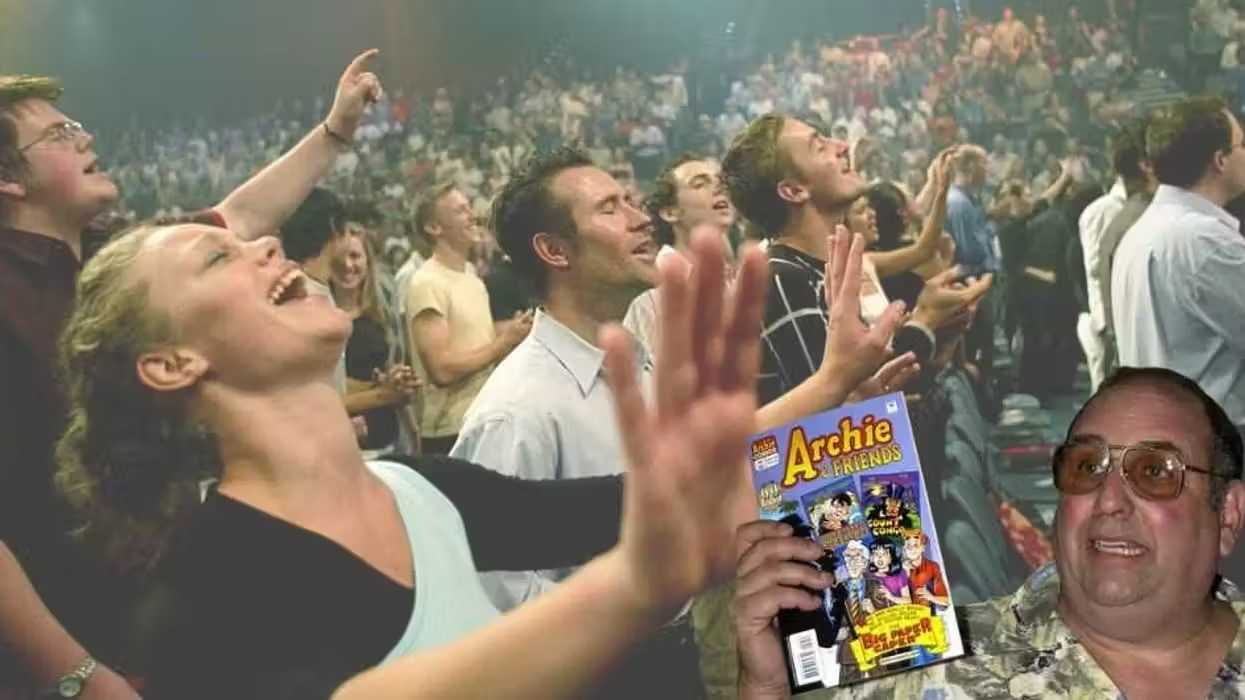 Albert L. Ortega/Sidney Morning Herald/Getty Images
Staying power
"Davey and Goliath" had surprising staying power. After the initial run of 39 episodes and four specials, the Lutheran Church in America funded another 27 episodes and two specials in the 1970s. The last original special aired in 1975, although reruns remained a Sunday-morning fixture into the early '80s.
Then even that began to change. According to the Associated Press, commercial stations discovered they could make money selling airtime around other religious programming — much of it produced by conservative Christians — rather than carrying the Lutherans' free little claymation show. "Davey and Goliath" gradually disappeared from mainstream television.
The United Lutheran Church had meanwhile become part of the Lutheran Church in America in 1962. Another round of mergers in 1988 produced the Evangelical Lutheran Church in America.
Along with churches, pension obligations, and hymnals, the ELCA inherited an unusual piece of intellectual property: "Davey and Goliath."
And eventually it decided Davey was worth dusting off.
Snowboard synodality
The duo's first resurrection was an unlikely one. In 2001, the ELCA licensed "Davey and Goliath" for a Mountain Dew commercial that gently spoofed the characters' hopeless squareness. The joke worked precisely because viewers still recognized them. Better yet for the ELCA, the royalties helped finance a proper comeback.
In 2004, after nearly three decades without a new adventure, Davey and his dog returned in the hour-long "Davey and Goliath's Snowboard Christmas."
Davey now has two new friends: Sam, who is Jewish, and Yasmeen, who is Muslim. The three go snowboarding while comparing Christmas, Hanukkah, and Ramadan and learning to respect one another's religious traditions. ELCA staff worked with Jewish and Muslim scholars on the script.
ECLA communications director Eric Shafer described the resulting program to the Associated Press as “very much an interfaith show about the oneness of the three faces of Abraham.”
In 1961, Davey's lessons about how to treat other people proceeded from a specifically Christian account of reality: God, Scripture, church, Christ on the cross, Holy Communion. By 2004, interfaith understanding and inclusion had moved much closer to the center of what Davey's church wanted him to tell the wider world.
It might be asking a lot of a little clay boy and his talking dog, but "Davey and Goliath" remained in Lutheran hands long enough to become a potent symbol of American religious decline.
Somewhere between the cave and the snowboard slope, "Davey and Goliath" changed — from teaching Christian truths with a light touch to burying them beneath universalist platitudes. And in that journey, you can see American mainline Protestantism changing with it.
More from this network:
Domains for Sale · GOTPeople.org · TheDSAPlatform · The Truth About Socialism
What's Your Reaction?
 Like
0
Like
0
 Dislike
0
Dislike
0
 Love
0
Love
0
 Funny
0
Funny
0
 Wow
0
Wow
0
 Sad
0
Sad
0
 Angry
0
Angry
0

I am just an average American. My teen years were in the late 70s and I participated in all that that decade offered. Started working young, too young. Then I joined the Army before I graduated High School. I spent 25 years in, mostly in Infantry units. Since then I've worked in information technology positions all at small family owned companies. At this rate I'll never be a tech millionaire. When I was young I rode horses as much as I could. I do believe I should have been a cowboy. I'm getting in the saddle again by taking riding lessons and see where it goes.
Premium domains for sale













Comments (0)