

Why ‘No Child Has Two Moms or Two Dads’ Billboards Went Viral
Premium domains for sale
Freedom Is Back In Style
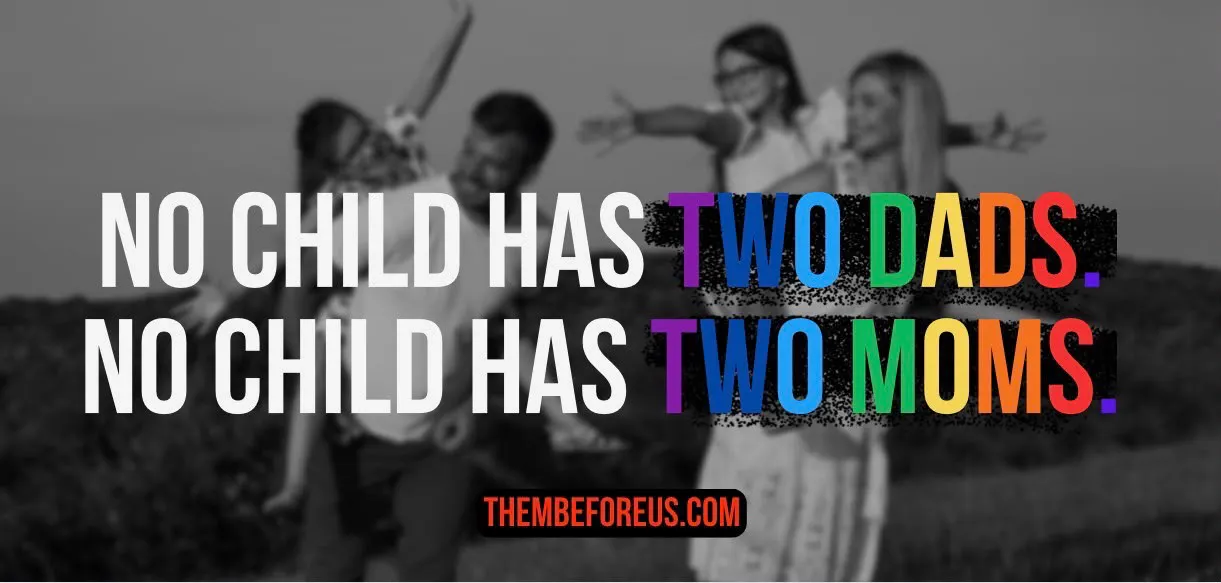
When Them Before Us placed billboards across the Midwest declaring, “No child has two dads. No child has two moms,” we knew this obvious biological fact would ruffle a few feathers. What we didn’t know was that the message would go viral.
Freedom Is Back
In Style
Premium domains for sale
We’ve been accused of being religious zealots, and we very well may be. But the billboard did not make a religious statement. The recognition that children come from one mother and one father is not a truth owned by Christianity. It’s not exclusive to the Left or the Right. It is a human universal — something on which every culture and every faith agreed until, historically speaking, about five minutes ago.
That unrefutable reality has become controversial because our culture increasingly sees mothers and fathers as optional. It believes marriage, and increasingly parenthood, exists to fulfill adult desires.
Leading up to Obergefell v. Hodges, Americans were assured that gay marriage pertained only to the privacy of an adult bedroom. It wasn’t about children. It wasn’t about changing family overall. It wasn’t about remaking society.
Eleven years later, we know that wasn’t true.
Redefining marriage has inevitably meant redefining parenthood. Mothers and fathers have been scrubbed from parentage laws. Birth certificates have been rewritten so unrelated adults can replace a child’s biological parent at birth. States and insurance companies increasingly subsidize the intentional creation of motherless or fatherless children through assisted reproduction and surrogacy. Entire industries now profit from separating children from one of the two people to whom they are naturally connected.
This was never just about marriage. It was always about whether children have a right to their mother and father — or whether adults should be able to create a family that aligns with their romantic desires or sexual identities.
Our critics insist the billboard is hateful. They call it anti-LGBTQ rhetoric. In one sense, that’s simply the latest version of a strategy we’ve watched for more than a decade: don’t engage the argument — attack the people making it.
But in another sense, they’re right about one thing.
Our message does conflict with the central claim of modern gender and sexual ideology — that biology can be rejected and that mothers and fathers are interchangeable. You cannot simultaneously believe children have a right to be known and loved by the man and woman who created them while also believing adults have a right to intentionally deprive children of one or both.
“But what about adoption? Don’t those children have two moms?”
Ironically, that objection proves our point.
Adoption exists because something has already gone wrong. A child has a relationship with one or both biological parents through death, abuse, neglect, addiction, abandonment, or relinquishment. Adoption does not celebrate that loss. It responds to it.
Adoptive parents are not creating a child without a mother or father. They are stepping into a tragedy they did not cause, sacrificing to give a vulnerable child the love, stability, and permanence every child deserves. Adoption is an act of restoration. Current adoption practice encourages the knowledge and involvement of the first family whenever possible, exactly because the child’s origins matter to them.
The same is true for grandparents raising grandchildren, widows raising children alone, or single parents doing their best after divorce or abandonment. These adults are responding to loss, not intentionally creating it.
Children raised by two mothers or two fathers experience that same loss. The difference is that we often refuse to acknowledge it. Instead, they are often told they haven’t lost anything at all. That they’re “so lucky” to have two moms or two dads.
And when they long for the parent they lost — the parent they wonder about, imagine meeting someday, or fear they unknowingly passed on the street — they may be told that longing is evidence of internalized prejudice rather than a reflection of what every child throughout history has wanted: to know and be loved by both parents who brought them into the world.
For 15 years, social intimidation has kept many people silent. Anyone who questioned the aggressive remaking of marriage and family was branded a bigot or a homophobe. Americans — even many Christians — often decided it was easier to stay quiet than risk being ostracized.
While we stayed quiet, the children paid the price.
They were commodified through reproductive technologies. They were intentionally deprived of either a mother or a father. They were stripped of legal protections that recognized their relationship to both biological parents. Adult desires increasingly became the organizing principle of family law.
At Them Before Us, we’ve documented the stories of donor-conceived adults, adoptees, and children raised by same-sex couples. Again and again, they describe the same father hunger or mother hunger. They speak of identity struggles after being intentionally severed from one or both biological parents. Many say they felt guilty for wanting what every child naturally wants because they had been told they were supposed to feel grateful instead.
Telling the truth about children comes at a cost. But the alternative is asking children to bear the cost of our silence.
It is not cruel to state biological reality.
What’s cruel is telling children they do not have a mother, that they do not have a father, or that losing one of the two people to whom they have a natural claim is simply the price that must be paid for a new adult civil right.
Our billboard resonated because millions of Americans are tired of pretending obvious truths are controversial.
No child has two moms. No child has two dads.
Every child comes from one mother and one father. The question is whether our laws, and our courage, will reflect that reality.
***
Katy Faust is the founder and president of Them Before Us and spokeswoman for the Greater Than campaign. Follow her on X @Katy_Faust.
More from this network:
Domains for Sale · GOTPeople.org · TheDSAPlatform · The Truth About Socialism
What's Your Reaction?
 Like
0
Like
0
 Dislike
0
Dislike
0
 Love
0
Love
0
 Funny
0
Funny
0
 Wow
0
Wow
0
 Sad
0
Sad
0
 Angry
0
Angry
0

I am just an average American. My teen years were in the late 70s and I participated in all that that decade offered. Started working young, too young. Then I joined the Army before I graduated High School. I spent 25 years in, mostly in Infantry units. Since then I've worked in information technology positions all at small family owned companies. At this rate I'll never be a tech millionaire. When I was young I rode horses as much as I could. I do believe I should have been a cowboy. I'm getting in the saddle again by taking riding lessons and see where it goes.
Premium domains for sale













Comments (0)