

WPATH FILES: Trans Surgeon Admits Patients May Experience Painful Complications
Premium domains for sale
Freedom Is Back In Style
The World Professional Association of Transgender Health (WPATH) is the world’s preeminent transgender medical organization and a leading force in the push for minors to receive transgender medical interventions, including sex-change surgeries. The group’s medical guidance, called the Standards of Care Version 8, informs clinical practice, insurance policy, and government regulations throughout the United States.
Freedom Is Back
In Style
Premium domains for sale
Systematic reviews and legal investigation have shown the SOC-8 to be built on faulty methodology and politicized science. The Federal Trade Commission filed a lawsuit against WPATH in June 2026, stating the organization has “misled parents and children about the medical consensus and medical necessity, as well as the safety and effectiveness” of child sex-change interventions.
WPATH members receive access to a member-only forum that discusses various topics related to transgender medicine and policy. Through a public records request The Daily Wire uncovered almost 250 pages of messages from WPATH’s member-only forum written between June 2024 and November 2024. The messages offer a glimpse into the organization’s cultural reach and challenge some of its public-facing recommendations.
This is the first article in The Daily Wire’s investigative series on the uncovered WPATH messages.
***
A pioneering transgender surgeon acknowledged that genital surgeries leave patients with painful complications and a burdensome recovery process many cannot cope with.
Members of the World Professional Association of Transgender Health (WPATH) discussed the pain and complications of vaginoplasty, a genital sex-change surgery, in an online member forum in the summer of 2024. Marci Bowers, a transgender surgeon and Immediate Past-President of WPATH, wrote in a message that some patients don’t want to “maintain their vagina” due to “pain and discharge” after surgery.
“Just because someone does not wish to maintain their vagina because of pain and discharge, jumping to regret should not be our first response,” wrote Bowers.
Vaginoplasty is a procedure that involves removing a penis, scrotum, and testicles, and using the genital tissue to surgically construct a vagina. If the patient doesn’t have enough genital tissue to complete the procedure, surgeons may borrow tissue from the colon. WPATH calls the final product a “neovagina,” which is a large wound that requires lifelong dilatation to prevent vaginal stenosis, a condition where scar tissue in the vagina hardens and narrows.
“Vaginal Stenosis after vaginoplasty with symptoms and no desire to keep canal” was the subject of a WPATH forum message thread obtained by The Daily Wire through a public record request.
“I have been seeing quite a few patients recently who after vaginoplasty stop dilating and do not desire to keep the canal,” wrote a nurse practitioner to start the thread. “They have come to see me with symptoms of pelvic pain, accompanied by bleeding and discharge for a few weeks before symptoms resolve.”
A physical therapist replied to the message that pain and bleeding after vaginoplasty surgery are “very common.”
“Regarding the issue of pain, it is very common in many cases, especially during the first three months, due to the surgery itself and the muscle tension it generates, as well as bleeding and secretions,” wrote the WPATH member. “Bleeding can be due to the operation itself since they have internal wounds that will expel a bloody fluid or slight bleeding during dilations.”
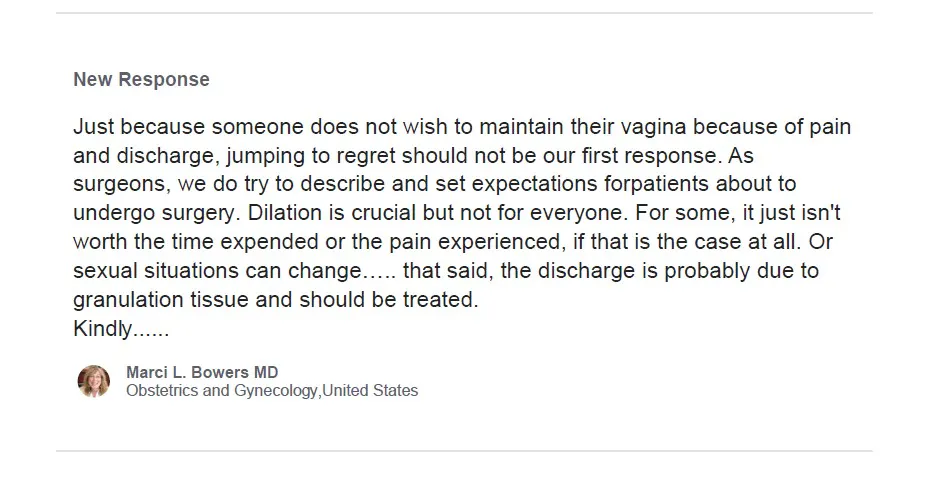
Screenshot of a WPATH member forum message obtained by The Daily Wire through a FOIA request.
Patients are typically recommended to dilate for 30 to 60 minutes at least 3-4 times a day during the initial post-operative period, a painful time commitment. Bowers suggested the pain and effort needed to keep the genital wound flexible might not be “worth the time” for some patients.
“Dilation is crucial but not for everyone,” wrote Bowers. “For some, it just isn’t worth the time expended or the pain experienced, if that is the case at all. Or sexual situations can change.”
A social worker asked if patients expressed “any desire to de-transition” when deciding to stop dilating after surgery. Bowers responded that the “first response” of members should not be to assume a patient has regretted their sex-change surgery if they no longer wish to “maintain their vagina.”
Patients who don’t follow dilation recommendations risk losing the ability to experience penetrative sex because the surgically created vaginal canal will lose flexibility without dilation. A psychologist, who described himself as a “post-op trans woman,” responded to Bowers with his personal experience of stopping dilation after genital surgery.
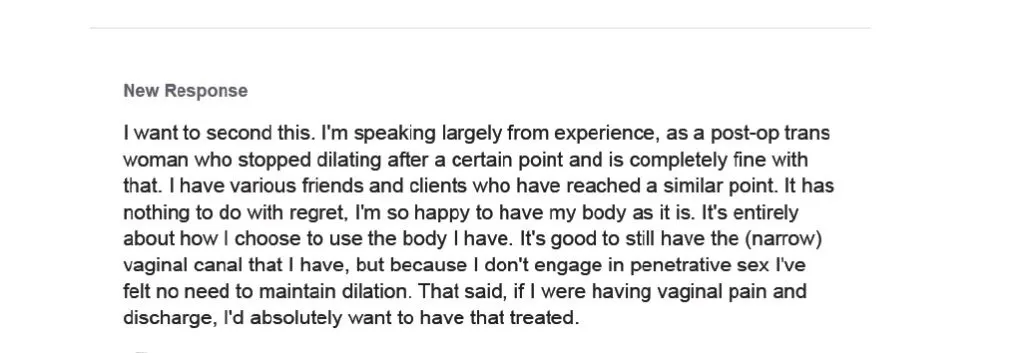
A screenshot of a message obtained through a public record request by The Daily Wire.
“I’m speaking largely from experience, as a post-op trans woman who stopped dilating after a certain point and is completely fine with that. I have various friends and clients who have reached a similar point,” wrote the psychologist. “It has nothing to do with regret, I’m so happy to have my body as it is. It’s entirely about how I choose to use the body I have. It’s still good to have the (narrow) vaginal canal that I have, but because I don’t engage in penetrative sex I’ve felt no need to maintain dilation.”
WPATH does not recommend any minimum age minor patients should meet before receiving vaginoplasty surgery in its medical guidance, Standards of Care version 8. The only time-connected guardrail WPATH provides in the guidelines is that minors should receive 12 months of cross-sex hormones before undergoing the permanent sex-change surgery, with some exceptions. The Federal Trade Commission alleged WPATH had misled the public regarding the safety and necessity of pediatric transgender medical interventions, including vaginoplasty, in a June 2026 lawsuit it filed against WPATH.
“It is inherently harmful and unsafe to surgically remove a child’s healthy and functioning genitals,” states the lawsuit. “Nevertheless, WPATH deems it ‘medically necessary’ for treating dissatisfaction with or distress about sex traits.”
Bowers’ name appears in the lawsuit 18 times, and Bowers is described as advocating for males to receive vaginoplasty surgery as minors because they have the parental support needed to endure the brutal post-operative dilation schedule.
“Some transition doctors, including Dr. Bowers, believe performing the surgery while the boy is a minor still living with his parents is preferable, rather than when the boy is living in a communal setting with limited privacy,” states the FTC lawsuit. “This is in part due to the brutality of the procedure. Recovery from vaginoplasty requires the patient to ‘dilate’ the new wound 3-4 times daily for months so that it does not heal.”

Screenshot of a WPATH member forum message obtained by The Daily Wire through a FOIA request.
The FTC lawsuit alleges Bowers made more than a million dollars in 2023 “mostly from performing transition surgeries.”
In a separate WPATH forum thread, Laura Kuper, a psychologist at Children’s Health in Dallas and co-author of WPATH’s “nonbinary” chapter in the Standards of Care, asked peers to recommend “US-based surgeons” with expertise in performing vaginoplasty on patients who had early pubertal suppression in a September 2024 message. Giving young males puberty blockers stops the growth of male genital tissue and makes it more difficult to perform a vaginoplasty surgery.
One doctor said pubertal suppression prevents “the growth of the vagina,” during a private WPATH symposium in September 2022, according to reporting from The Daily Caller.
Bowers responded that the surgeries “are not easy” and require “experience and technical skill.”
“Laura — as you may be aware, limited skin is a severe limitation for those with early puberty blocked, both cosmetically and for attaining depth,” Bowers wrote. “These cases are not easy, and I would state that a critical combination of experience and technical skill is required, meaning the list of qualified surgeons is not large. We have performed approximately 100 of these procedures thus far with approximately 15 each summer. There are also several excellent surgeons in excellent institutions which may have similar numbers.”
Kuper was a pediatric psychologist at the now-shut-down Children’s Health GENder Education and Care, Interdisciplinary Support clinic. Texas Attorney General Ken Paxton filed a February 2026 lawsuit against Children’s Health that alleges gender-affirming practitioners subverted Texas state law and continued providing minors with sex-change medical interventions after the state’s ban went into effect on September 1, 2023.
Other messages acknowledge that transgender voice surgeries, which seek to make an individual’s voice sound more like the opposite sex, are “not usually effective” and have uncertain outcomes.
“Voice is one of the hardest things to achieve primarily because surgical options are not usually effective,” wrote a WPATH member in the forum.
“If your patient chose to pursue surgery, they would need to accept the science and physics behind the intention of the procedures as well as the unknowns in terms of outcome,” wrote an ears, nose, and throat doctor.
In the SOC-8, WPATH lists “voice therapy and/or surgery” as a “medically necessary gender-affirming” medical intervention. Transgender voice surgeries are explicitly covered by some state insurance plans.
WPATH did not respond to The Daily Wire’s requests for comment. Dr. Bowers declined to provide a comment to The Daily Wire. The University of Texas Southwestern Medical Center and Children’s Health did not respond to The Daily Wire’s requests to obtain a comment from Laura Kuper.
More from this network:
Domains for Sale · GOTPeople.org · TheDSAPlatform · The Truth About Socialism
What's Your Reaction?
 Like
0
Like
0
 Dislike
0
Dislike
0
 Love
0
Love
0
 Funny
0
Funny
0
 Wow
0
Wow
0
 Sad
0
Sad
0
 Angry
0
Angry
0

I am just an average American. My teen years were in the late 70s and I participated in all that that decade offered. Started working young, too young. Then I joined the Army before I graduated High School. I spent 25 years in, mostly in Infantry units. Since then I've worked in information technology positions all at small family owned companies. At this rate I'll never be a tech millionaire. When I was young I rode horses as much as I could. I do believe I should have been a cowboy. I'm getting in the saddle again by taking riding lessons and see where it goes.
Premium domains for sale























Comments (0)