

You’re Being Watched: The Flock Camera Controversy Sweeping California
Premium domains for sale
Freedom Is Back In Style
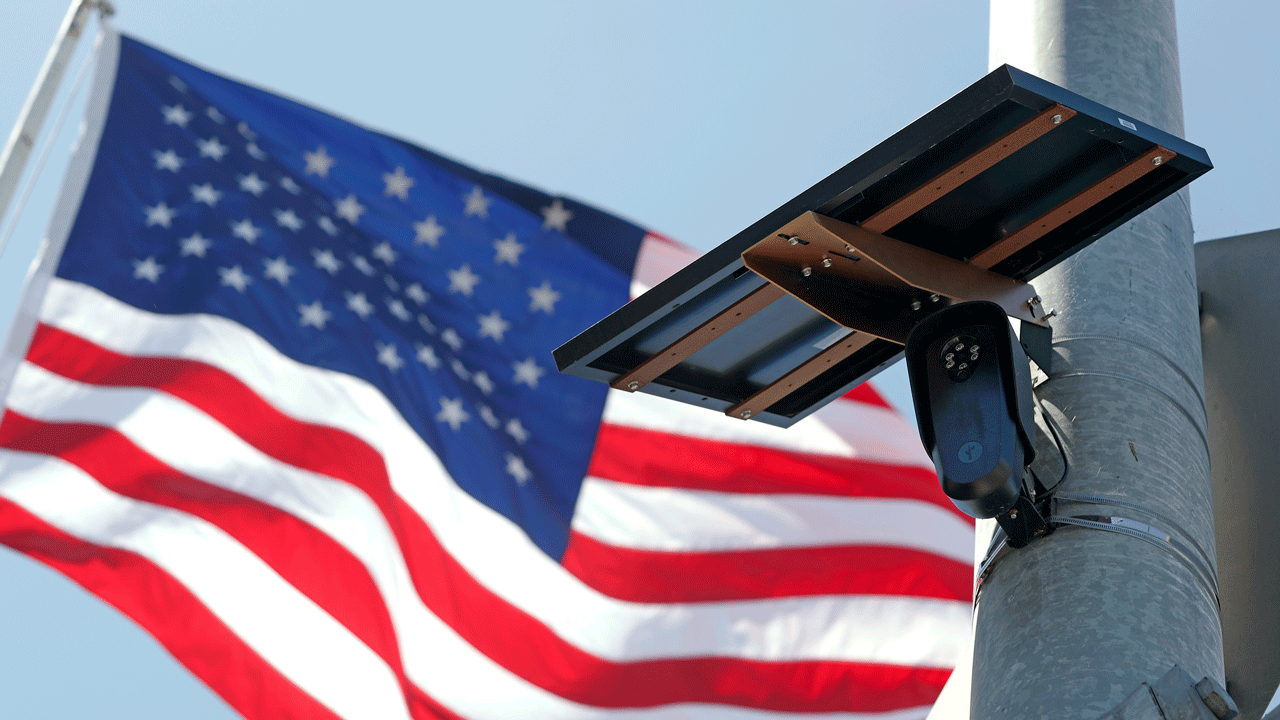
Across California, cameras are quietly capturing the license plates and features of millions of vehicles—and allowing law enforcement to search where those vehicles have been.
Freedom Is Back
In Style
Premium domains for sale
The cameras are operated by Flock Safety, a surveillance technology company whose rapidly expanding network has become the center of a growing debate over crime fighting, privacy, and mass surveillance.
Flock says its cameras help communities “deter crime, respond to emergencies, and investigate safety incidents.”
But the technology can capture more than a license plate, cataloging characteristics such as a vehicle’s color, make, model, bumper stickers, and other identifying features.
With more than 120,000 cameras now deployed across the U.S., supporters say the technology gives police a powerful tool to identify suspects and solve crimes. Critics warn that connecting thousands of cameras into a searchable network gives law enforcement unprecedented ability to track people’s movements.
In California, that debate has centered on who can access the information, how it can be used, and what happens when safeguards fail.
One of the biggest concerns has been whether data collected by local police departments could ultimately be accessed or shared with federal immigration authorities.
Concerns over data sharing prompted the Los Angeles Police Department to halt its relationship with Flock in July amid questions over how data collected by the cameras is owned, stored, secured, and shared.
Los Angeles Mayor Karen Bass went further in August, calling for the department to cut ties with Flock altogether because the company had “lost the trust of Angelenos.”
The Daily Signal spoke with Seth Hall, tech lead for the Transparent and Responsible Use of Surveillance Technology San Diego Coalition, or TRUST SD, about concerns surrounding the technology.
Hall argued that questions over government access to surveillance data extend beyond immigration enforcement or any one presidential administration.
“This power and this capability [are] not … unique to just this president or this administration or this agency,” Hall said. “This is a structural thing that’s happening. This mass surveillance data capability is being stood up for long-term use.”
In Costa Mesa, a former police officer was accused of using the city’s Flock system for personal reasons, including to track a woman with whom he had been romantically involved.
But some law enforcement officials argue the technology’s crime-fighting benefits outweigh concerns over its potential misuse.
Riverside County Sheriff Chad Bianco, who ran for California governor as a Republican, has been an outspoken supporter of Flock, arguing the technology has helped law enforcement make communities safer.
In an interview with The Center Square, Bianco called Flock a “game changer for law enforcement,” pointing to a nearly 25% decline in vehicle thefts statewide in 2025, owed in part to the cameras.
But even when the technology accurately captures information, how that information is interpreted can have serious consequences.
In November 2025, a San Diego man was arrested and spent nearly a month behind bars after police used an image captured by a Flock camera to connect the vehicle he was riding in to an attempted carjacking.
According to reporting from the Times of San Diego, the Flock camera photographed the vehicle about five miles away, just 23 seconds after officers attempted to stop the suspected carjacker’s vehicle. Despite the timing and distance, an officer identified the car in the Flock image as the same one police had been pursuing.
The charges against the man were later dropped.
Flock has also responded to privacy concerns by recommending that agencies reduce their data retention period from 30 days to seven days, after saying its analysis found that officers conduct more than 90% of searches without a complete license plate number within a week.
Hall pointed out, however, that the recommendation does not require individual agencies to adopt the seven-day limit. Local agencies ultimately determine how long their data is retained.
Hall said his concerns extend beyond the Flock cameras already being debated across California, warning that newer surveillance systems are moving forward while communities are still grappling with technology already in use.
“While we’re talking about Flock today, do you even know what’s around the corner and planned for the community you live in?” Hall said.
He pointed to San Diego, where police recently proposed a drone-as-first-responder program, as one example.
“Flock is actually kind of yesterday’s thing,” Hall said. “Almost every community that’s facing this problem is staring down the barrel of the next five systems that are coming.”
More from this network:
Domains for Sale · GOTPeople.org · TheDSAPlatform · The Truth About Socialism
What's Your Reaction?
 Like
0
Like
0
 Dislike
0
Dislike
0
 Love
0
Love
0
 Funny
0
Funny
0
 Wow
0
Wow
0
 Sad
0
Sad
0
 Angry
0
Angry
0

I am just an average American. My teen years were in the late 70s and I participated in all that that decade offered. Started working young, too young. Then I joined the Army before I graduated High School. I spent 25 years in, mostly in Infantry units. Since then I've worked in information technology positions all at small family owned companies. At this rate I'll never be a tech millionaire. When I was young I rode horses as much as I could. I do believe I should have been a cowboy. I'm getting in the saddle again by taking riding lessons and see where it goes.
Premium domains for sale


















Comments (0)