

An Encyclical For The Ages: AI, Universities, And Builders Of Humanity
Premium domains for sale
Freedom Is Back In Style
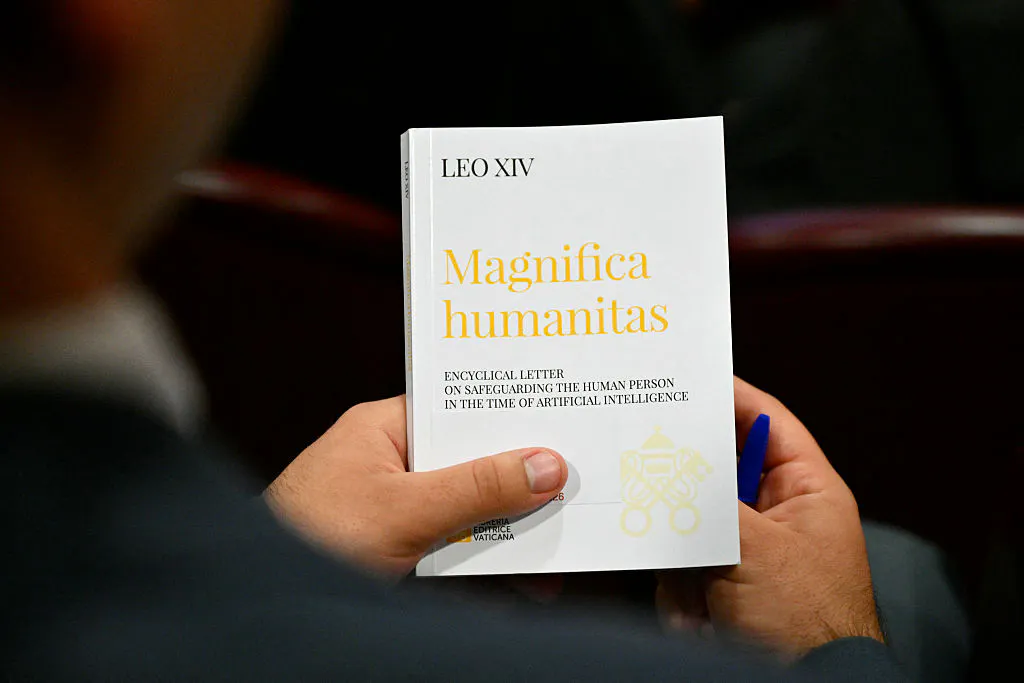
I often ask my physics students, “If you can learn this from AI, why are you here in my classroom?” Every time, they arrive at the same conclusion: They come to learn from a human. They come for the part of a college education that turns information into formation and expertise into opportunities to grow in virtue and thus grow as professionals. The classroom might be one of the few arenas we will have left to train the builders of the AI era, not with replaceable skills, but with the skills of wisdom and discernment. I am a scientist and an expert on AI with a mission at the intersection of Catholicism, science, and technology. Last year, that mission took me into the college classroom, where the battle to disarm AI, as Pope Leo XIV calls for in Magnifica Humanitas, is currently being waged.
Freedom Is Back
In Style
Premium domains for sale
“Schools are not called to follow the pace of the digital world, but to offer that which the digital sphere by itself cannot provide, namely a shared time for learning and developing trustworthy relationships” (Magnifica Humanitas 147).
Lately, the word university makes many of us cringe. The deterioration of higher education in America and the declining enrollment are undeniable. Universities no longer pursue true formation as they used to. At Franciscan University of Steubenville, I was blessed to find one of the few institutions that remain untouched by the woke ideology that has a hold on academia and whose enrollment continues to thrive. Most importantly, I found a true commitment to student formation grounded in the faith.
This encyclical comes at a time of profound change in our world that is as much promising as it is destabilizing. For those of us who still hope for a return to the true spirit of the university, this new encyclical is a breath of fresh air and a unifying call to strengthen our stands in the education arena, where a true formation grounded in values and the liberal arts, especially in technical careers, is more important than ever.
“If technological development advances without a corresponding ethical and social progress, the result may be an increase in means without a growth in humanity: having more without being more” (Magnifica Humanitas 94).
In this technocratic world, we have forgotten that the flourishing of the human person and not merely our economic development is the true measure of whether a technology is of real benefit. This is layered throughout the document, and so is the fact that the pursuit of this flourishing is impossible to accomplish without a strong understanding of what makes us human and of what, or rather Who, endows us with value.
The document acknowledges that the nature of education is changing and speaks to the importance of meeting this challenge rather than thoughtlessly embracing it or continuing to teach as if it isn’t happening. Most importantly, it speaks of our mission and of what education truly delivers: professionals who can discern not only if we are building, but why and for what vision of the world.
“The primary choice is not between a yes or no to technology, but rather between constructing Babel or rebuilding Jerusalem; between a power that claims to dominate the heavens and a people who work together in the presence of God to rebuild the walls of fraternal coexistence” (Magnifica Humanitas 9).
It was not their great success that doomed the builders of the Tower of Babel to be scattered by God in punishment. It was the pride and self-sufficiency upon which they built. “Let us make a name for ourselves,” they said in Genesis 11:4, much like today’s society pushing for advancement and productivity toward a goal, often motivated purely by self-interest and economic gain. Magnifica Humanitas invites us to build with the knowledge that something good can come out of this AI revolution if only we preserve the magnificent value of the human person.
A lot of people right now are tempted to move away from technical careers, thinking their jobs will soon be replaced by AI. Indeed, we are seeing a reduction of entry-level jobs even in technical industries. The world doesn’t need conveyor-belt coders right now. What it needs are experts with depth: in philosophy, in an understanding of the human person, and in the capacity for discernment. We are called to build, and we need to educate builders who are grounded in a relationship with Christ and in an understanding of what must be preserved in this new era.
“In the era of artificial intelligence… ours is the pressing duty to remain profoundly human” (Magnifica Humanitas 15).
With the question of job loss and automation looming across industries, we could ask why Pope Leo chose to highlight the importance of what builders must do. For those of us in education and for the young professionals we are forming, this call is a welcome invitation to direct our focus to the current moment. Technical skills alone will not save you from the job market debacle. Technical skills grounded in a theological and philosophical understanding of the human person, however, may just enable you to be one of the builders the world needs right now. I believe this moment is also a calling for all universities, but especially for Catholic universities: To keep alive and, in many cases, to return to the model of education that enhances the human element based on true and deep encounter with those we serve.
Disarming AI means freeing it from the mentality of armed competition, which today is not limited simply to the military context, but is also an economic and cognitive phenomenon – (Magnifica Humanitas 110).
Education is not just information transfer. AI will soon be able to do that better than we can anyway. Universities can still — must — be the training fields and the armories for the challenges of this age. As we follow the Holy Father’s call to disarm AI, it is also a time to arm ourselves and those who will build the AI era with the armor of God and to hold firm the ground of who we are and why we are building in the first place.
***
Dr. Fernanda Psihas is a professor of physics and computer science at Franciscan University of Steubenville and a Catholic speaker on the intersection between faith, science, and technology. She conducts research in experimental particle physics and AI.
More from this network:
Domains for Sale · GOTPeople.org · TheDSAPlatform · The Truth About Socialism
What's Your Reaction?
 Like
0
Like
0
 Dislike
0
Dislike
0
 Love
0
Love
0
 Funny
0
Funny
0
 Wow
0
Wow
0
 Sad
0
Sad
0
 Angry
0
Angry
0

I am just an average American. My teen years were in the late 70s and I participated in all that that decade offered. Started working young, too young. Then I joined the Army before I graduated High School. I spent 25 years in, mostly in Infantry units. Since then I've worked in information technology positions all at small family owned companies. At this rate I'll never be a tech millionaire. When I was young I rode horses as much as I could. I do believe I should have been a cowboy. I'm getting in the saddle again by taking riding lessons and see where it goes.
Premium domains for sale


















Comments (0)