

Commemorating the 250th Anniversary of the First American Amphibious Raid: The Raid of Nassau
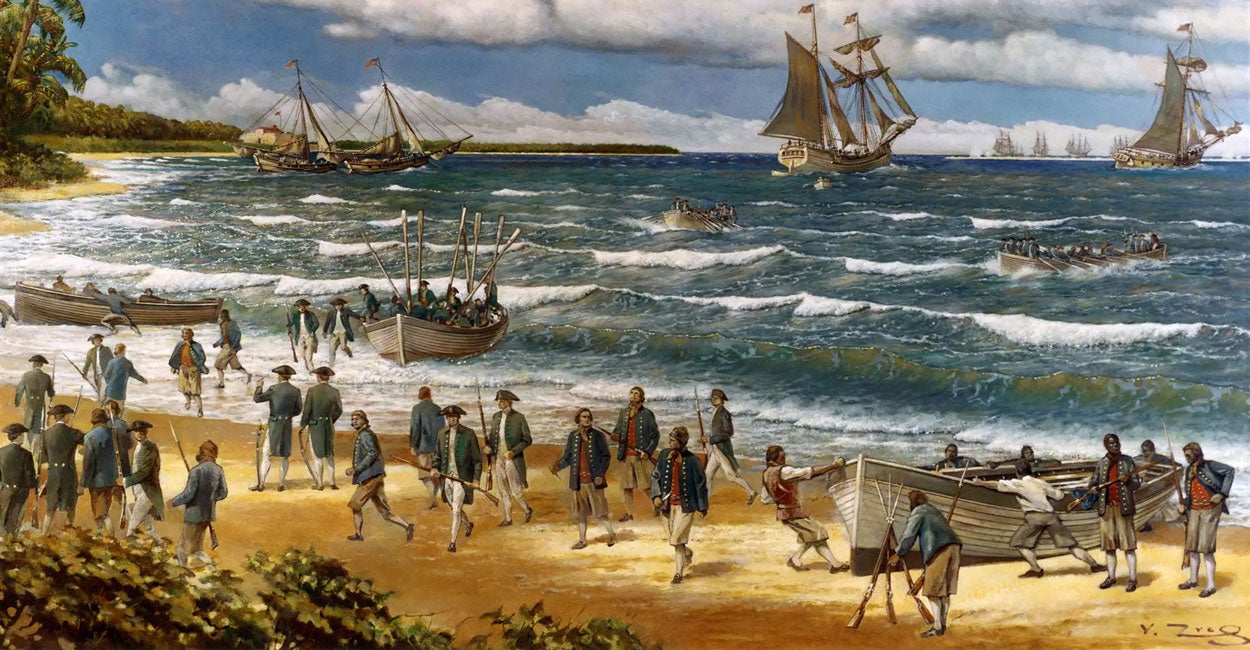
The arrest of Nicolas Maduro this year is far from the first time the United States has felt compelled by national security reasons to deploy troops to the Caribbean.
Live Your Best Retirement
Fun • Funds • Fitness • Freedom
One of our earliest actions in the Caribbean, and the first amphibious assault conducted by the U.S. Navy and Marine Corps, occurred in Nassau, the largest city and now capital of the Bahamas, 250 years ago on March 3 and 4, 1776.
Preparations for the amphibious landing began in Philadelphia, where Commodore Esek Hopkins, the first commander in chief of the Continental Navy, set about recruiting Marines at the city’s Tun Tavern.
Hopkins had been tasked by the Continental Congress with combating the British Royal Navy presence in the Chesapeake Bay with his force that would grow to six ships and around 200 Marines.
Hopkins, observing an increased British fleet presence in the Chesapeake and the acute need of the fledgling American forces for military supplies, decided to sail first for the Bahamas, seeking to acquire the valuable arms, munitions, and other military supplies stored in the British bases on the islands.
Along with Hopkins was Lt. John Paul Jones, who would later distinguish himself in the War of Independence as one of the U.S. Navy’s greatest commanders.
Sailing south from the Delaware Inlet on February 17 and arriving off the coast of New Providence Island on March 2, Hopkins made the decision to attack Fort Nassau and Fort Montagu, the fortress guarding New Providence island’s primary harbor. British forces were led by General William Howe and consisted of around 110 militia.
The American force initially landed on the eastern side of the island of New Providence under the command of Marine Capt. Samuel Nicholas. Upon landing, Fort Montagu surrendered within the day, with most of its garrison choosing to return home rather than resist the American force. The Governor of New Providence withdrew most of the fort’s cannons and force to Fort Nassau.
Overnight, the British forces began evacuating Fort Nassau, taking most of their gunpowder barrels on a small fleet to St. Augustine, Florida.
The next morning, Fort Nassau and the leadership of New Providence surrendered to the American forces. The Americans occupied the town of Nassau and the rest of New Providence for two weeks, capturing the remaining gunpowder and whatever military supplies their ships could carry.
Hopkins’ mission to the Bahamas was successful and initially celebrated by Americans, but Hopkins was relieved of command following complaints from some of the captains involved in the mission.
What Esek Hopkins and Samuel Nicholas achieved, however, was historic. They captured a British overseas territory through an amphibious landing, the first of its kind in U.S. military history and a landmark early achievement of the Continental Navy and Marine Corps.
The arms and munitions they brought back, especially the 103 pieces of artillery taken from the two captured forts, were the biggest such capture of the war to date and would prove instrumental to fortifying New England against the British.
Nicholas, the first commissioned officer in the Marine Corps, was promoted to major after the battle, and he is considered by tradition to have been the first Commandant of the Marine Corps.
As we celebrate and reflect on the 250th anniversary of our independence, we should remember the efforts of our country’s Founders and the earliest American service members to secure American liberty.
The Battle of Nassau 250 years ago was but the first of the many successes of our Navy and Marine forces in amphibious operations.
The post Commemorating the 250th Anniversary of the First American Amphibious Raid: The Raid of Nassau appeared first on The Daily Signal.
What's Your Reaction?
 Like
0
Like
0
 Dislike
0
Dislike
0
 Love
0
Love
0
 Funny
0
Funny
0
 Wow
0
Wow
0
 Sad
0
Sad
0
 Angry
0
Angry
0

I am just an average American. My teen years were in the late 70s and I participated in all that that decade offered. Started working young, too young. Then I joined the Army before I graduated High School. I spent 25 years in, mostly in Infantry units. Since then I've worked in information technology positions all at small family owned companies. At this rate I'll never be a tech millionaire. When I was young I rode horses as much as I could. I do believe I should have been a cowboy. I'm getting in the saddle again by taking riding lessons and see where it goes.








Comments (0)