

Crybaby College Commencement Protests Are Getting The Boot
Premium domains for sale
Freedom Is Back In Style
This piece is part of MI x DW, a collaboration that brings Daily Wire readers exclusive commentary and research from the Manhattan Institute’s world-class team of scholars.
Freedom Is Back
In Style
Premium domains for sale
***
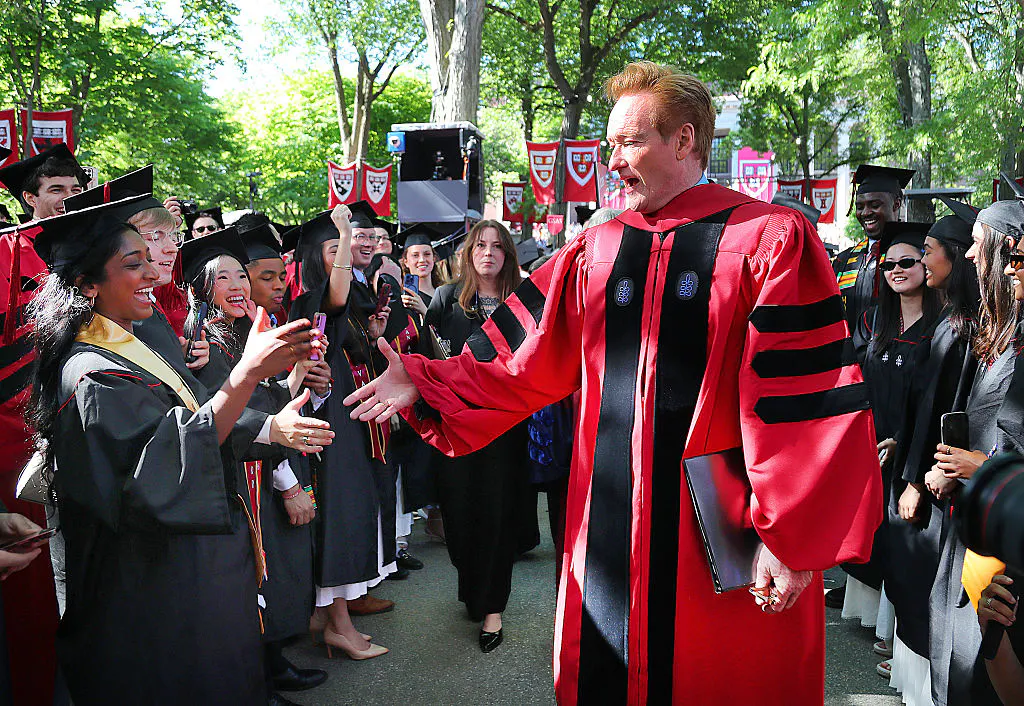
“We are living through a period of extreme narcissism,” comedian and late-night talk show host Conan O’Brien told Harvard University graduates assembled for his commencement address on May 28. O’Brien, a Harvard alumnus, used his platform to poke fun at the Trump administration. But in recent years, laughter has been less common at college commencement addresses, which have become lightning rods for militant and performative activism by students who hijack what should be joyous celebrations. Thankfully, some university administrations are finally pushing back.
Ask New York University social psychologist Jonathan Haidt, whose institution chose him as this year’s commencement speaker. Ignoring Haidt’s bestselling books, prize-winning research, and decades of dedication to his calling, angry students — including the executive committee of NYU’s student government — denounced his selection as “deeply unsettling.” As grounds for demanding his removal and replacement, detractors cited Haidt’s alleged “anti-LGBTQ” comments, long-standing advocacy against DEI, support for campus viewpoint diversity, and empirical critique of Gen Z digital device use.
They had a reasonable hope of success. The Foundation for Individual Rights and Expression (FIRE) has documented 350 attempts to cancel campus commencement speakers since 1998, many of them successful. So far this year, South Carolina State University, a historically black institution, has canceled a planned commencement address by Lt. Gov. Pamela Evette, a candidate for governor in 2026. Students expressed dismay over Evette’s vocal criticism of DEI policies and support for President Donald Trump, who has since endorsed her gubernatorial bid. Two commencement speakers — David Kaganovsky at Drexel and Morton Schapiro at Georgetown’s law school — were forced to withdraw after their support for Israel became public knowledge on campus.
Rutgers University also canceled its scheduled commencement speaker Rami Elghandour, an alumnus who is chairman and CEO of Arcellx, a biotech company, following complaints about his past online posts accusing Israel of “genocide” amid its war in Gaza. And at Utah Valley University, where Charlie Kirk was assassinated last September, author Sharon McMahon’s commencement invitation was canceled following outrage about posts (later deleted) in which she was critical of Kirk in the days after his murder.
Click here for more Manhattan Institute content.
In an encouraging sign, however, NYU held firm. Responding to the controversy, a university spokesman described Haidt as “one of the most consequential thinkers of the 21st century.” President Linda Mills, a licensed clinical social worker who has launched a collaborative initiative with Haidt to reduce student reliance on digital devices, said that she is “inspired” and “moved” by his work. At NYU’s commencement on May 14, she proudly introduced Haidt to the assembled crowd and presented him with an honorary doctorate. Some students booed and others walked out, but Haidt delivered his remarks in full — and neither the world nor NYU came to an end.
Fortunately, NYU was not alone this season. At the University of Arizona, former Google CEO and Chairman Eric Schmidt survived a cancellation attempt launched against his commencement speech by students aggrieved by his former girlfriend and business partner’s allegations of sexual harassment and assault. Arizona’s Women and Gender Student Council circulated a petition demanding his cancellation, a move supported by numerous other student groups.
But Arizona’s administration avidly backed Schmidt, with President Suresh Garimella praising “his investments in scientific discovery and emerging technologies” and “research that shapes the future.” When Schmidt appeared before the graduating students, he was heavily booed — but apparently for comments promoting AI, which many graduates regard as an obstacle to employment. An arbitration court has since ruled that Schmidt’s ex’s accusations against him were false, and awarded Schmidt $10 million in defamation charges.
Morehouse School of Medicine, another historically black institution not far from censorious South Carolina State, similarly stood by its chosen commencement speaker, Georgia Republican Congressman Richard McCormick. A white alumnus, McCormick faced vocal student opposition due to “statements, views, and policies” that his critics alleged, “directly go against our institution’s mission and training.” McCormick’s detractors, who included over a thousand signatories to a petition opposing his selection, singled out as disqualifying factors his opposition to DEI, “gender affirming care,” and illegal immigration.
A Morehouse spokesman said that its administration had heard out student concerns but declared that the school “is a nonpartisan institution, and Dr. McCormick was invited because of his distinction as an alumnus.” Like Haidt, McCormick faced some booing, but more and more colleges seem to be deciding that a speaker’s accomplishments are what should matter.
Showing some backbone is increasingly the wise choice for the controversy-averse administrators now facing scrutiny from government, media, civil society, donors, alumni concerned with free speech, tuition-paying parents, and students who just want an education. As higher education begins to encounter the long-predicted “enrollment cliff” of fewer students and lower revenues, the spotlight will only intensify. At least in the realm of commencement speakers, the pressure seems to be bearing fruit.
***
This is republished with permission from the Manhattan Institute’s City Journal. The original can be found here.
Paul du Quenoy is president of the Palm Beach Freedom Institute.
More from this network:
Domains for Sale · GOTPeople.org · TheDSAPlatform · The Truth About Socialism
What's Your Reaction?
 Like
0
Like
0
 Dislike
0
Dislike
0
 Love
0
Love
0
 Funny
0
Funny
0
 Wow
0
Wow
0
 Sad
0
Sad
0
 Angry
0
Angry
0

I am just an average American. My teen years were in the late 70s and I participated in all that that decade offered. Started working young, too young. Then I joined the Army before I graduated High School. I spent 25 years in, mostly in Infantry units. Since then I've worked in information technology positions all at small family owned companies. At this rate I'll never be a tech millionaire. When I was young I rode horses as much as I could. I do believe I should have been a cowboy. I'm getting in the saddle again by taking riding lessons and see where it goes.
Premium domains for sale











Comments (0)