

Fly Me To The Moon — America’s Celebrity Hero Slop Factory Killed Outer Space Dreams
Premium domains for sale
Freedom Is Back In Style
“Fly me to the moon,” Frank Sinatra sang in 1964, “Let me play among the stars.” The song was recorded more than 100 times before Sinatra’s version appeared on his album, It Might as Well Be Swing. It was released one year after President John F. Kennedy was assassinated. In another five years, Sinatra’s recording would play on a Sony TC-50 portable cassette player on the Apollo 10 mission, which orbited the Moon in May 1969.
Freedom Is Back
In Style
Premium domains for sale
It was fitting that the biggest star in American entertainment — the Chairman of the Board, the leader of the Rat Pack, Mr. Las Vegas and Palm Springs — with those electric blue eyes and buttery voice, would lend his singular vocals to the mid-20th century’s consummate moment. Pop culture meets celebrity meets the American Space Cowboy in one bold, frontier-expanding, mind-blowing, breathtaking, victorious, seemingly impossible starburst adventure into the heavens themselves.
What happened to us?
Space, that final frontier, is overshadowed by the perpetual glow of screens and the mind-crushing, unimaginative “creator class” more interested in monetizing people’s brain synapses through cat memes and AI slop bots.
At one time, astronauts ruled the covers of glossy magazines, nightly newscasts, and film reels. The nation hung breathlessly on NASA updates during our Cold War battle with the Soviet Union. It was a unique convergence of nerd-meets-jock as America’s brightest minds built a pathway to space helmed by the country’s daredevil real-life rocket men who practically double-dog dared each other to blow Death himself a kiss behind the throttles of experimental planes as post-WWII test pilots. These men had the Right Stuff, and Americans were cheering them every step of the way because the very existence of the free world and the American way of life was at stake.
At the time, astronauts and just about anyone in NASA’s orbit could be included in the celebrity-hero category. Even astronauts’ wives piqued the American people’s curiosity and subsequent press coverage. They were the first “Real Housewives,” but with a more wholesome, patriotic plotline.
Now, famous-for-being-famous is the truthism of our time. Celebrity is not much more than a slurry of performative indulgence, self-important fame whoring, and personal branding. One needs to look at Jeff Bezos’s foray into civilian space travel to see this in action. It was a real cast of characters in the worst all-female remake of a space adventure imaginable. The Girl Power Space Cadets — launched into a few minutes of weightlessness via the Blue Origin spacecraft — were powered by Bezos, who seems plenty happy to orbit his wife’s celestial spheres and send her, in a nod to Jackie Gleason’s Honeymooners character Ralph Kramden, “To the moon!” in addition to making those same celebs angry about buying his way into Monday evening’s Met Gala. What’s a billionaire to do?
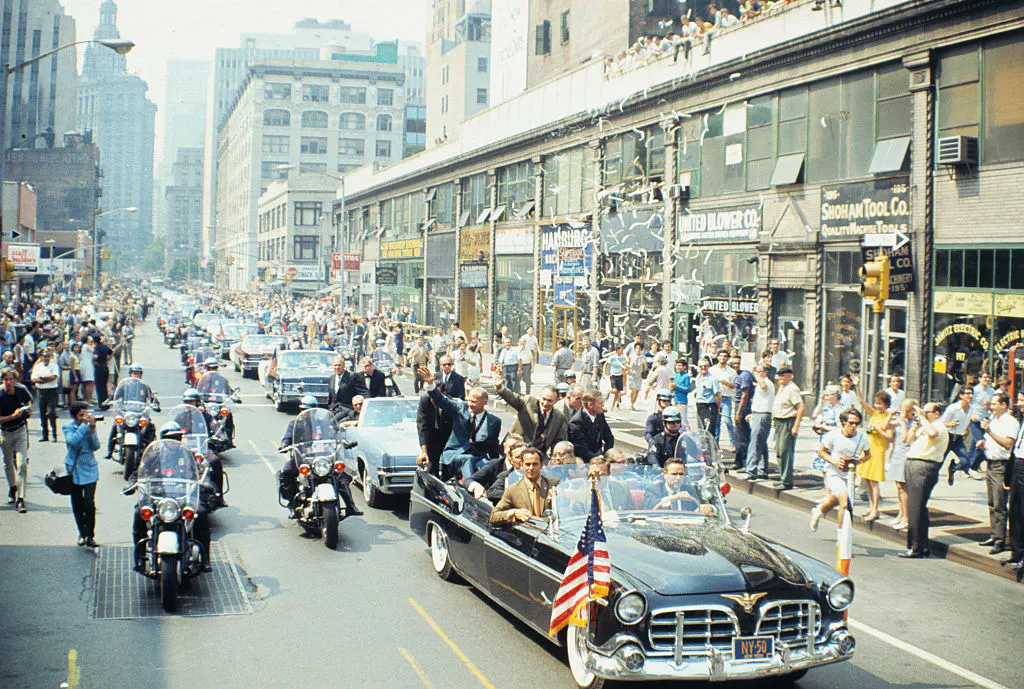
No, these aren’t heroes, and they barely qualify as celebrities, even by today’s standards. The real astronauts, the ones who should be cruising down New York City’s Fifth Avenue in a ticker-tape parade, who should be invited to speak at every college and university commencement address this graduation season, who should be the star of every party and never have to buy a beer at one ever again, are the Artemis II astronauts. Sure, they didn’t actually land on the moon, but they reached farther into the depths of space than any human ever. They witnessed the Earth set behind the moon. They didn’t listen to Dark Side of the Moon; they experienced it. It was the first crewed flight beyond low Earth orbit since Apollo 17 in 1972, and everyone just shrugged.
In fact, when the four-man crew (Victor Glover, Christina Koch, Jeremy Hansen, and Reid Wiseman) recently appeared in the Oval Office standing behind President Donald Trump, not a single question was directed at them by the press. The late comedian-prophet Norm Macdonald is nodding with knowing disappointment from the great beyond.
Even when the press asks the Artemis II crew questions, they center on an identity-based narrative rather than the enormity of the accomplishment. To his credit, Victor Glover has redirected this messaging toward an American experience and achievement rather than on his being a black man.
We should expect as much from the press and fame ecosystem, where what passes for being a celebrity or an admired entertainer is their “influencer” status. Ask kids these days what career path they aspire to, and influencer is the safe (non-porn-adjacent) answer. If you were to take a time machine and travel back to, say, 1955 and explain that, Yes! We made it to the moon. By golly, we even hit a few golf balls while we were there. And no, not every little Jimmy and Susan aspires to explore the thing that has captured mankind’s imagination for eons and been a reference point for everything from classic literature, science fiction film and television, art and design, and even automobiles and ladies’ undergarments.
Kennedy implored his fellow Americans to reach the moon before 1970. In his 1962 address at Rice University about the nation’s efforts into space, he declared, “This country of the United States was not built by those who waited and rested and wished to look behind them. This country was conquered by those who moved forward — and so will space.”
Kennedy’s words are a reminder that the American spirit is the driver of great things. The soul of an American yearns for a challenge, to meet what lies beyond the horizon, and to push beyond the quiet complacency of mediocre content dished out to us. We mustn’t accept our exceptionalism as a characteristic of a bygone era. What we should do is turn on Sinatra, gaze up at space, and “See what spring is like, On Jupiter and Mars.”
More from this network:
Domains for Sale · GOTPeople.org · TheDSAPlatform · The Truth About Socialism
What's Your Reaction?
 Like
0
Like
0
 Dislike
0
Dislike
0
 Love
0
Love
0
 Funny
0
Funny
0
 Wow
0
Wow
0
 Sad
0
Sad
0
 Angry
0
Angry
0

I am just an average American. My teen years were in the late 70s and I participated in all that that decade offered. Started working young, too young. Then I joined the Army before I graduated High School. I spent 25 years in, mostly in Infantry units. Since then I've worked in information technology positions all at small family owned companies. At this rate I'll never be a tech millionaire. When I was young I rode horses as much as I could. I do believe I should have been a cowboy. I'm getting in the saddle again by taking riding lessons and see where it goes.
Premium domains for sale















Comments (0)