

How Culture War of Andrew Johnson’s Senate Trial Resonated in Clinton, Trump Impeachments
Premium domains for sale
Freedom Is Back In Style
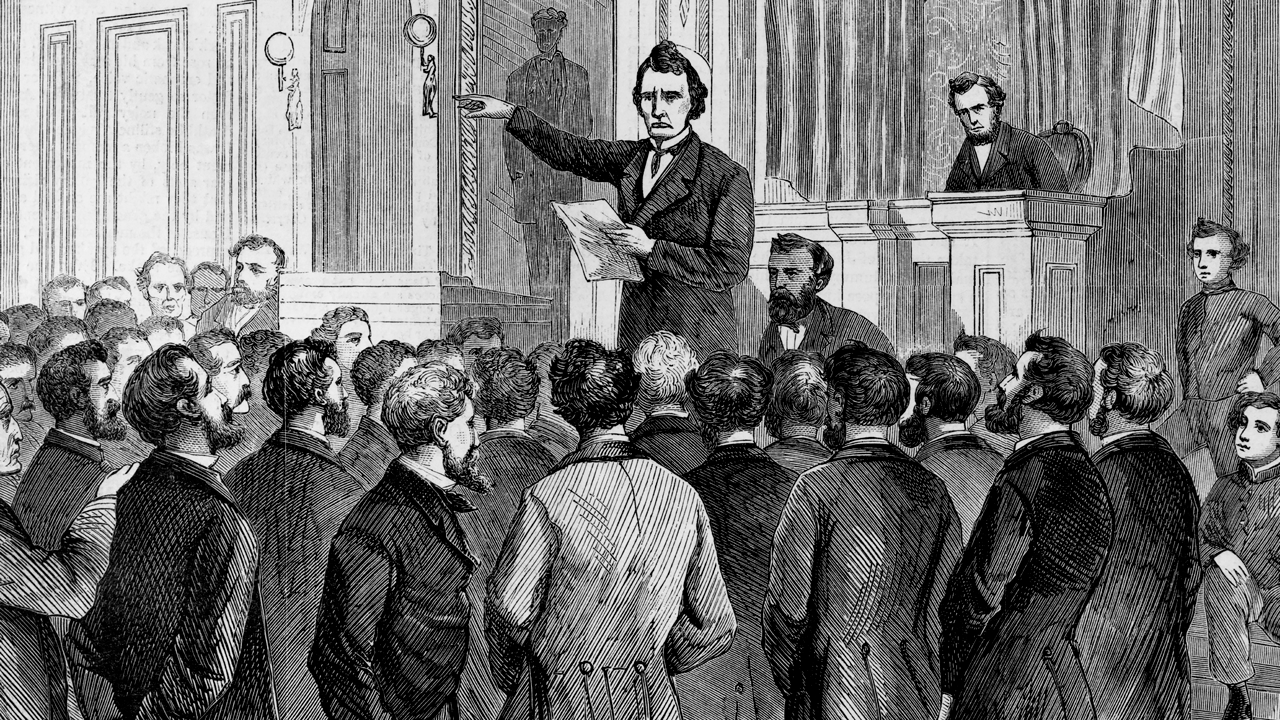
As the first presidential impeachment trial was drawing to a close, newspaper titan Horace Greeley’s New York Tribune ran a bold headline: “CONVICTION ALMOST A CERTAINTY.” If by “certainty” the paper meant falling one vote short of the two-thirds needed to remove President Andrew Johnson, the headline proved accurate.
Freedom Is Back
In Style
Premium domains for sale
On May 26, 1868, Johnson slipped the political noose with a 35–19 vote, after 10 Republicans—perhaps the “RINOs” of their day—broke ranks to acquit.
The trial featured 25 prosecution witnesses and 16 for the defense. The Senate gallery was so packed that lawmakers introduced a ticketing system for crowd control, a practice used in later impeachment trials.
Author and journalist Mark Twain observed the frenzy: “The multitude of strangers were waiting for impeachment.” He added that many “did not know what impeachment was, exactly,” but imagined it would come “in the form of an avalanche, or a thunder-clap, or that maybe the roof would fall in.”
For decades, historians judged the episode harshly, noting that the Supreme Court later declared the Tenure of Office Act, which Johnson was accused of violating, unconstitutional in 1926. Yet the procedural rules forged during Johnson’s impeachment would go on to serve as a road map for the Senate trials of Presidents Bill Clinton and Donald Trump.
Impeachment Trap
Republican President Abraham Lincoln arguably made his biggest political miscalculation by selecting Tennessee Democrat and Union loyalist Andrew Johnson as his running mate for the 1864 ticket, which focused on unity.
Johnson proved to be a deeply flawed president and an outspoken racist—even by the standards of his time. While he was lenient toward the defeated South, as Lincoln likely would have been, he also obstructed civil rights and voting protections for freed slaves—measures Lincoln almost certainly would have supported.
By mid-1867, Republicans—armed with more than a two-thirds majority—were openly discussing impeachment but lacked a clear trigger. They created one by overriding Johnson’s veto to pass the Tenure of Office Act, which required Senate approval to remove Senate-confirmed officials.
Johnson walked directly into the trap by firing Secretary of War Edwin Stanton.
The House impeached him on Feb. 24, 1868, by a decisive 126–47 vote.
The Senate trial began March 5, with Chief Justice Salmon P. Chase presiding. Attorney General Henry Stanbery resigned to devote himself fully to leading the president’s defense.
Johnson’s legal team argued he had not violated the Tenure of Office Act because Stanton had been appointed by Lincoln, not Johnson. It also contended that the president sought to test the law’s constitutionality before the Supreme Court.
Skeptical of securing a conviction, Republican leaders scheduled votes on what they viewed as the three strongest of the 11 articles of impeachment. The first vote fell one short of conviction, at 35–19. After regrouping, the Senate returned 10 days later to vote on two additional articles—with identical results.
On May 26, House managers abandoned efforts to vote on the remaining articles, and Johnson was acquitted.
“I cannot agree to destroy the harmonious working of the Constitution for the sake of getting rid of an unacceptable president,” Sen. James Grimes, R-Iowa, said in explaining his vote to acquit.
Evolving Perception
Historical judgment of Johnson’s impeachment has shifted over time.
The 1943 film “Tennessee Johnson” portrayed the 17th president, played by Van Heflin, as a constitutional defender standing against overreaching Republicans in Congress. Similarly, in his Pulitzer Prize–winning 1955 book “Profiles in Courage,” then-Sen. John F. Kennedy praised Sen. Edmund G. Ross, the Kansas Republican whose vote helped secure Johnson’s acquittal.
In “Grand Inquests” (1992), Chief Justice William Rehnquist—who later presided over the Clinton impeachment—argued that acquittal preserved “the American system of government” from congressional dominance.
Other historians dissent. Larry Schweikart, in “A Patriot’s History of the United States,” contends the Senate failed in its duty by not focusing solely on whether Johnson committed the charged offenses.
More recent works, including David O. Stewart’s “Impeached” (2009) and Brenda Wineapple’s “The Impeachers” (2019), emphasize Johnson’s racism and argue he was fundamentally unfit for office.
Culture War Impeachments
The Johnson impeachment, like every presidential impeachment since, unfolded amid deep cultural and political division.
Johnson’s trial came during Reconstruction following the Civil War. The impeachment process against Richard Nixon took shape amid the Vietnam War and anti-war protests; Nixon ultimately resigned after the House Judiciary Committee approved articles of impeachment, but before a full House vote took place.
Bill Clinton emerged from that same anti-war generation. To many Republicans, his 1998 impeachment reflected broader cultural conflicts, as critics contrasted Clinton’s personal conduct with that of his predecessor, George H. W. Bush.
And, of course, the Trump impeachments took place in an era of intense polarization. Many on the left viewed Trump as uniquely dangerous and unfit for office, while his defenders saw the impeachment efforts as politically motivated—resulting in his becoming the first president acquitted twice by the Senate.
More from this network:
Domains for Sale · GOTPeople.org · TheDSAPlatform · The Truth About Socialism
What's Your Reaction?
 Like
0
Like
0
 Dislike
0
Dislike
0
 Love
0
Love
0
 Funny
0
Funny
0
 Wow
0
Wow
0
 Sad
0
Sad
0
 Angry
0
Angry
0

I am just an average American. My teen years were in the late 70s and I participated in all that that decade offered. Started working young, too young. Then I joined the Army before I graduated High School. I spent 25 years in, mostly in Infantry units. Since then I've worked in information technology positions all at small family owned companies. At this rate I'll never be a tech millionaire. When I was young I rode horses as much as I could. I do believe I should have been a cowboy. I'm getting in the saddle again by taking riding lessons and see where it goes.
Premium domains for sale








Comments (0)