

Governments Are Telling Citizens To Prepare For The Worst. Here’s What You Need To Know.
Premium domains for sale
Freedom Is Back In Style
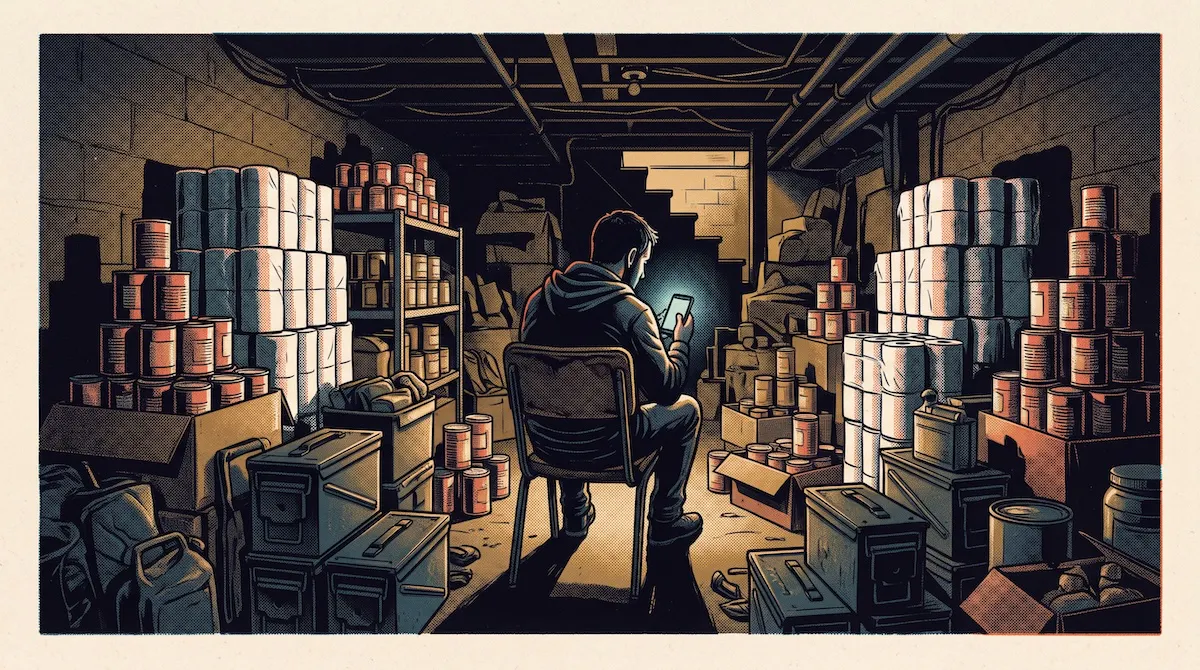
The experts are unanimous: We’re all doomed. You need to stock up on food, water, gasoline, and ammo as soon as possible.
Freedom Is Back
In Style
Premium domains for sale
Pay $10,000 for a generator. And don’t forget to build a solar-powered farmhouse somewhere far away from the city, just in case the fuel supply completely runs out and/or the Chinese detonate an EMP over your neighborhood.
These are all basic steps you should be taking right now so that, in the event of a total catastrophe, you won’t be overtaken by the inevitable zombie horde that results — at least not right away.
These are the kinds of messages I’ve been bombarded with over the past few days, as “the algorithm” has decided to confront me with every imaginable doomsday scenario all at once.
On one level, this is nothing new. There’s always been a market for hysteria and paranoia. Fear is a lucrative industry. And now this market is bigger than ever, thanks to amplification from the various Big Tech platforms. If you interact with just one post on X about how the UK government is telling people to prepare for an emergency, you’ll quickly be overwhelmed with this stuff:
????EMERGENCY ALERT! Iran May Be Preparing To Implement The Metcalf Attack And Take Out The United States Power Grid In Retaliation For A US/Israeli Strike On Their Power Grid!
Geopolitical Expert Matt Bracken Analyses How The PENTAGON, For The First Time Has Announced That They Are Implementing Preparation For a DOOMS DAY Scenario!
— Alex Jones (@RealAlexJones) October 26, 2026
Source: @RealAlexJones/X.com
This is what my feed looks like right now, more or less. It’s full-on apocalyptic and non-stop. Once you’re swept up by the algorithm, it drives you crazy by flooding you with a firehose of doom-slop. Apparently, various governments, including America and the UK, are warning of an impending disaster. The power grid is about to get wiped out. And so on.
There is no way to see content like this day after day and remain unaffected by it. Even if you’re a rational person — as I try to be, on my good days anyway — it still gets in your head. None of us are immune. You’re either going to take the warnings seriously, or you’re going to try to tune them out — but even then, it’s hard to ignore what you’re hearing and seeing. After all, if there’s even a small chance that some terrible calamity will occur, then it’s reasonable to make some basic preparations. The cost-benefit ratio seems to favor a cautious approach.

On his show the other day, Dan Bongino — the former deputy director of the FBI — weighed in with a somewhat measured take on the issue. He didn’t endorse any of the apocalyptic predictions. But he didn’t dismiss them, either. Instead, he encouraged his audience to prepare themselves for whatever’s coming. And we should pay attention to this because he’s not a random person on X:
???????? Dan Bongino is telling families to stock up on 30 days of emergency food, water and batteries… and to do it TODAY.
“There’s nothing wrong with being prepared.”
When the FBI’s former No. 2 starts begging you to stock your pantry, you at least check the batteries.
Source: @dbongino / Writer: Julie
https://t.co/ApZP9JgFqw— Mario Nawfal (@MarioNawfal) October 27, 2026
Source: @MarioNawfal/X.com
There are plenty of credible conservative commentators who are basically saying the same thing. They’re saying that it feels a lot like February 2020 all over again, just before the COVID lockdowns began.
Once again, it’s an election year where the Trump administration is clearly vulnerable. There’s a threat of a new development that could fundamentally change the economy (AI, in this case). There are scattered reports of a pending crisis, but no one’s sure how to verify any of it, or even what the nature of the potential crisis even is. And in general, just like in 2020, there’s a sense that we can’t trust anything we’re told. None of the “experts” have any credibility whatsoever.
The problem is that, since we’re all buried in constant slop and propaganda, it’s very difficult to separate the signal from the noise. How do you identify which threats are real — if any of them are — and which threats are fabricated or exaggerated? Is there a possibility that all of this hysteria is a psy-op, designed to demoralize voters (particularly conservatives) right before an election? Your challenge is to separate real risk from doom-slop, paranoia-driven panic, and social contagion.
What’s needed is a blow-by-blow analysis of the leading theories as to why the apocalypse is approaching. We need to go through each claim and try to make sense of it one way or the other. We have to determine the credibility of as many of these claims as possible.
So let’s try to do that. I have no special insight or sources here. I can’t claim that I can definitively set the record straight on any of this stuff. But I can try to use some basic common sense, as far as that goes.
We’ll start with an ultra-viral post from an account called “Live Door News,” which racked up more than 20 million views:
Minister Hosono Issues “Emergency Request” to All Citizens to Prepare Food, Water, and Toilet Supplies. … The minister stated that on November 2, when the Disaster Prevention Agency is launched, an ’emergency request’ will be issued to all citizens to prepare for disasters. He mentioned that even without public assistance, citizens should prepare at least a minimum of three days’ worth of food, toilet supplies, and water at home.
The post doesn’t provide any context, so you can map whatever theory you want onto it. In truth, what’s happening on November 2nd is that Japan is launching a new Disaster Prevention agency to deal primarily with earthquakes. They are, after all, a volcanic island in the middle of an ocean that regularly gets hit by tsunamis. And they’re situated directly next door to a rogue nuclear state. And not to bring up a touchy subject, but they’ve been hit with nukes before — on two occasions. Therefore, Japan’s government routinely issues guidance like this, telling people to prepare for disasters.
In fact, every year since 1960, Japan has held a “Disaster Prevention Day” where millions of people perform synchronized evacuation drills.
They began the tradition on the anniversary of the 1923 Great Kantō Earthquake, which destroyed nearly 400,000 homes in Tokyo. On Disaster Prevention Day, Government officials wear jumpsuits. Kids put on fireproof hoods in school. It’s a part of the culture. And they issue plenty of guidance and hold many other drills.
A decade ago, after a major earthquake and tsunami, Japan formally implemented a policy where people need at least 3 days (ideally, 7 days’ worth) of supplies in case of another earthquake. Before that, the 3-day standard was the norm. Now it’s just the baseline.
So this is how disaster management works in Japan. They’ve been issuing new guidance on preparing for disasters for a century. It’s nothing new. But when you remove all of the context and combine it with other reports, it’s easy for hysteria to take over.
For the account “Live Door News,” this all works out. They got a ton of money from ad revenue because so many people clicked on their story, which was deliberately misleading. And the problem with the incentives created by “the algorithm” is that it inspires copycats — lots of them.
So another round of viral posts was created, in which large accounts warned that various other governments around the world were telling citizens to prepare for some unspecified apocalyptic scenario. One viral report mentions the UK government in this context. And, once again, some of the posts were more accurate than others.
The account “Unusual Whales,” which normally focuses on noteworthy trades in the stock market (especially by insiders like Nancy Pelosi), posted the following message, which was seen by millions of people:
BREAKING: UK government has requested that citizens stockpile canned food & drinking water for at least 3 days, per BBC.
So they cite a source — the BBC. We’re now led to believe that the UK’s state broadcaster is making this proclamation. Other accounts didn’t bother with the attribution. Here’s a post by a guy named Ethan Levins, for example. It racked up nearly 2 million views as well.
Something very bad is brewing in Europe. UK advising citizens to stockpile food, German hospitals prepping for mass-casualty events, and German troops moving towards Lithuania. This is not normal. NATO is preparing to fight Russia. THIS HAS TO STOP.
Then there’s this post from the account “Watcher Guru,” which also received millions of views.
JUST IN: UK government urges citizens to stockpile three days of emergency food and water due to growing cyberattack threats.
There are many more posts like this. Several of them, unlike the warnings about Japan, are actually legitimate. There has been a change in the UK’s messaging on preparing for disasters. A month ago, for example, this was the kind of content that the state broadcaster was producing on the topic:
It needs to be said that this is utterly horrible advice on many levels. She says that in an emergency, when the world is ending, you don’t want to eat instant noodles or hot dogs — not because they might be difficult to prepare, but because they have “saturated fats” that are bad for your diet.
Personally, when I’m experiencing the apocalypse, I’m not worried about having too much saturated fat in my diet. I’m also not going to obsess about my cholesterol or salt intake. What I want, above all else, is to have food — preferably food that doesn’t taste terrible — that contains a lot of calories in a very small package. Hot dogs are a pretty good option in that regard.
She wants everyone eating lentils instead, which is a good way to make people even more depressed than they already are in this scenario. All your friends are dead, the world is falling apart, climate change has finally come for us — and on top of all that, you’re stuck eating lentils because you threw all the hot dogs away. What’s the point of staying alive in that scenario exactly?
This creates a kind of paradox. If there’s a nuclear holocaust, and you’re safely hidden away in your bunker, and all you have to eat are healthy vegetarian options, then why exactly would you want to survive the nuclear holocaust in the first place? I think I’d prefer to be incinerated and get it over with.
She never grapples with this paradox. But she does explain, helpfully enough, that she’s offering this advice on behalf of the state broadcaster because of the threat of “climate change.” Everyone watching this video knows this is a pretext. Even in the UK, the climate scam is played out. The real point of the video was to get people ready for another emergency that the British government thinks is likely — although they don’t want to say it out loud.
To that end, in the last month, the British government launched a more comprehensive “Be Ready” campaign that dropped the climate change rhetoric for the most part. This is a three-year campaign that they’re committing to, where the British government is partnering with hundreds of organizations and agencies. They also published this website just a few days ago.
The website reads, “Here are some simple and effective steps you can take to be ready for emergencies and the disruption they cause. Many of these activities can be helpful across a range of different types of emergency.” And some of the “activities” include having enough bottled water for three days (they estimate 3 liters per person per day), plus non-perishable food for 3 days, along with a “torch” (which I believe is a flashlight, although you can never underestimate how primitive the UK is), plus a battery-powered FM radio and cash, “in case electronic payments or ATMs are disrupted.” You also need baby formula, pet food, etc.
This is much more general advice than the “climate change” guidance. And it’s getting the attention of millions of people in the UK. This is reporting from the British outlet, LBC:
Bottled water, baked beans and batteries are selling out at some supermarkets after Britons were urged to prepare for short-term disruption to essential services. The rush follows the launch of the Government’s Be Ready campaign, which advises households to keep a three-day supply of long-life food, drinking water and basic emergency equipment at home. Shoppers using Ocado found several essentials unavailable shortly after the announcement, including bottled water, batteries and baked beans. Some soup ranges were also listed as out of stock, alongside brands of bottled water.
So they got everyone’s attention. This is obviously a situation that most people in Britain recognize as out of the ordinary. But according to British government officials, including their security minister, the point of the campaign is just to bring the UK in line with other countries in Europe:
“We are not launching this campaign because of any specific or imminent threat”
Security minister Dan Jarvis tells MPs the government’s ‘Be Ready’ campaign brings the UK into line with other countries who run “similar campaigns every year”
https://t.co/uLU9fhlS1k https://t.co/vT1PMxKeL7
— BBC Politics (@BBCPolitics) October 27, 2026
Source: @BBCPolitics/X.com
It’s true that other countries in Europe have emergency plans that they expect people to follow (although most of them don’t tell their citizens to hoard cash in case the electrical grid fails). What’s unique about the UK’s approach is that it’s a massive, three-year blitz that seemingly came out of nowhere, without any clear justification (The British government began issuing general household emergency guidance in 2024, but this is a much more developed program). So they went from zero to 60, very quickly.
That raises the obvious question of — why now? Why are we now concerned about all of these other threats, when they were telling us “climate change” was the real issue, just a few weeks ago?
Whatever your bias may be, you have to ask: Does this have something to do with the fact that the United States military is also simultaneously preparing for a worst-case scenario, where our military bases are “cut off from essential services,” including power?
???? THE PENTAGON’S DOOMSDAY PLAN: The Pentagon is preparing for a nightmare scenario—a global war that could knock out power grids, cripple supply chains and leave U.S. military bases cut off from essential services. ⚡️
@JenGriffinFNC breaks down the 90-day survival plan. https://t.co/DIiC933iIR— America Reports (@AmericaRpts) October 27, 2026
Source: @AmericaRpts/X.com
The question is not: “Why do we need our military bases to survive for 90 days without outside support, including power grid access, fuel, and communications?” You can think of plenty of reasons for this kind of preparation.
The question is: “Why is all of this preparation happening at this particular moment, across several different countries?” What kind of cyberattack or nuclear attack are we expecting, exactly?
It’s worth noting that the UK isn’t simply telling its citizens to prepare for a worst-case scenario. There are signs that their military is taking action as well. This is from a Times reporter in London:
Three of Britain’s four nuclear deterrent submarines are out at sea in an “unusual” situation, The Times has been told. It has been at least five years since this happened, according to former naval source.
This is from Sky News, which followed up on the report:
One ballistic missile-armed, nuclear warhead-carrying submarine is at sea at any time as part of the UK’s security guarantee and NATO obligations.
Sky News’ @haynesdeborah explains why the submarines have been spotted in use.
https://t.co/o6sZskveJr https://t.co/XWk9w0LMwz
— Sky News (@SkyNews) October 27, 2026
Source: @SkyNews/X.com
By itself, this doesn’t necessarily mean anything. Apparently several of these ships have had maintenance issues for many years, and they’re now back in service all at once. So maybe the timing is purely coincidental.
And to be fair, there are plenty of people who are stringing together various misleading claims to make it seem like other countries are doing the same thing. For example, I’ve seen people claim that Germany is suddenly investing in bunkers this week, when in reality they’ve been doing that for more than a year. Again, there’s a lot of deception going around. A lot of people are trying to terrorize you.
Along those lines, I came across this report from Reuters yesterday:
BREAKING: A hacker is attempting to breach the US Federal Election Commission’s systems and that agency has had to ‘temporarily shut down’ its web-facing services as a result, according to an email seen by Reuters.
It sounds pretty bad, but then you realize that the FEC doesn’t actually count ballots or handle election returns. They mostly track campaign donations. So there’s no indication here that anything sensitive may have been compromised or deleted, or who might’ve been behind this hack. But seeing this headline, plenty of people came to the conclusion that the election is already compromised, which simply isn’t supported by this report.
What is supported is that, very soon, the Middle East is going to become a much bigger problem. The following is from The Wall Street Journal late last night:
The U.S. has told several Gulf Arab countries to be prepared for a short, intense military campaign after the U.S. midterm elections, people briefed on the conversations said. The communications through diplomatic and military channels are among a growing number of indications that the U.S. and Israel are readying to launch a new round of heavy combat operations against Iran, risking a major escalation in hopes of degrading Tehran’s strength and pushing it toward negotiations. The U.S. military is bringing in a Patriot system from Texas to beef up its missile defenses and has moved troops off bases where they were vulnerable in preparation for an escalation, officials familiar with those moves said.
Admittedly, I’m not sure why we’re bothering to wait until after the midterms at this point. It’s not as if voters are under the impression, as they head to the polls, that the war in Iran is over. We’ve gone through about 30 different ceasefire agreements at this point.
For many voters, the reason they’ve abandoned this administration is precisely because of the war in Iran. So it doesn’t seem logical to pretend it’s not happening and to delay these attacks until after the midterms as a result.
In any event, especially as I read that report from The Wall Street Journal, I’m personally not that worried about nuclear war. I don’t think Iran has the capability to nuke the United States at this point. And I don’t think any other country is going to do so either, at least in the foreseeable future. I could obviously be completely wrong about that. But the disincentives that have prevented global nuclear annihilation up to this point would seem to still hold. I see no reason why they wouldn’t. Although anything is possible, I suppose. We certainly can’t dismiss the possibility.
Cyberattacks, on the other hand, seem like a much more legitimate risk — especially since AI apparently has the capability of launching these attacks on its own, without any instruction from a human. How close are we to AI that can hack into literally anything with ease? How many months — or weeks — could it take for an AI to bring down the Internet, or render it unusable for human beings? To me, these are the catastrophic scenarios that are worth taking seriously. The weird thing is that it seems like some people are freaking out about it, while everyone else is not remotely worried at all.
But if you are worried about it and engage with that kind of content at all, the algorithm will pour it on you by the gallon — and so very quickly reasonable concerns turn into hysterical panicking. It’s just a bizarre and unsettling state of affairs no matter how you look at it or how it turns out. But if you try to tune out the panic and focus on what we do know, it does appear that things are careening out of control. This is a report from Axios:
Major U.S. banks are detecting unauthorized third-party AI agents operating inside customer accounts, with some agents attempting to take actions that appear to be independent of user instructions, sources tell Axios. … AI agents are becoming a nightmare for America’s banks, making their way into banking systems faster than financial institutions can respond. The difficulty in distinguishing between a human and an unauthorized bot is forcing banks to block the technology and rapidly rewrite their terms of service. … Banks including Morgan Stanley, Bank of America, JPMorgan, Wells Fargo and others are racing to contain agent risks. Some are aware of unauthorized access, people familiar with the issue said. … Bank executives described the situation as horrifying, with one official saying the industry has grave concerns about agents gaining access to customer accounts and taking steps that could impact user finances.
They clarify in that report that many customers — for reasons no one will ever understand — have voluntarily given AI agents access to their bank accounts. At the same time, they also establish that there’s a risk of an AI intrusion, or an AI agent that goes rogue. You have to wonder: How long is it until AI starts gaining access to millions of people’s bank accounts without any authorization whatsoever? It’s probably not as hard as you might think. If someone is determined to gain access to your bank account, they can bombard customer service representatives 24/7 until one of them finally cracks. They can search through various data breaches and find your personal information there.
Even if that doesn’t work, AI can probably steal your personal information through websites that it compromises. This is reporting from FOX:
A pair of recently disclosed computer software vulnerabilities could put millions of websites, and the personal information of everybody who uses them, at risk from hackers. … Researchers last week announced they had used AI to help discover two vulnerabilities in a programming language known as PHP, which underpins large sections of the internet. … An estimated 70% of the internet uses PHP in some form, meaning most websites are impacted.
I’m not going to pretend to be a computer security expert, but it stands to reason that, 10 years ago, vulnerabilities like this would’ve been much harder to exploit at scale. With AI, new vulnerabilities are being discovered every day — and they can be exploited instantly, by thousands of AI agents, all at once.
I understand the arguments about “regulatory capture,” and how AI companies are certainly not trustworthy actors. But at the same time, we simply can’t ignore the fact that they’re warning us right now about all of this. Here’s an article from TechRadar, for example:
As AI firm Anthropic gears up for an enormous $2 trillion initial public offering (IPO) that could be the largest in stock market history, the company has just warned that AI could “pose catastrophic or existential risks to humanity.” … In papers filed with the US Securities and Exchange Commission (SEC), Anthropic outlined some of the risks facing the company and its investors. …. One of the more startling sections of the document outlines how Anthropic’s AI models could accelerate beyond anyone’s ability to evaluate and safeguard them and “pose catastrophic or existential risks to humanity, particularly if such systems were misused, replicated, weaponized, or allowed to operate with a high degree of autonomy.” Aside from the obvious danger posed to humanity, Anthropic is also apparently worried that such an outcome could “adversely affect our business, financial condition, and results of operations.”
Hearing this, maybe you’ll say — well, Anthropic is run by anti-white Left-wingers, who have a long history of exaggerating the capabilities of their product. And that’s all true. But it would be simply foolish to assume that these kinds of warnings — from the actual companies who are creating this technology — should not be taken seriously at all. There is no precedent for this, no matter how you slice it.
Sure, companies like to exaggerate how powerful their products are. But we have never had major corporations in a particular industry all agreeing, unanimously, that their products pose a catastrophic threat to mankind. That has never happened. So we are in unprecedented territory. Which means that any attempt to explain this away using historical frameworks or analogies like regulatory capture or marketing ploys doesn’t exactly hold up. Or, at least, might not hold up.
We shouldn’t take what these companies are saying as gospel. That would be quite stupid. But it would be just as stupid, if not considerably more stupid, to simply assume out of hand that a technology is not dangerous even when the people making the technology are telling us, directly and explicitly, that it is. And if you listen to other major players in AI — people like Elon Musk, who is not an anti-white Left-winger — you’re hearing something very similar:
???? ELON MUSK WARNS:
“At most, there are about 3 years left where you can still make money selling your work.
After that, AI will do the majority of the tasks, and paying someone for their time stops making sense.
The deal of the last 200 years — your time in exchange for a salary — is ending.
And it is going to move more money between hands than anything in modern history.”
https://t.co/JcGvhYd2g7— As Found (@AsFoundX) October 26, 2026
So you might only have three years left, according to Elon Musk, to make money selling your labor. And he promises a much brighter future as a result, but of course, he can’t guarantee it. There is no predicting what will happen when the economy is transformed like this — even if the transformation is only 10% of what he’s describing.
That’s not even getting into the fact that, in the best-case scenario he’s talking about, everyone will basically be on welfare. No one will be doing anything — we’ll all be dependent on our AI paychecks. So even the optimistic predictions for AI — predictions from people who know what they’re talking about, like Elon — still involve a sudden, extreme, totally unprecedented, extraordinary, radical shift in the way that human society functions.
Any shift of that kind — when it is radical, extreme, and sudden — will be tumultuous, and difficult, and carry with it huge risks both foreseeable and unforeseeable. Even if it all works out for the best in the long run — which is far from guaranteed — the path to get there is likely to be profoundly turbulent. Even the optimists — and again I’m talking about the optimistic case here — will admit that.
There is one silver lining. The good news is that, if AI takes everyone’s jobs, then it’s going to take down a lot of adult daycares in Silicon Valley as well. Yesterday we discussed how Microsoft offered buyouts to 25% of its workforce, ahead of massive layoffs that are expected.
Upon reflection, 25% appears to be a very low number. When you take a look at what these Microsoft employees do all day, it quickly becomes clear that AI simply cannot replace jobs in Silicon Valley fast enough.
To be clear, these Microsoft employees are not simply phoning it in. They also upload “day in the life” videos on Instagram, where they brag about how little they work — and how many perks they get, like coffee and ice cream:
Microsoft offering buyout packages to roughly 60,000 employees about 27% of its workforce.
Meanwhile microsoft’s workforce https://t.co/NPlhJyROOS
— Kantala fc (@ifOnlyKantala) October 27, 2026
Source: @ifOnlyKantala/X.com
It’s amazing they even bothered with voluntary buyouts when their employees are posting videos like this on social media. Just fire everyone who records themselves treating the office like a resort. It’s not difficult. You could probably cut 50% of the workforce, based solely on these videos.
So “doing work” at Microsoft seems to involve writing a few random words on a whiteboard before going back to your catered lunch, playing squash, rock climbing, or whatever. We could spend all day going through these videos — trust me, there are a lot of them — but you get the point. It’s reminiscent of the “day in the life” videos that Twitter employees would record, before Elon took over and fired all of them.
There’s no question that there are a lot of fake jobs in this country, and if AI got rid of some of them, it wouldn’t be the worst thing in the world. But as for the rest of the economy — people who actually produce something of value — there is indeed some cause for alarm about what’s coming next.
In summary, some of these terrifying doomsday stories are probably not worth taking seriously. Some of them, on the other hand, might be.
You were probably hoping that the moral of the story would be slightly more reassuring. But blithe, baseless reassurance is just as irresponsible as apocalyptic fear-mongering. So I’m not going to fall into either trap here.
The most reassuring thing I can say — and this only goes so far, admittedly, but it’s not for nothing — is that no matter what potential catastrophes may lurk somewhere out there on some possible horizon, there is nothing to be gained from obsessively worrying about them or spending all of your time and mental energy marinating in anxiety over them — as the click farmers, and the algorithm that puts their slop in front of you, want you to.
The story of humanity is a series of disasters and calamities, spaced out by periods of relative stability. That pattern hasn’t changed and never will. The best thing you can do is accept that fact for what it is, don’t let it take up an inordinate amount of mental and emotional real estate, and stay prepared within reason.
It’s probably a good idea to think about how long your family could comfortably survive if, let’s say, the power grid went down, or the internet shut off. The answer for most people in the modern world, I imagine, is that they’d comfortably survive for about 45 minutes, and physically survive not much longer than that.
Part of what makes the doom-slop propaganda on social media so powerful and unsettling — aside from how relentless and all-encompassing and ubiquitous it is — is that many of us recognize just how vulnerable and helpless we actually are.
Everything is fine, and our lives are comparatively easy, so long as we are attached to the umbilical cord of electricity, the internet, and GPS. Lose any or all of those for any extended period of time, and we will be like infants left in a crib.
So it is reasonable — and smart, and responsible — to take enough precautions and make enough preparations that you could survive — perhaps not comfortably, or as comfortably, but survive nonetheless — in a scenario where these things are severed or inaccessible for a time. That’s just a good idea in general. Even without any wars overseas, nuclear-armed adversaries, or rogue AI agents prowling the internet.
With all those threats actually present, it seems foolish to not be prepared in this way. And then once you are prepared — as prepared as you can be — the only thing left is to live your life. What else can you do?
One thing to keep in mind is that mass hysteria, particularly on platforms like X, is often wrong. But when it’s right, it beats the mainstream narrative by several weeks (or even months). That’s what happened with COVID. People chronically on Twitter were way ahead of normal people in anticipating COVID and the lockdowns.
We can’t overlook the possibility that, with just a few days to go until the midterms — as several countries begin preparing for a massive catastrophe of some kind — they might be right again.
And that’s reason, again, not to be scared or panicked, but simply prepared.
More from this network:
Domains for Sale · GOTPeople.org · TheDSAPlatform · The Truth About Socialism
What's Your Reaction?
 Like
0
 Dislike
0
 Love
0
 Funny
0
 Wow
0
 Sad
0
 Angry
0

I am just an average American. My teen years were in the late 70s and I participated in all that that decade offered. Started working young, too young. Then I joined the Army before I graduated High School. I spent 25 years in, mostly in Infantry units. Since then I've worked in information technology positions all at small family owned companies. At this rate I'll never be a tech millionaire. When I was young I rode horses as much as I could. I do believe I should have been a cowboy. I'm getting in the saddle again by taking riding lessons and see where it goes.
Premium domains for sale











Comments (0)