

Identity Politics Is Burying Science
Premium domains for sale
Freedom Is Back In Style
It was 30 years ago this month that a couple of college students in Kennewick, Wash., stumbled upon a rare archaeological discovery — one that would help trigger a war between science and racial identity politics, or what we now call “DEI.” Three decades later, it’s clear that if we don’t act quickly, it’s a fight science will probably lose.
Freedom Is Back
In Style
Premium domains for sale
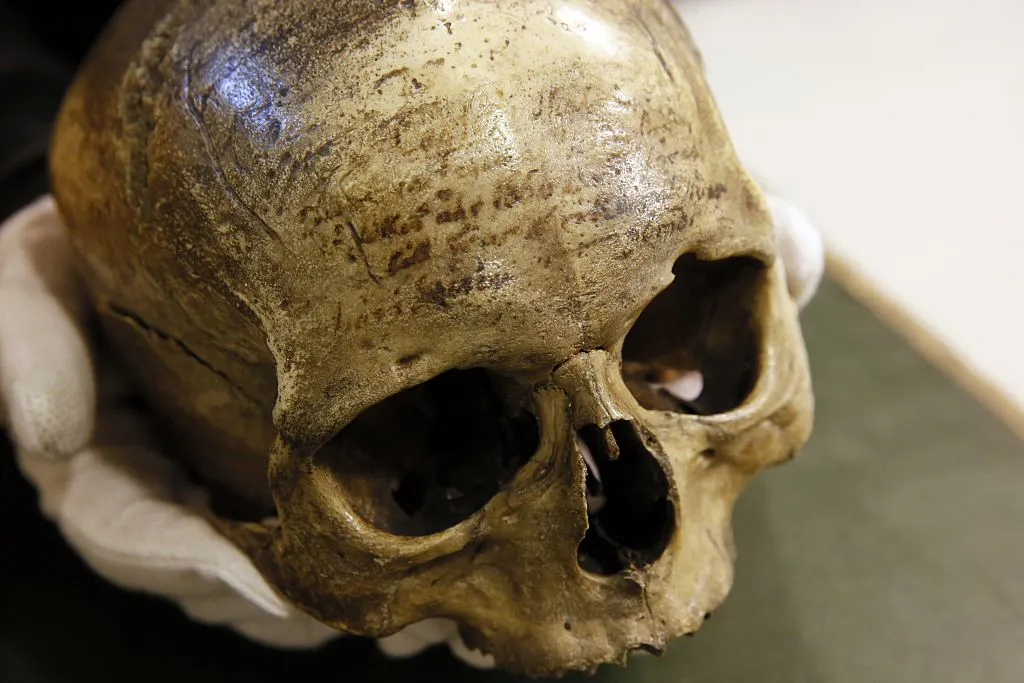
What the students found was a 9,000-year-old skeleton that was soon nicknamed Kennewick Man. It was certainly one of the most precious anthropological finds ever. At the time, it was the oldest human skeleton ever found in North America, and it had signs of an injury from an arrow or a spear. More intriguingly, it seemed to have less in common with the skeletons of Native Americans than with those of ancient Japanese peoples, thus potentially changing our understanding of how humans first arrived in the New World.
But that’s when the federal government stepped in. Under a law called the Native American Graves Protection and Repatriation Act, or NAGPRA, skeletons found on federally owned land (as Kennewick Man was) must be turned over, or “repatriated,” to the Native American tribes they’re related to. NAGPRA was written in response to the actions of 19th- and early 20th-century archaeologists who sometimes engaged in practices that would be unacceptable today to acquire specimens, and it requires not only the “repatriation” of human remains, but also of “funerary objects” — that is, things buried alongside bodies.
Kennewick Man was far older than any existing tribe and not related to any of them. Nevertheless, tribal officials insisted that the bones be kept away from scientific study and turned over for reburial, which would destroy their usefulness for scientific research. In compliance with those demands, federal officials confiscated the skeleton and buried the Kennewick Man site under 600 tons of rock and fill to prevent any further discoveries.
Scientists sued, arguing that NAGPRA simply doesn’t apply to objects that old. After years of litigation, federal courts ruled in their favor. Indeed, the courts found that government officials had acted in bad faith and awarded the scientists $2 million in attorney fees. A year later, even though DNA research revealed that Kennewick Man was closest to South American indigenous peoples, an executive order by then-President Barack Obama forced the scientists to turn Kennewick Man over to a group of Northwest Coast Native American tribes who destroyed the bones forever.
That was bad enough, but in the years since, tribal activists and sympathetic politicians have taken increasingly aggressive positions in demanding the “repatriation” of specimens — many of which have no true connection to tribes, and others that aren’t even particularly old. Some museums have even “repatriated” artworks made in the 1980s and purchased from gift shops — as if these were sacred remnants of someone’s ancestors.
Today, in museums across the country, it has become common to see empty display cases, featuring signs like the one spotted recently at the San Diego Museum of Us: “As part of our decolonization process, these items have been moved to a sanctuary space.”
Equally absurd are cases in which scientists are forced to relinquish animal bones — literally the trash our ancestors threw away — on the theory that they’re somehow “funerary objects” that should be off-limits out of racial or religious sensitivities.
What’s more, some museums have adopted rules based on tribal practices to govern how scientists handle objects in their collections. These sometimes bar female scientists from handling specimens, since that’s sometimes prohibited by Native religious taboos. Museums are also required by federal regulation to have “advisory” committees that include practitioners of tribal religions. Christians, Jews, and Hindus aren’t given the same preferential treatment.
It’s hard to imagine a starker example of the collision between racial identity politics and the scientific rationality that our social and technological progress depends on. Out of deference to politically correct race politics and irrationally romanticized conceptions about “stolen land,” the institutions where science should reign supreme are being suborned into erasing the accumulated knowledge of centuries. In effect, an entire field of scientific inquiry has been placed at risk by an overzealous activist movement using the regulatory power of the state.
The study of human remains and artifacts isn’t just some antiquarian hobby. It provides critical insights about present-day issues like climate change and provides insights that can help police officers solve crimes. But entire areas of anthropological research may now be shutting down, thanks to the aggressive use and misuse of NAGPRA.
The science of anthropology can still be saved if we act now. Museum officials and state governments can push back. For one thing, many “repatriation” efforts aren’t actually required by NAGPRA. Museum leaders should refuse to be cowed by activist demands that fall outside the law. And states should adopt legislation prohibiting the return of specimens that are too old to be associated with a tribe or too young to be a “funerary object.” They should also forbid any museum from following rules that discriminate on the basis of sex or religion.
Science is too precious to be sacrificed to the political demands of DEI and the wishful thinking of angry activists who prioritize race over research, discovery, and progress.
***
Timothy Sandefur is the vice president for legal affairs at the Goldwater Institute’s Scharf-Norton Center for Constitutional Litigation.
Elizabeth Weiss is a professor emeritus of anthropology at San José State University and author of the Goldwater Institute report, “The Reburial of the Southwest: Closing Off Native History and Archaeology”
More from this network:
Domains for Sale · GOTPeople.org · TheDSAPlatform · The Truth About Socialism
What's Your Reaction?
 Like
0
Like
0
 Dislike
0
Dislike
0
 Love
0
Love
0
 Funny
0
Funny
0
 Wow
0
Wow
0
 Sad
0
Sad
0
 Angry
0
Angry
0

I am just an average American. My teen years were in the late 70s and I participated in all that that decade offered. Started working young, too young. Then I joined the Army before I graduated High School. I spent 25 years in, mostly in Infantry units. Since then I've worked in information technology positions all at small family owned companies. At this rate I'll never be a tech millionaire. When I was young I rode horses as much as I could. I do believe I should have been a cowboy. I'm getting in the saddle again by taking riding lessons and see where it goes.
Premium domains for sale





















Comments (0)