

If Two Dems Advance in CA Gov’s Race, Conservative Vote Split Will Be a Key Factor
Premium domains for sale
Freedom Is Back In Style
Tuesday is decision day in California. Voters head to the polls in the state’s top-two “jungle” primary, a system in which every candidate competes on a single ballot and only the top two vote-getters advance to November—regardless of party affiliation.
Freedom Is Back
In Style
Premium domains for sale
Designed to produce more moderate outcomes, the jungle primary instead often functions as a trap for smaller parties and divided fields. In a low-turnout election, the arithmetic is merciless, and this year’s contest for California governor has become a textbook case.
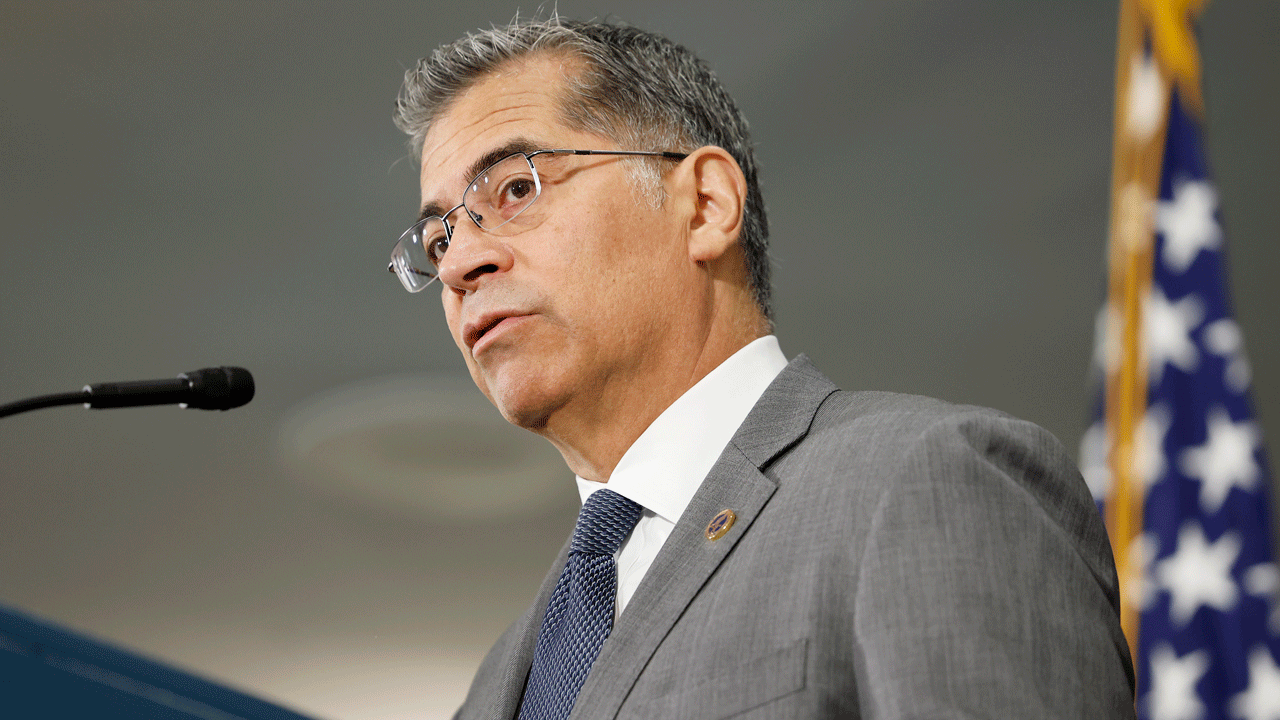
Recent polling shows Xavier Becerra holding a clear lead. The Emerson College poll conducted May 27-28 placed Becerra at 28%, Tom Steyer at 22%, Steve Hilton at 21%, and Chad Bianco at 12%. The UC Berkeley Institute of Governmental Studies survey showed Becerra at 25%, Hilton at 21%, Steyer at 19%, and Bianco between 11% and 13%. The Public Policy Institute of California’s mid-May survey had Becerra at 23%, Hilton at 20%, Steyer at 15%, and Bianco at 13%. Becerra is heavily favored to finish first.
The intense battle is for the second and final advancement spot, and it sits squarely inside the margin of error.
Republicans constitute roughly 25% of California’s registered voters. When sympathetic no-party-preference voters are added in a low-turnout primary environment, the conservative-leaning share of the electorate typically lands between 22% and 25%. In theory, that should be enough to secure one of the two November slots. In practice, the conservative vote is currently fractured between Hilton and Bianco. That split is the central tension of the race.
Hilton’s campaign has argued that Bianco’s support is drawn almost entirely from the same pool of Republican and conservative voters. They contend that every percentage point going to Bianco directly subtracts from Hilton’s total, stalling him in the low 20s while giving Steyer—who draws from a much larger Democratic base—a viable lane to consolidate and overtake for second place. In their view, the continued division risks producing a Becerra-Steyer general election ballot with no Republican voice.
Bianco’s campaign pushes back just as strongly. They maintain that Hilton has not proven he is the strongest general-election candidate and that Bianco’s record as Riverside County Sheriff gives him a better chance to consolidate broader support and mount a credible challenge. Bianco has pointed to his high-profile stands against sanctuary city policies and Proposition 47, arguing these credentials position him as the more authentic and electable conservative in the race. His team has rejected pressure to exit, insisting that voters should decide rather than having the field cleared artificially.
This mutual recrimination—each side calling for the other to step aside—underscores the structural problem of the jungle primary. Democrats enjoy a massive registration advantage, roughly 45% to the Republicans’ 25%. That larger base gives them more margin for error; even with multiple candidates, they can usually consolidate enough votes to advance one or even two contenders.
Republicans, operating from a significantly smaller pool, have far less room for division. A split that might be survivable in a traditional primary becomes potentially fatal in California’s top-two system.
Both candidates bring legitimate conservative credentials. Steve Hilton, a former senior advisor to British Prime Minister David Cameron, has campaigned on a “Califordable” agenda that includes eliminating state income tax on the first $100,000 of earnings or tips, aggressive deregulation, housing supply reforms, strong support for law enforcement, parental rights in education, and suspension of certain green mandates blamed for skyrocketing energy costs. He is leading “Save Girls Sports” rallies while Steyer cheers biological males dominating girls’ track.
Chad Bianco, a career lawman, has built his profile on tangible opposition to sanctuary policies, criticism of soft-on-crime measures, and a visible law-and-order approach in one of California’s largest counties. Supporters of each man passionately believe their candidate offers the clearer contrast against the state’s entrenched Democratic leadership.
Yet the jungle primary does not reward résumés or intentions. It rewards raw vote totals and punishes fragmentation. With early voting already heavy and many ballots already returned, the final 48 hours will determine whether the conservative electorate’s division proves decisive. If the split persists and Steyer edges into second, California could wake up Wednesday morning facing a Becerra-Steyer matchup—two Democrats offering variations on the same policy themes with little serious opposition.
The stakes are substantial. California continues to grapple with chronic homelessness despite billions spent, energy prices among the nation’s highest, housing costs that have driven out working families, persistent retail theft and open drug use in major cities, and heated debates over parental rights and biological reality in school sports. A general election without a Republican on the ballot would offer voters no meaningful choice on these issues.
The jungle primary was sold as a reform to break partisan gridlock. In reality, it has often amplified the power of the state’s dominant party by making it difficult for the minority party to advance candidates when its voters divide.
Past cycles have shown how easily a split conservative field can result in two Democrats advancing, effectively deciding the outcome in November before a single general-election vote is cast.
Tomorrow’s results will not hinge on rhetoric or biography alone. They will reflect cold math: whether enough conservative and independent voters concentrated their support to overcome the structural disadvantage, or whether division delivered the November ballot to a single party.
In a state already facing deep policy challenges and out-migration trends, the difference between a contested general election and an uncontested coronation could shape California’s trajectory for years to come.
We publish a variety of perspectives. Nothing written here is to be construed as representing the views of the Daily Signal.
More from this network:
Domains for Sale · GOTPeople.org · TheDSAPlatform · The Truth About Socialism
What's Your Reaction?
 Like
0
Like
0
 Dislike
0
Dislike
0
 Love
0
Love
0
 Funny
0
Funny
0
 Wow
0
Wow
0
 Sad
0
Sad
0
 Angry
0
Angry
0

I am just an average American. My teen years were in the late 70s and I participated in all that that decade offered. Started working young, too young. Then I joined the Army before I graduated High School. I spent 25 years in, mostly in Infantry units. Since then I've worked in information technology positions all at small family owned companies. At this rate I'll never be a tech millionaire. When I was young I rode horses as much as I could. I do believe I should have been a cowboy. I'm getting in the saddle again by taking riding lessons and see where it goes.
Premium domains for sale














Comments (0)