

‘Irresponsible Escapade’: Alito Rips SCOTUS Majority in Ruling Involving Big Tech Data and a Bank Robbery
Premium domains for sale
Freedom Is Back In Style
The Supreme Court narrowed the conditions for law enforcement to obtain a warrant to access someone’s Google Location History data, ruling that it constitutes a search under the Fourth Amendment.
Freedom Is Back
In Style
Premium domains for sale
In a case involving Big Tech and a bank robbery, the Supreme Court issued a 6-3 ruling Monday that individuals have a reasonable expectation of privacy with their cellphones. The case involved law enforcement’s access to geolocation data used to convict an alleged bank robber—who made a conditional guilty plea. The justices didn’t divide along traditional ideological lines.
Justice Elena Kagan wrote for the majority, joined by the high court’s two other Democrat appointees, Justices Sonia Sotomayor and Ketanji Brown Jackson, as well as Republican appointees Chief Justice John Roberts and Justices Brett Kavanaugh and Neil Gorsuch.
Kagan wrote, “A cell-phone user is not to be viewed as sharing private information with third parties—which then can be freely passed on to the government—just by doing the ordinary things cell-phone users do.”
“The Fourth Circuit did not address the questions that unusual warrant raises,” Kagan later wrote for the majority, referencing the warrant obtained by law enforcement in the case. “Because this is ‘a court of review, not of first view,’ … the Court leaves it up to the Court of Appeals to decide whether, at each step of the search process, the warrant satisfied the Fourth Amendment’s requirements of particularity and probable cause.”
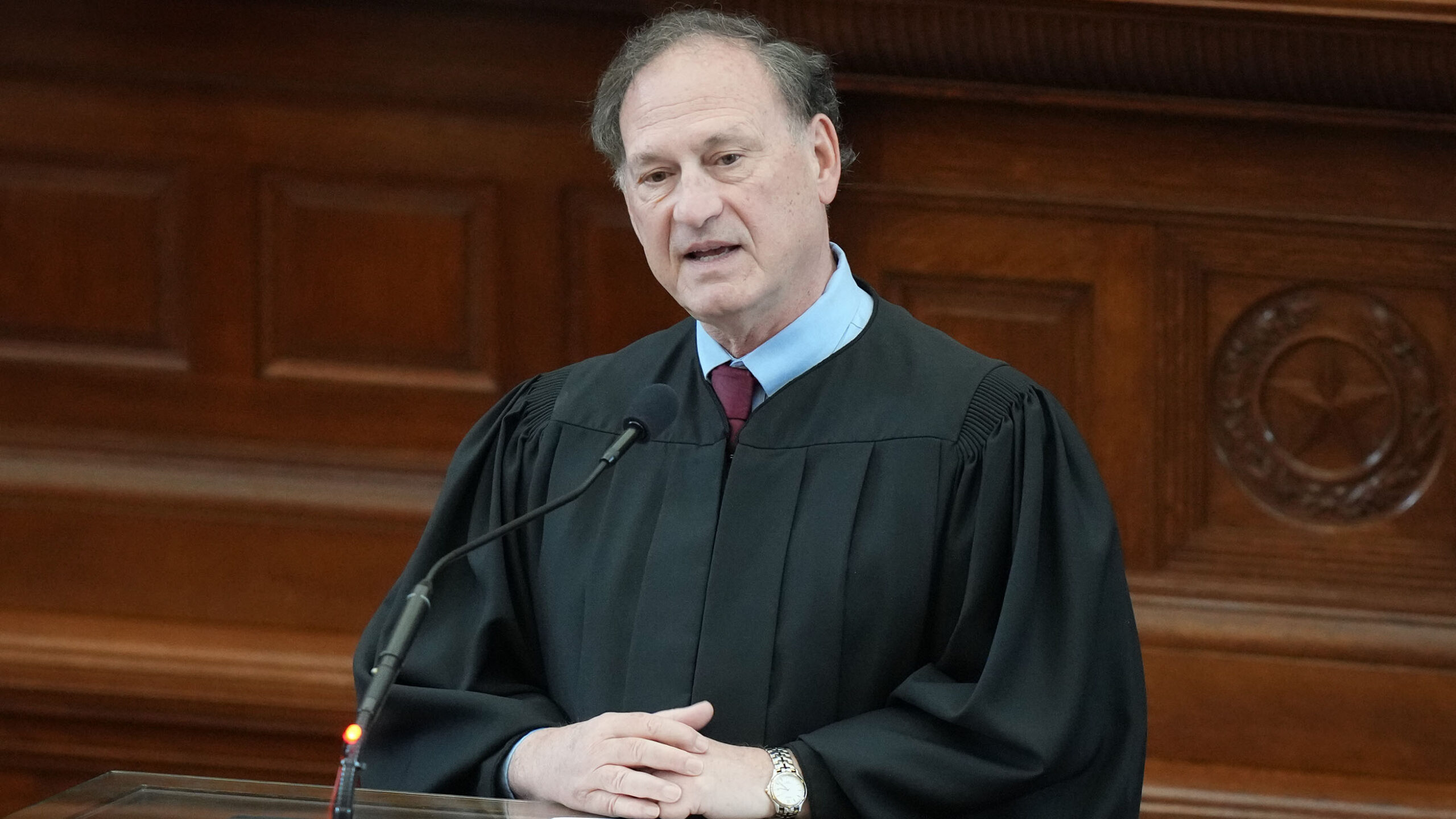
Justice Samuel Alito wrote the dissenting opinion, joined by Justices Clarence Thomas and Amy Coney Barrett.
In his dissent, Alito argued the majority is “striking a pose,” but the case is unlikely to change the outcome.
“Although today’s decision will send seismic waves through our Fourth Amendment doctrine, not one iota of the majority opinion will affect the outcome of this case,” Alito wrote. “The Court knows this and does not claim otherwise. Indeed, by refusing to review the one question that could have at least theoretically given Chatrie some hope of relief, the court carefully set the stage for its planned performance: striking a pose as a great champion of privacy in the digital age. I cannot support this irresponsible escapade.”
The case stemmed from the prosecution of Okello Chatrie, who conditionally pleaded guilty in 2022 to robbing a Midlothian, Virginia, credit union. He reserved his right to make the case for suppressing evidence if it was illegally obtained.
Chatrie’s defense lawyers argued a court-approved geofence warrant used to identify and apprehend him violated the Fourth Amendment. The warrants were used to compel third-party companies such as Google to search customer location data from multiple devices in a finite area during a finite time, in this case, the time of the robbery.
Chatrie was sentenced to nearly 12 years for taking $195,000 from the bank. Law enforcement argued it exhausted other leads in its investigation before resorting to a geofence warrant.
More from this network:
Domains for Sale · GOTPeople.org · TheDSAPlatform · The Truth About Socialism
What's Your Reaction?
 Like
0
Like
0
 Dislike
0
Dislike
0
 Love
0
Love
0
 Funny
0
Funny
0
 Wow
0
Wow
0
 Sad
0
Sad
0
 Angry
0
Angry
0

I am just an average American. My teen years were in the late 70s and I participated in all that that decade offered. Started working young, too young. Then I joined the Army before I graduated High School. I spent 25 years in, mostly in Infantry units. Since then I've worked in information technology positions all at small family owned companies. At this rate I'll never be a tech millionaire. When I was young I rode horses as much as I could. I do believe I should have been a cowboy. I'm getting in the saddle again by taking riding lessons and see where it goes.
Premium domains for sale












Comments (0)