

Is America still a 'first world' country? Not compared to Japan
Premium domains for sale
Freedom Is Back In Style
Recently, someone on X.com said that Japan was the last “first world country" left on earth. I felt an instinctual agreement when I read this statement. America no longer feels very “first world” to me. Not lately.
Freedom Is Back
In Style
Premium domains for sale
When the three worlds concept was first invented — in 1952, during the Cold War — America was the definition of “first world."
Everywhere you looked you saw competence, excellence, and cultural cohesion.
America, most of Western Europe, Japan, Korea, and a few other prosperous nations were “stable capitalist countries with the highest literacy rates, life expectancies, and living standards.”
Communist countries, especially those controlled by the Soviet Union, were considered “second world.” They had modern amenities but limited freedoms. Living conditions were significantly lower. And the governments were coercive and authoritarian.
Poor countries in places like Latin America and Africa were “third world.” These countries suffered entrenched poverty and deeply corrupt, criminal governments.
Which way, Western man?
It seems that America and most of the other first world countries have begun to slide downhill toward second world status.
The citizens of Western nations have watched helplessly while their homelands have been transformed by mass immigration. Can you be a first world country if a large portion of your population just arrived from the third world?
Not to mention the growing presence of Soviet-style socialist/communist ideologies in many of these countries.
In America, we might be one election cycle away from having a Mamdani-style socialist running for president.
Land of the Rising Sun?
Japan has problems too. But having visited there in 2023, their problems are nowhere near our problems.
From the moment I arrived in Tokyo, I felt a sense of safety and order as well as an uplifting feeling of civic and cultural pride.
The city itself was spectacular. The arts were thriving. The technological advancement was instantly apparent. You felt like you were in a science-fiction movie.
At the same time, the past was celebrated and preserved: shrines, torii gates, beautiful parks. Everywhere you looked you saw competence, excellence, and cultural cohesion.
Plus, Tokyo natives were friendly and helpful. If you were lost, were on the wrong train, or had accidentally deviated from some local custom, a Tokyo-ite would appear and cheerfully assist you.
The 'Japanese Wives Club'
In Kyoto, I met a bunch of male, English-speaking expats. They called their group the “Japanese Wives Club,” as most of them were married to local women.
I expressed my admiration for Japanese society to these guys. They assured me there were plenty of difficulties and drawbacks to living in Japan.
But when I asked them if they would eventually leave, they all said no. They liked their Japanese wives. They liked their adopted home.
One guy said he’d recently returned to his hometown of Denver to visit family. Denver was a dump. He wouldn’t even consider moving back there.
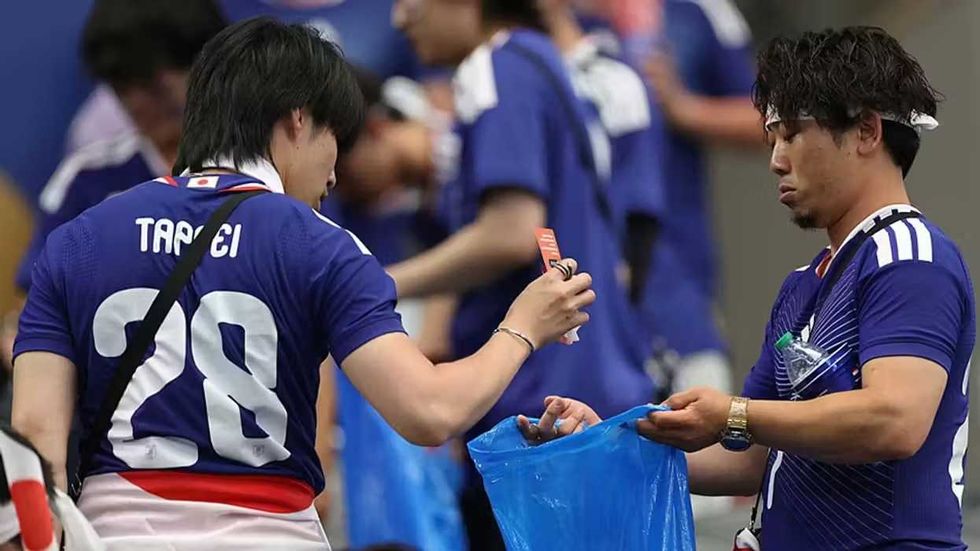
RELATED: Japanese soccer fans show Texas what being a good foreign guest actually looks like
 Charlotte Wilson/Getty Images
Oh thank heaven ...
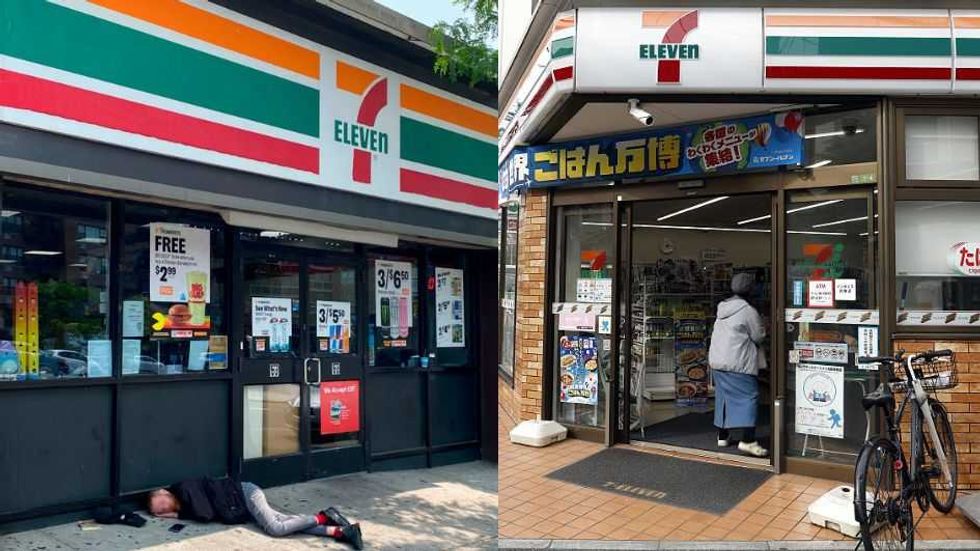
Later in my trip, I stayed in a small village outside Tokyo. Here, there was one grocery store, one café, a few restaurants. And a 7-Eleven.
Being American, I mostly frequented the 7-Eleven. It was immaculately clean and full of exotic snacks and beverages.
But I couldn’t figure out the coffee machine. The first time I tried it, I made such a mess the proprietor — a very old, very skinny Japanese man — came out from behind his counter and began scolding me in Japanese.
After more harsh words, he demonstrated step by step how to work the coffee machine.
The next morning, I returned to the 7-Eleven. When I approached the coffee machine, that same old man watched me with deep suspicion.
But I had paid attention when he showed me which buttons to push. It was actually quite easy. And when I brought my coffee to the counter, he smiled approvingly. So I wasn’t a complete moron! Good for me!
He and I developed a relationship. He was very helpful. He gave me discounts. Not personal discounts, that would be dishonest. But the posted discounts I wasn’t aware of because they were written in Japanese. Two mini pizzas and a Hello Kitty soda ... only 400 Yen!
After four days, I had barely scratched the surface of the most colorful and technologically advanced 7-Eleven I’d ever seen.
Return to the darkness
When it came time to go home, I packed my bag and went to the train station in the center of the town. I had been in Japan a total of three weeks, and I had loved every second of it. But now I had to leave!
I stood in the tiny village square, where I felt TOTALLY SAFE, where everyone wanted to HELP ME, where I had become FRIENDS WITH THE CRANKY 7-ELEVEN guy. There was no #metoo, no BLM, no Antifa, no cries of "racism," no protesters, no nose rings, no LGBTQ flags. Everything worked, nothing was graffiti-ed, no vending machines had been kicked in or destroyed ...
I sat down on a little bench, in that little square, which had been lovingly constructed to create a sense of peace and serenity.
I sat down on that bench, and I started to cry. I had to go back. I had to go back to broken America. And all I could do was cry.
More from this network:
Domains for Sale · GOTPeople.org · TheDSAPlatform · The Truth About Socialism
What's Your Reaction?
 Like
0
Like
0
 Dislike
0
Dislike
0
 Love
0
Love
0
 Funny
0
Funny
0
 Wow
0
Wow
0
 Sad
0
Sad
0
 Angry
0
Angry
0

I am just an average American. My teen years were in the late 70s and I participated in all that that decade offered. Started working young, too young. Then I joined the Army before I graduated High School. I spent 25 years in, mostly in Infantry units. Since then I've worked in information technology positions all at small family owned companies. At this rate I'll never be a tech millionaire. When I was young I rode horses as much as I could. I do believe I should have been a cowboy. I'm getting in the saddle again by taking riding lessons and see where it goes.
Premium domains for sale
















Comments (0)