

NASA Begins Final Countdown Rehearsal For First Crewed Moon Mission In Over 50 Years
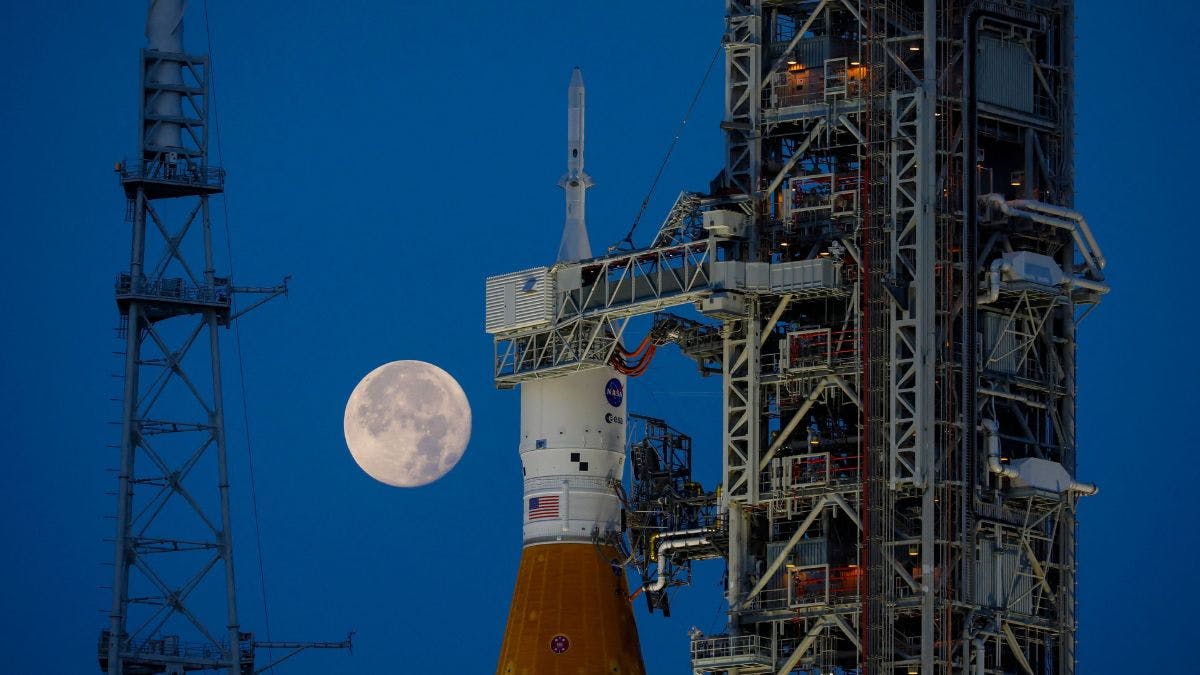
In the early hours of a cold February Sunday morning, a full moon hung low behind NASA’s towering Space Launch System (SLS) rocket at Kennedy Space Center as the agency began a critical two-day practice countdown for Artemis II.
Live Your Best Retirement
Fun • Funds • Fitness • Freedom
The rehearsal simulates every step of launch day short of engine ignition, including loading the rocket with more than 700,000 gallons of super-cold liquid hydrogen and liquid oxygen propellant. The “wet dress rehearsal” marks one of the final major tests before NASA attempts its first crewed mission beyond low Earth orbit in more than 50 years.
If the test proceeds smoothly, it could clear the way for a launch attempt as early as February 8, within a narrow window dictated by orbital mechanics and weather.
While rocket teams work in Florida, the Artemis II crew is already in quarantine at NASA’s Johnson Space Center in Houston. Commander Reid Wiseman, Pilot Victor Glover, and Mission Specialists Christina Koch and Jeremy Hansen entered the agency’s health stabilization program in late January, a standard precaution to prevent illness from disrupting the mission.
The astronauts will monitor the countdown rehearsal remotely before traveling to Kennedy Space Center if the rocket is cleared for flight.
Artemis II will be the first crewed mission to travel beyond low Earth orbit since Apollo 17 in 1972. Over roughly 10 days, the Orion capsule, named Integrity by the crew, will carry the astronauts on a free-return trajectory around the Moon, passing about 6,400 miles beyond the lunar far side before splashing down in the Pacific Ocean.
The crew has trained together since 2023, logging countless hours in Orion simulators, flying T-38 training jets, and participating in mission control tests at Kennedy Space Center. Wiseman is flying his second space mission, Glover his first, Koch returns to space after setting a record for the longest single spaceflight by a woman, and Hansen will become the first Canadian to fly on a lunar mission.
For the astronauts, the flight represents both a technical and generational milestone. Wiseman has described Artemis as the moment when space exploration moves from memory back into lived experience.
“In our lifetime, we’ve looked at the Moon knowing that people had been there,” he said in a NASA interview. “And now in the Artemis generation, kids will walk out and look at the Moon going, we are there. We are there now, and we are going further into our solar system.”
The launch timeline has not been without challenges. The recent deep freeze has delayed the fueling demonstration by two days, forcing teams to adapt by adding heaters to the Orion capsule and adjusting rocket purge systems. The 322-foot-tall SLS rolled out to the launch pad two weeks ago and remains there as engineers work through final checks.
Mission managers have said the lunar flight must launch by February 11 or wait until the next available window later in the year.
The Artemis II crew has framed the mission as something deeper, more connected to human nature. Speaking on NASA’s Curious Universe podcast, Glover described exploration as a defining human impulse.
“Pushing ourselves to explore is just core to who we are,” he said. “We want to know what’s out there just beyond the horizon, and so the Artemis program is our opportunity.”
Koch echoed that sense of inevitability, framing the program not as a revival but as a continuation. “From the time humans started exploring, this was always in our future and in our fate,” she said. “We were always going to the Moon.”
As NASA works toward a sustained human presence on and around the Moon, and eventually Mars, Artemis II marks the moment humanity takes one small step back to the heavens.
What's Your Reaction?
 Like
0
Like
0
 Dislike
0
Dislike
0
 Love
0
Love
0
 Funny
0
Funny
0
 Wow
0
Wow
0
 Sad
0
Sad
0
 Angry
0
Angry
0

I am just an average American. My teen years were in the late 70s and I participated in all that that decade offered. Started working young, too young. Then I joined the Army before I graduated High School. I spent 25 years in, mostly in Infantry units. Since then I've worked in information technology positions all at small family owned companies. At this rate I'll never be a tech millionaire. When I was young I rode horses as much as I could. I do believe I should have been a cowboy. I'm getting in the saddle again by taking riding lessons and see where it goes.




















Comments (0)