

The last knight of Europe rides again
Premium domains for sale
Freedom Is Back In Style
History can tell you what happened at Lepanto. G.K. Chesterton can make you hear it.
Freedom Is Back
In Style
Premium domains for sale
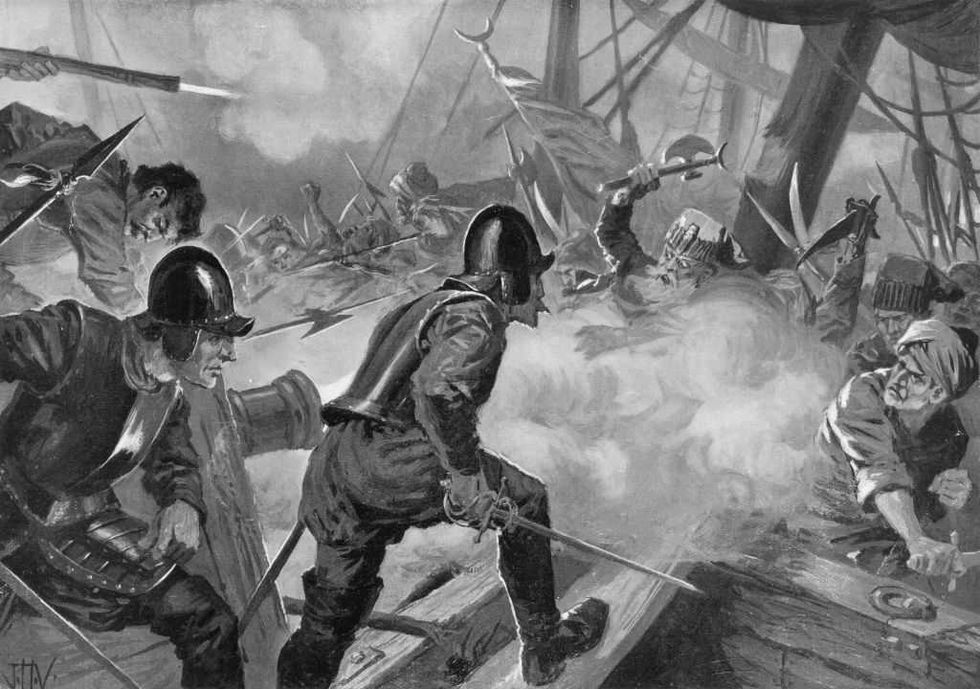
On October 7, 1571, a fleet of the Holy League met the Ottoman navy off western Greece in one of the largest galley battles ever fought. The Christian victory halted Ottoman naval momentum in the Mediterranean and became one of the defining military events of early modern Christendom.
We are not observers of a glorious Christian past.
Four hundred and fifty-five years later, the battle itself is rarely discussed outside history books and Catholic circles. Chesterton’s “Lepanto” helps explain why that is a loss.
The poem does something a chronology cannot. It takes an old battle and makes it present.
That distinction matters because we have largely forgotten how to teach history as inheritance. Too often, the past arrives as a clinical sequence of dates and events — or worse, as a catalog of embarrassments for which the living are expected to apologize. Our ancestors understood that memory had to be cultivated.
I was fortunate enough to grow up partly outside that system. My homeschool education included memorizing and reciting some of the great poems of the Western canon.
Memorization itself was useful. But those poems did more than exercise the mind. They taught me to love and remember the heroes, soldiers, saints, and scholars who built the civilization I inherited.
A textbook can explain the Crimean War. Tennyson makes you hear the cavalry moving: “Half a league, half a league, half a league onward.” A history of Rome can tell you the legend of Horatius at the bridge. Thomas Babington Macaulay puts the choice in the mouth of the man himself:
Then out spake brave Horatius
The Captain of the gate:
“To every man upon this earth
Death cometh soon or late.
And how can man die better
Than facing fearful odds,
For the ashes of his fathers
And the temples of his gods.”
The same is true closer to home. A paragraph about the British march on Concord can explain what happened. Longfellow’s “Listen, my children, and you shall hear” makes a child want to remember it.
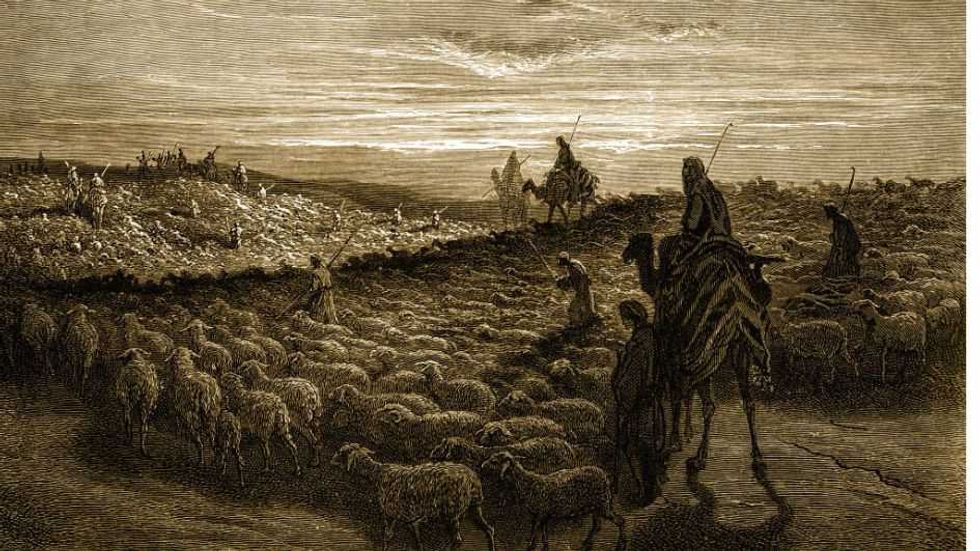
RELATED: Remember the Battle of Lepanto
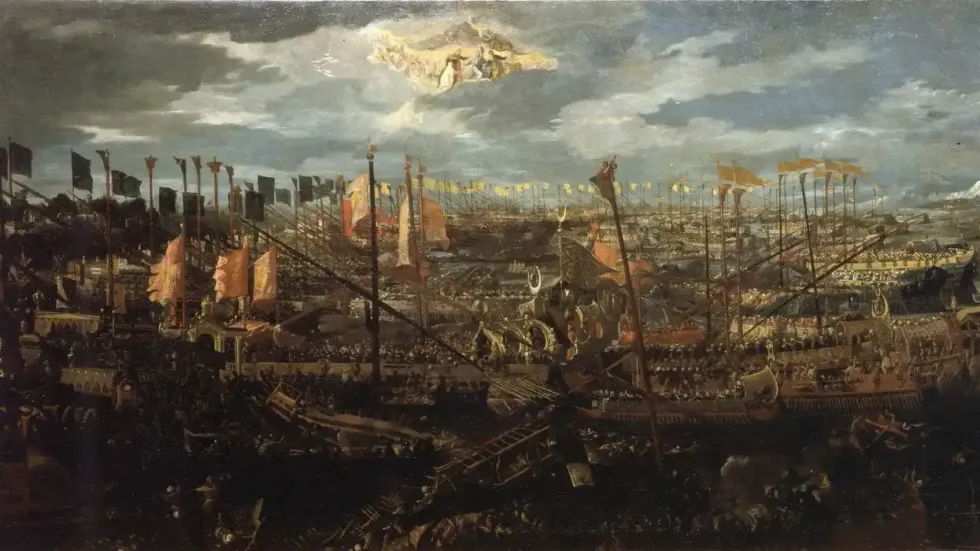 Fine Art Images/Heritage Images/Getty Images
These works are literary masterpieces, but that is not the whole of their value. They are meant to stir the imagination. They give history rhythm, voice, courage, tragedy, and glory.
Chesterton’s “Lepanto” belongs in that company.
He wrote it in 1911, before World War I and more than a decade before he formally entered the Catholic Church. Yet the poem’s religious imagination is already unmistakable. Chesterton does not treat Lepanto merely as a naval engagement. He presents it as civilizational and spiritual combat, with Don Juan of Austria riding into a struggle that reaches backward through Christian history.
The poem’s movement is part of its power: drums, gongs, guns, trumpets, waves, banners, and cannon fire. Chesterton does not ask the reader to stand at a safe academic distance. He drags him onto the deck.
At one point, the Ottoman side hears something older than the fleet approaching it:
But a noise is in the mountains, in the mountains, and I know
The voice that shook our palaces four hundred years ago:
It is he that saith not "Kismet"; it is he that knows not Fate;
It is Richard, it is Raymond, it is Godfrey in the gate!
Chesterton uses “Kismet” to dramatize what he saw as a contrast between fatalism and the Christian refusal to surrender to supposedly inevitable defeat. Richard the Lionheart, Raymond of Saint-Gilles, and Godfrey of Bouillon appear not as museum pieces but as members of the same inheritance. Godfrey, leader of the First Crusade, became ruler of Jerusalem under the title Advocate of the Holy Sepulchre.
The poetry lets the reader place himself in that line. Christian history ceases to be a collection of remote episodes and becomes a living inheritance — something received, loved, defended, and handed on.
That spirit has become difficult for the modern West to summon.
One line from the poem has always stayed with me. Describing a Europe divided by religious conflict while the Ottoman threat advanced, Chesterton writes: “And dead is all the innocence of anger and surprise.”
He was writing about a particular historical moment, but the line captures something recognizable now: spiritual exhaustion disguised as sophistication. We have seen so much, mocked so much, qualified so much, that conviction itself begins to look embarrassing.
Chesterton’s Europe is divided, distracted, and half-convinced that resistance is pointless. The pope calls for “swords about the Cross,” while other rulers hesitate or look elsewhere. Even the Christian captives below the Ottoman decks have nearly stopped expecting deliverance.
Then comes Don Juan.
Dim drums throbbing in the hills half heard,
Where only on a nameless throne a crownless prince has stirred,
Where, risen from a doubtful seat and half attainted stall,
The last knight of Europe taketh weapons from the wall.
That is the great appeal of the poem. Don Juan does not enter because victory is guaranteed. He enters because something must be defended.
RELATED: After 800 years, why do we still treat St. Francis as a glorified garden gnome?
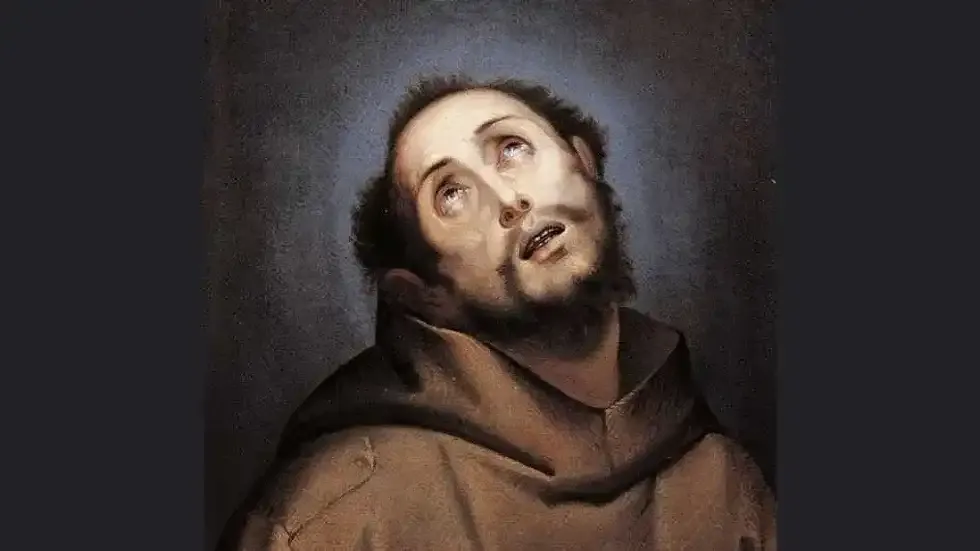 Mondadori Portfolio/Getty Images
Chesterton reminds the reader that courage often arrives from an unexpected quarter. Don Juan, the illegitimate son of Charles V, was hardly born into the tidy life of a storybook hero. Yet he became the man who took command when command was needed.
That is what the old poems can still teach us. We are not merely observers of a glorious Christian past, reading about better men in safer times. We inherit what they defended, and inheritance creates an obligation.
We owe a debt to the saints and heroes who came before us. Honoring it does not require pretending we are Don Juan of Austria. It requires the willingness to take responsibility for what has been handed to us — and the courage to defend what is true when resignation would be easier.
History can tell us that Lepanto happened.
Chesterton reminds us why anyone should care.
In that enormous silence, tiny and unafraid,
Comes up along a winding road the noise of the Crusade.
More from this network:
Domains for Sale · GOTPeople.org · TheDSAPlatform · The Truth About Socialism
What's Your Reaction?
 Like
0
Like
0
 Dislike
0
Dislike
0
 Love
0
Love
0
 Funny
0
Funny
0
 Wow
0
Wow
0
 Sad
0
Sad
0
 Angry
0
Angry
0

I am just an average American. My teen years were in the late 70s and I participated in all that that decade offered. Started working young, too young. Then I joined the Army before I graduated High School. I spent 25 years in, mostly in Infantry units. Since then I've worked in information technology positions all at small family owned companies. At this rate I'll never be a tech millionaire. When I was young I rode horses as much as I could. I do believe I should have been a cowboy. I'm getting in the saddle again by taking riding lessons and see where it goes.
Premium domains for sale
















Comments (0)