

The Media Does Not Want To Talk About This Historic NASA Launch. Here’s Why.
Premium domains for sale
Freedom Is Back In Style
On Christmas Eve of 1968, as American soldiers became increasingly involved in a protracted war in a faraway country, and as political assassinations were becoming a regular feature of domestic politics — stop me if any of that sounds familiar — a single broadcast was watched by more than a quarter of the world’s population. I’ll say that again. One in four people on the planet, across dozens of countries, stopped what they were doing and watched a single broadcast. That had never happened before. And it’s never happened since.
Freedom Is Back
In Style
Premium domains for sale
This massive audience was not tuning into a deranged, depressing political podcast. They weren’t watching a hysterical panel on CNN, or the latest true crime documentary to roll off the assembly line at Netflix, or the season finale of a network television drama that was produced to appeal to the lowest common denominator. They weren’t watching an endless stream of dreck on the internet, either, courtesy of social media algorithms designed to confuse and demoralize them.
Instead, this is what a quarter of the world’s population was watching on Christmas Eve of 1968:
Source: NASA Video/YouTube.com
That’s the most popular broadcast in world history: Astronauts quoting the book of Genesis, on board Apollo 8, as they orbited the Moon. They had gone farther from Earth — a lot farther — than any other astronaut in history. No one else had ever left the Earth’s orbit.
No one else had ever taken a photograph like this one:
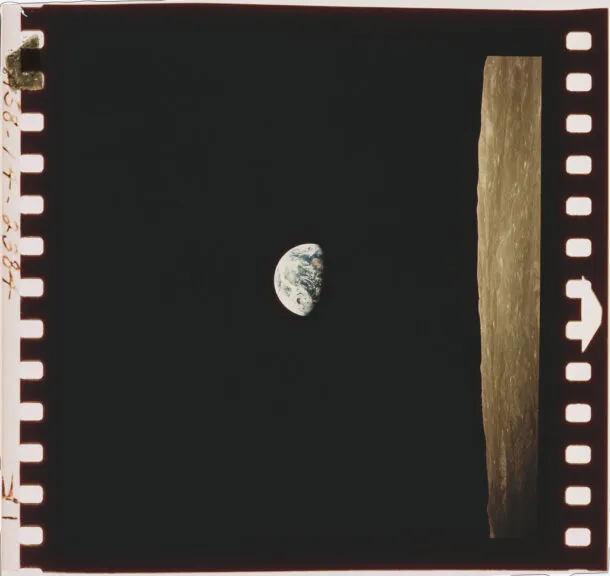
Space Frontiers/Getty Images
You may have seen this picture before.
It shows Earth rising over the horizon of the Moon. It was taken by the astronaut Bill Anders. By any measure, it’s one of the most iconic photographs ever taken.
When they got back to Earth, the astronauts became Time Magazine’s “Men of the Year”. They received a ticker-tape parade. They appeared at the Super Bowl. They got a postage stamp. They addressed Congress. They were treated as heroes because they had done something that seemed impossible — something no one had achieved before. And more than that, this was an achievement that laid the groundwork for many more breakthroughs to come. It was also a clear and unambiguous sign that we had taken the lead in the Space Race over the communists. We were the superior country; therefore, we were producing superior results — results that were unprecedented. And everyone could see that.

A little over 57 years later, after many years of inactivity and dysfunction — which was largely the result of deliberate sabotage, most recently by the Obama administration — NASA is about to achieve another major milestone, something that’s never been done before. That’s the plan. On Wednesday evening at 5:24 PM Central Time, as part of the Artemis II mission, which will last 10 days, four astronauts — three Americans and one Canadian — will travel in the Orion spacecraft to the far side of the Moon, reaching roughly 4,700 miles beyond the Moon. That’s farther into deep space than any crew has gone before in the history of humanity. And when they return, they’ll enter the atmosphere at around 25,000 miles per hour, which is the record for fastest re-entry speed of a crewed vessel.
These are, objectively speaking, historic achievements. It’s historic that NASA is even attempting this. The overwhelming majority of people alive today have never seen a crewed mission to the Moon. The famous clock at the Kennedy Space Center hasn’t counted down to a mission like this — a mission where an astronaut has left low Earth orbit — since 1972. On top of that, just like Apollo 8, the Artemis II mission is part of a new Space Race with a communist power. This time, it’s China that’s trying to beat us to the Moon. They want to get there by 2030. And they’re not just looking for bragging rights. They could try to claim ownership of it — which would drastically alter the balance of power on Earth, if not the solar system.
Despite these stakes, though, you probably haven’t heard much, if anything, about Artemis II. There’s a reporter who goes by the name “Ellie in Space” who just walked around the streets of Boulder Colorado, to see if anyone was aware of this. And while some people had a vague understanding of the mission, for the most part, these are the kinds of responses she received.
Watch:
????DO PEOPLE KNOW THAT WE ARE GOING BACK TO THE MOON!?
☄️Space Youtuber, Ellie and I made a bet if people on the street know about the upcoming launch from the Kennedy Space Center Visitor Complex on April 1st.
????????????????????Many people had never heard of the mission Artemis 2.… pic.twitter.com/MH1zyxu4AM
— Angela Rose (@angelaroosee) March 30, 2026
Source: @angelaroosee/X.com
Unlike the old women at the “No Kings” rallies we talked about yesterday, these people — particularly the random street performer — have an excuse for their ignorance: The media has buried the story of Artemis II. And they’ve done that on purpose, because Artemis II is happening under the Trump administration. Therefore, the media is obligated to undersell it. They’re happy to run a million stories about Katy Perry launching to the edge of space for 12 seconds. But when NASA is on the verge of an historic achievement in space travel, we can’t talk about it — because that would make Trump look good. As a result, NASA is launching a mission around the Moon this week that will send humans farther into space than ever before — a landmark moment in the history of our species — and it’s getting almost no attention.
But history books will care about this moment even if the media doesn’t. I’ll admit that, hearing this, a lot of people are probably skeptical. In response, you might say, well, this mission isn’t actually that big of a deal. After all, we’ve already circled the Moon and landed on it. And that was a long time ago. So who cares if these astronauts are about to go 685,000 miles to the Moon and back?
First of all, even if you disregard all of the scientific significance of what’s about to happen, the fact remains that America has not had a collective achievement to celebrate for a long time. All of our big collective moments have been extremely bad — like 9/11, the invasion of Iraq, the 2008 Financial Crisis, the BLM riots, the COVID lockdowns, the political assassinations, and so on. The “I remember where I was” moments have not been inspiring, to say the least. America hasn’t had a good one of those in decades. Seriously: When was the last time there was a truly historic moment, to the point that, for the rest of your life, you’ll always remember where you were when it happened? Then ask yourself: Is that a high point or a low point in this country’s history? Almost certainly, it’s the latter. If I’m missing something, let me know.
That’s not to say our country hasn’t accomplished anything in the past generation. In fact, we’ve had some major accomplishments in space. Just last year, SpaceX rescued two NASA astronauts who were stranded in space for nine months — which wasn’t exactly easy to do. But it’s unavoidably true that a general decline in many areas, coupled with political polarization, has made collective celebration of anything almost impossible. When SpaceX saved those astronauts, the Left complained because Elon Musk was involved. That’s how broken and demented a large portion of the population has become. It seems like an impossible problem to solve, barring a civil war.
But if we make a substantial, broad push back into space — if we begin exploring new worlds, populating them, and harnessing their potential — then that could be unifying in a meaningful way. Problems on Earth have a way of feeling a lot smaller when you can travel 140 million miles away to a colony on Mars or the Moon, and start a life there. And even the potential for that future, all by itself, can change our culture. Remember when those people went down in that submersible to see the Titanic, and imploded at the bottom of the ocean? Remember how a lot of people made fun of them, for risking their lives to go where almost no living person has ever gone? That was the attitude, all over the Internet — that only a moron would risk his life in search of a new discovery.
Now watch this segment, featuring one of the Artemis II astronauts. See how he handles that type of concern.
Watch:
Source: CBS Evening News/X.com
The interviewer almost can’t believe what he’s hearing. It’s such an unusual statement, that it seems like a foreign language. But the astronaut is right. The “safety culture” of the Left — which is obsessed with avoiding “harm” (including “emotional damage” or whatever) — will lead to the death of humanity. We simply won’t make it, as a species, if the Left gets their way. People who want to “deconstruct” everything — from gender to the nuclear family to the legal system — will never launch a rocket to the Moon. They’ll never build a colony on Mars. They won’t do a single thing to preserve the future of humanity, because they’re deeply resentful people. And they don’t want humanity to continue. If the Artemis mission manages to put a dent in that nihilistic perspective, which millions of Americans are afflicted with, then it’ll be worth whatever it costs.
And to be clear, these astronauts will face very real risks during this mission.
Artemis II is scheduled to launch on Wednesday evening. pic.twitter.com/SBGVPGnmtA
— Tony Dunn (@tony873004) March 29, 2026
Source: @tony873004/X.com
It’s true that, even if the main engine fails, the astronauts will probably still be okay. The Moon’s gravity will slingshot them back to Earth, similar to what happened with Apollo 13 to get those astronauts home. This is called a “free-return trajectory,” and it’s one of the biggest built-in safety valves in the mission. (In addition to the fact that they aren’t even attempting to land on the Moon, which simplifies the mission quite a bit).
But among other things, the astronauts still have to survive re-entry into the atmosphere, at the highest speed ever attempted. And during the unmanned Artemis I mission, which was launched in 2022 in order to test the equipment and make sure everything would work for Artemis II, there was indeed a problem on re-entry. Gas was “trapped within the shield” that heated and expanded, which blew away some of the heat shield.
Watch:
Source: CBS/60 Minutes/YouTube.com
The goal is to enable a new era of space exploration that takes us to several other planets. And there are reasons to think that, unlike what happened after the 1960s, we can actually accomplish that goal this time around. For one thing, we now have several multi-trillion-dollar private companies that have designed technology that could take humans to the Moon, Mars, and beyond. So this is not simply a science experiment, or a proof of concept. For another, it’s now acceptable — for the first time in decades — to openly criticize the anti-white regime that’s emerged from the civil rights era. So none of these space corporations will be destroyed by mandatory affirmative action or DEI, which is what happened to NASA. We are, once again, a country in which the majority of the population wants to reward merit, rather than “equity.” And the consequences of that transformation will be profound.
It’s a very different approach from the one we took in the 1960s, although on the surface, it looks very similar.
Watch:
Source: CBS/60 Minutes/YouTube.com
The point of this new setup that’s being tested, as Elon Musk said, is to enable us to expand far beyond the Moon. In the 1960s, there was no clear plan for doing that. We didn’t have reusable rockets. We didn’t have the refueling system that we have now. And again, private companies didn’t have trillions of dollars in capital to spend on space exploration — in part because the economy was much smaller, and also because they didn’t know how it would benefit them.
But now it’s much more clear how space travel will benefit them. A week ago, in Austin, Elon Musk discussed the benefits of solar panels in space. Unlike solar panels on Earth, the solar panels in space can be arranged so that they always face the sun. They can constantly gather energy. And without the atmosphere in the way, they’re much more efficient. This is obviously very handy, since energy is a prerequisite for civilization. It’s also necessary to power data centers, which are currently straining our electrical grid, if you haven’t noticed.
So how do you get these solar panels in space? It’d be extremely expensive to launch them with rockets. So Musk’s plan is to install a mass driver on the Moon, and use the Moon’s gravity to launch the solar panels and the satellites into space.
Watch:
Source: CNET/YouTube.com
Source: Gear Musk/YouTube.com
This is just one example of how a colony on the Moon could completely change the world economy. It could mean infinite power, essentially. It could mean that we could make the dreams of the 1960s and 70s into reality.
Back in the 1960s, 70s, and 80s, as you may remember, it was commonly assumed we’d have flying cars and Moon colonies by now. Instead, everything’s degraded. As we talked about a few weeks ago, it currently takes longer to fly to London from the United States than it did back then. Airlines want to save on fuel, the skies are much more congested, and security lines are much longer. And that’s not even getting into the Concorde, which is gone now. A Concorde crashed after hitting a piece of debris on the runway — which didn’t even come from the Concorde, by the way — and no one ever wanted to fly the thing ever again. It was too expensive and everyone thought it was a death trap, so the airlines just gave up on it — just like they gave up on good service, and happy flight attendants, and competent pilots.
This is a recurring theme on the show for a reason. Things have gotten worse in large part because everything is so demoralizing now. Even the dystopias of the 1980s weren’t quite this bleak. Yes, Blade Runner was pretty dire. But you’ve got to realize — that was a movie that was set in 2019. They predicted a lot more technological advancement than we have now. No one expected that, outside of a handful of areas (like phones and the Internet), technology would become so stagnant.
But that’s exactly what did happen, largely because of all the garbage we’re wasting our money on. We could easily be a multi-planetary society by now, if we weren’t getting dragged down by entitlement spending, third-world scams, and so on. Something like one percent of the federal budget goes to dialysis payments via Medicare. If you spend $100 in taxes, one dollar is going to dialysis. Think about that.
In 1969, Medicare accounted for about 4% of the federal budget. Now it’s more than three times that amount — roughly 13%, all by itself. And that’s just one program. Total entitlement spending accounted for about a third of the federal budget in 1969. Now it accounts for nearly two-thirds. Medicare alone now costs more than the entire defense budget as a share of the economy.
And by the same token, in 1969, this country didn’t have any Somali fraudsters ripping us off, to the tune of hundreds of millions of dollars. States like California weren’t laundering tens of billions of dollars through fake construction projects, like their high-speed rail or their little wildlife bridge to nowhere. This is what we had instead. This is footage from the ending of Apollo 11, a fantastic documentary that uses only archival footage of the mission.
Watch:
Greatest montage ever made, the U.S. Navy’s preparations to pick up the Apollo 11 Astronauts with the USS Hornet, 1500 mi SW of Hawaii upon Apollo reentry, including 8000 aviators, sailors, frogmen, NASA scientists on July 29, 1969 set to
“Oh Mother Country, I Do Love You” pic.twitter.com/3ng68Jt2YD
— RodeoProfessor (@RodeoProfessor) July 11, 2025
Source: @RodeoProfessor/X.com
You don’t see many Somali fraudsters in those archival shots. There’s no HR department or DEI either. But you do see a lot of very competent people, who happen to be white men, who did something this country hasn’t been able to replicate in many years.
If Donald Trump can reverse our trend towards barbarism and self-sabotage, and make this a country of builders and spacefarers once again, then in spite of any criticisms one might make against him — some of them valid, some of them not — he will truly have made this country great again. It would be an extraordinary vindication for the United States. And it would give hundreds of millions of Americans, for the first time in a generation, something they haven’t had: A sense of pride in our country, and even more crucially, hope for the future.
More from this network:
Domains for Sale · GOTPeople.org · TheDSAPlatform · The Truth About Socialism
What's Your Reaction?
 Like
0
Like
0
 Dislike
0
Dislike
0
 Love
0
Love
0
 Funny
0
Funny
0
 Wow
0
Wow
0
 Sad
0
Sad
0
 Angry
0
Angry
0

I am just an average American. My teen years were in the late 70s and I participated in all that that decade offered. Started working young, too young. Then I joined the Army before I graduated High School. I spent 25 years in, mostly in Infantry units. Since then I've worked in information technology positions all at small family owned companies. At this rate I'll never be a tech millionaire. When I was young I rode horses as much as I could. I do believe I should have been a cowboy. I'm getting in the saddle again by taking riding lessons and see where it goes.
Premium domains for sale



















Comments (0)