

Congress may be quietly seeking to integrate US and Israeli militaries — but critics have taken notice

Premium domains for sale
Freedom Is Back In Style
The House Armed Services Committee released its first draft of the fiscal 2027 National Defense Authorization bill last week.
Freedom Is Back
In Style
Premium domains for sale
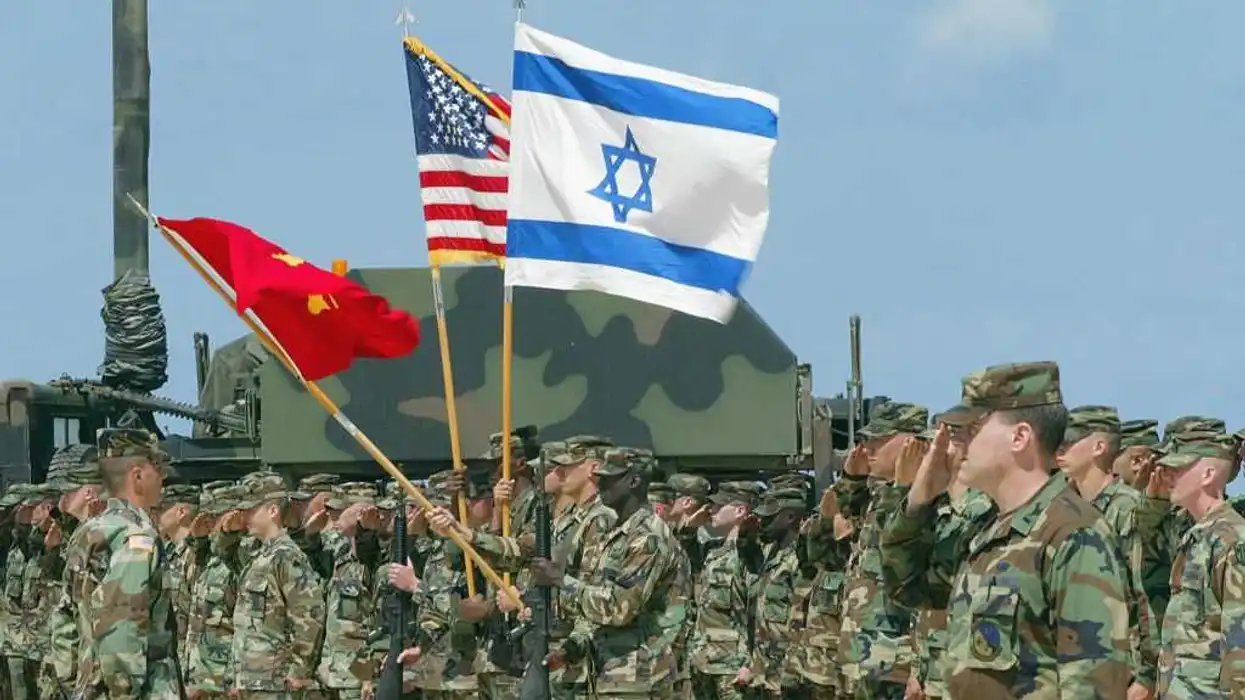
Section 224, a provision buried hundreds of pages into the $1.15 trillion defense policy legislation that outlines the "United States-Israel Defense Technology Cooperation Initiative," has generated some controversy on the fringes of Capitol Hill.
'This provision would flip the script on the current bilateral relationship.'
Committee member Rep. Derrick Van Orden (R-Wis.) is among those who rushed to characterize section 224 as benign, stating that it amounts to a "security agreement" that "will allow for the US to leverage advanced Israeli technologies."
Some, however, have expressed concerns that the initiative will effectively mean a politically consequential integration of the U.S. and Israeli militaries along with their respective industrial supports.
The legislative proposal
Section 224 of the 2027 NDAA draft would have the secretary of war designate a Pentagon official to oversee the synchronization of "cooperative efforts between the United States and Israel, to expand and accelerate bilateral defense technology research, development, testing, evaluation, integration, and industrial cooperation."
The designee would, among other things,
- identify Israeli-origin or jointly developed technologies that the U.S. could integrate into its systems and programs;
- facilitate the transition of such technologies from research and development into procurement and acquisition pathways;
- establish "frameworks for joint ventures, licensing agreements, and United States-based co-production or manufacturing partnerships with Israeli industry"; and
- promote "joint training exercises and information-sharing mechanisms to enhance operational readiness to deploy jointly developed technologies."
The section clarifies that the "cooperative efforts" pursued under this technology initiative can be carried out through numerous domains including: counter-unmanned systems; anti-tunneling and subterranean threats; missile and air defense technologies; AI; directed energy; cyber warfare; biotechnology and biomanufacturing; network integration; and defense industrial base cooperation, manufacturing, and co-production.
Backlash
Ben Freeman, director of the Democratizing Foreign Policy program at the Quincy Institute, claimed in a recent analysis for Responsible Statecraft that "if fully enacted, this proposal would provide a higher level of military-industrial integration than the U.S. has with any other country in the world."
 YOAV LEMMER/AFP/Getty Images
While acknowledging that the U.S. has worked closely "with its NATO partners on co-production and shared supply chains, most notably via the Defence Production Action Plan," Freeman said that section 224 would not only "fuse the U.S. and Israeli defense sectors in multiple areas vital to the battlefields of the future" but afford the foreign power "the opportunity to greatly expand one of the most powerful levers of influence in U.S. politics: jobs in the U.S."
Beyond potentially setting the stage for more Israeli influence over American politics and fusing together the two nations' military-industrial complexes at a time when the majority of Americans hold an unfavorable view of Israel, Freeman — echoing a colleague at the Quincy Institute — suggested that the initiative will shield the relationship from public scrutiny by migrating it from a visible aid vote in Congress "into the opaque machinery of defense acquisition, where oversight is limited and political accountability is minimal."
House Armed Services Committee Chairman Mike Rogers (R-Ala.), the leadership of the Senate Armed Services Committee, and the Pentagon did not respond to Blaze News' requests for comment.
Responding to Freeman's report, departing Rep. Thomas Massie (R-Ky.) tweeted, "If the provision in the NDAA to integrate/synchronize the U.S. and Israeli militaries (section 224) makes it out of committee, I’ll offer an amendment to strip it from the bill on the floor."
"We are a sovereign country," Massie added in a post Rep. Van Orden suggested was the "dumbest possible take."
Democrat Rep. Ro Khanna (Calif.), who serves on the House Armed Services Committee, said that he will introduce an amendment in committee to axe section 224. Khanna noted further that "Trump can't kill the Massie/Khanna partnership no matter how much he posts on Truth Social."
A New Policy, the PAC founded in 2024 by a pair of Biden staffers who quit over the administration's support for Israel, is campaigning against section 224.
"At a policy level, this provision would flip the script on the current bilateral relationship, shifting the leverage we currently hold because of our security assistance to Israel over to the Government of Israel who would be able to hold key [Department of Defense] capabilities hostage through the integration of Israeli technologies into the DOD supply chain," states the PAC's template letter to members of the House Armed Services Committee. "Section 224 also assumes a commonality of national security interests between Israel and the U.S., which, as the current conflict with Iran clearly demonstrates, does not exist."
Code Pink, the leftist group co-founded by former Democrat political activist Jodie Evans, has also seized upon section 224 as a cause du jour, calling upon Congress to reject "US integration with the Israeli military."
Like Blaze News? Bypass the censors, sign up for our newsletters, and get stories like this direct to your inbox. Sign up here!
More from this network:
Domains for Sale · GOTPeople.org · TheDSAPlatform · The Truth About Socialism
What's Your Reaction?
 Like
0
Like
0
 Dislike
0
Dislike
0
 Love
0
Love
0
 Funny
0
Funny
0
 Wow
0
Wow
0
 Sad
0
Sad
0
 Angry
0
Angry
0

I am just an average American. My teen years were in the late 70s and I participated in all that that decade offered. Started working young, too young. Then I joined the Army before I graduated High School. I spent 25 years in, mostly in Infantry units. Since then I've worked in information technology positions all at small family owned companies. At this rate I'll never be a tech millionaire. When I was young I rode horses as much as I could. I do believe I should have been a cowboy. I'm getting in the saddle again by taking riding lessons and see where it goes.
Premium domains for sale





















Comments (0)