

The Oldest Bibles On Earth Leave America In Two Weeks — Then Return To The Dark
Premium domains for sale
Freedom Is Back In Style
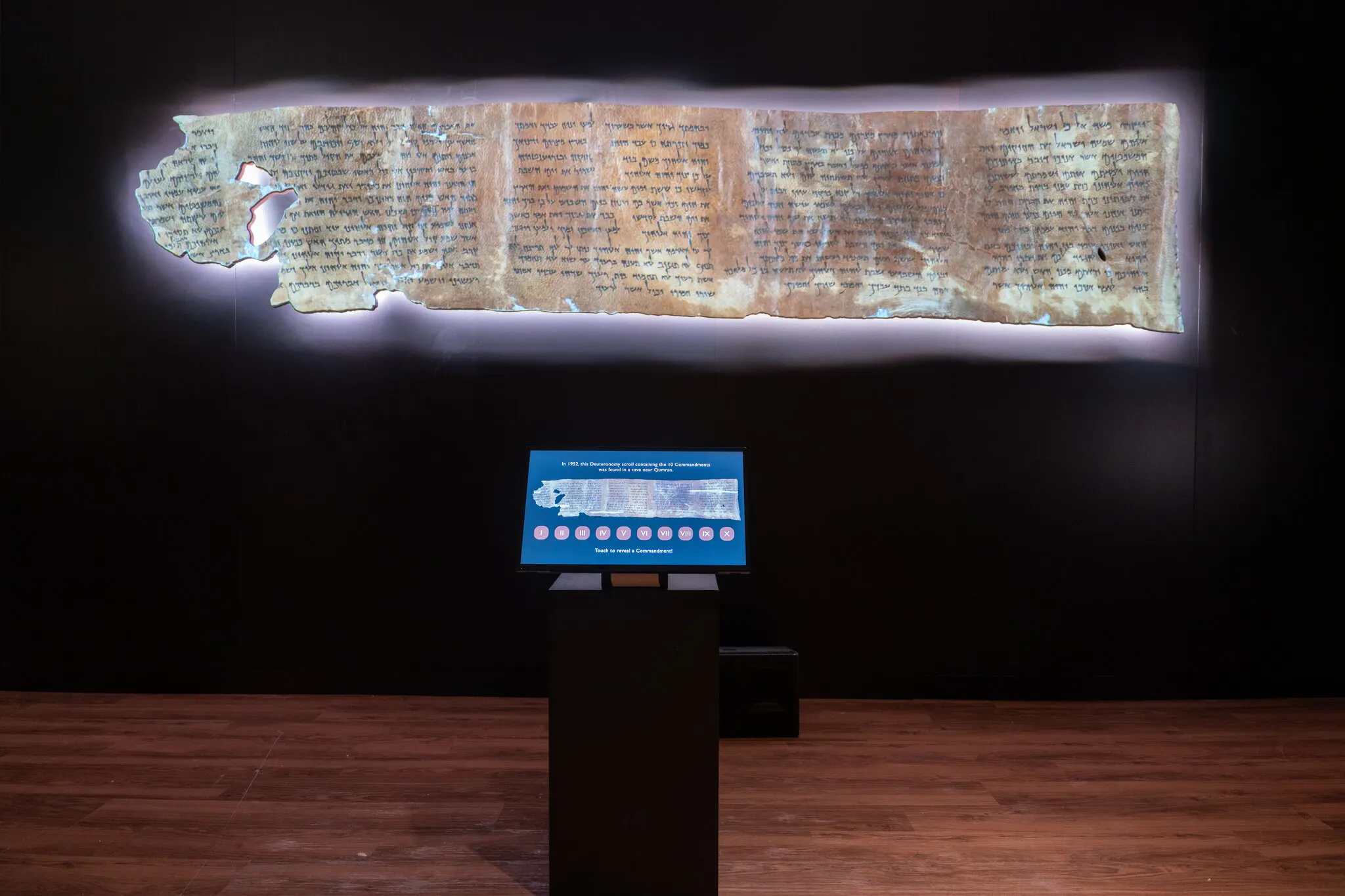
The oldest surviving copies of biblical texts are on view for a final few weeks at the Museum of the Bible in Washington. Dead Sea Scrolls: The Exhibition, now in its last rotation on the museum’s fifth floor, closes September 7. The fragments recovered from the caves near Qumran remain among the most important archaeological finds of the twentieth century, offering a direct window into the Hebrew Scriptures and the Jewish world of the Second Temple period.
Freedom Is Back
In Style
Premium domains for sale
Dr. Carlos Campo, President and CEO of the Museum of the Bible, walked The Daily Wire through the galleries and spoke about what the manuscripts still make clear.
By Campo’s breakdown, roughly a third of the collection is biblical, another third covers the life and rules of the community that preserved the texts, and the rest concerns ancient practice. The people who lived at Qumran are usually called Essenes. They were Jewish separatists who withdrew to a remote place by the Dead Sea, studied the texts with care, and followed strict rules of purification. Campo explains that many scholars believe they settled there to prepare for the coming of the Messiah.
“There was an emphasis on the Messiah,” he says. “So very often, you think of Messiahship only as something related to Christianity, but that’s not true. Matter of fact, not just this scroll, of course, but if you look at the scrolls that were retained by these men in this community, a lot of them talked about the Messiah and the coming of the Messiah. And so while there’s clear debate between Jews and Christians about who was the Messiah, or has the Messiah come, there was no debate about the emphasis on the Messiah, and how he is pointed to in the Hebrew scriptures.”
The same collection shows how varied Jewish life already was. Pharisees and Sadducees appear often in the New Testament. The Qumran group stood outside both. “These men probably were Essenes,” Campo says.
“If they were the Essenes, and that’s what we generally see, they would make up a whole different sect that are outside of those two. And so I think that’s the other thing that these scrolls demonstrate is that, certainly, as within Christianity, that many denominations and beliefs within those denominations, the same is true in Judaism. It’s a very diverse faith.”
One of the fragments on display comes from the Book of Isaiah and includes part of the Suffering Servant passage. Campo returns to the reliability of the text. Before 1947, the oldest Hebrew manuscripts of the Bible available to scholars were medieval, copied in the tenth and eleventh centuries. The Qumran material pushed that horizon back by roughly a thousand years.
“We’re looking at a text even though this was a later Isaiah text, it’ll probably, you know, first century. So, AD. But still, the remarkable similarity between these texts and the text that we have today. So this is at least 1,000 years older than the oldest text that we had. And if you were to compare these texts to those texts, it’s extraordinary how similar they were. I mean, it’s not every jot and tittle, but it’s pretty darn close. So I think that’s one. The whole idea of the reliability of scripture, the Dead Sea Scrolls do many things, but for Jews and Christians today, it’s the reliability of the text.”
A Damascus Document fragment makes the historical texture concrete. It rules that an animal which falls into a well or ditch on the Sabbath should not be pulled out. Jesus spoke of the same situation and took the opposite view. “There’s actually a passage in the one that we have that talks about, what do you do if your animal falls into a well or falls into a ditch. This idea that, which of you, if your animal falls into a ditch, do you not pull it out. Even on the Sabbath. Well, this Damascus scroll actually says, You shouldn’t do that.”
Nearby sits the Magdala Stone, uncovered on the shore of the Sea of Galilee in 2009. Israeli antiquities officials were running a required salvage dig ahead of construction on a Catholic retreat center when a tractor turned up carved limestone barely a foot below the surface.
The stone came out of a first-century synagogue at Magdala, the town most scholars take to be Mary Magdalene’s home. Campo says she would have known the building. Archeologists have since uncovered a second synagogue at the same site.
The museum has its own history with these texts. In 2020, an outside investigation it commissioned and paid for found that all 16 fragments it had purchased and displayed as Dead Sea Scrolls were modern forgeries, manufactured on scraps of old leather to pass for antiquities. Nothing in the current exhibition comes from that collection. The fragments on the fifth floor are on loan from the Israel Antiquities Authority, which holds the authentic corpus recovered from the caves.
Each fragment may stay in the light for only three months. After that it must spend at least five years in complete darkness so the material does not break down further. “They treat these with the utmost care,” Campo says. “They see these as the most important relics in all Jewish history.”
Yet in a time of rising antisemitism the scrolls still function as texts that Jews and Christians both receive, manuscripts capable of closing distance rather than widening it. He reaches for an African saying. “When you’re really far away, you seem to me to be a wild beast. As you get closer, I can see you’re a human being. When you get closer, still, I see you’re a member of my family, and when I feel your breath upon me, I know you are my brother. And to me, that’s a message that is biblical.” He adds, “You have to atomize a human being into something less than human before you can hate them.”
What he hopes visitors take away is a desire to keep reading the written word. “We say that the Bible is one of the few documents in the world where the deeper you go, actually, the more you feel that you know about yourself. The more you know, the more you realize how little you know. That’s one of the things we believe about scripture. The deeper you go, the more you realize my goodness. This document is so much more complex than I thought it was. And to me, the Dead Sea Scrolls reveal some of that.”
The fragments remain on the fifth floor through early September. Then they must return to five years of darkness. Campo hopes people leave with a clearer sense of the continuity these texts have maintained from the Second Temple period to the present.
More from this network:
Domains for Sale · GOTPeople.org · TheDSAPlatform · The Truth About Socialism
What's Your Reaction?
 Like
0
Like
0
 Dislike
0
Dislike
0
 Love
0
Love
0
 Funny
0
Funny
0
 Wow
0
Wow
0
 Sad
0
Sad
0
 Angry
0
Angry
0

I am just an average American. My teen years were in the late 70s and I participated in all that that decade offered. Started working young, too young. Then I joined the Army before I graduated High School. I spent 25 years in, mostly in Infantry units. Since then I've worked in information technology positions all at small family owned companies. At this rate I'll never be a tech millionaire. When I was young I rode horses as much as I could. I do believe I should have been a cowboy. I'm getting in the saddle again by taking riding lessons and see where it goes.
Premium domains for sale




















Comments (0)