

The Politician Under Troy Jackson’s Logging Jacket
Premium domains for sale
Freedom Is Back In Style
Summary
Freedom Is Back
In Style
Premium domains for sale
- Maine Democrat candidate for Senate Troy Jackson has a compelling story.
- There is another side to Jackson: roughly 20 years in the state Legislature.
- His record raises serious questions about how he would legislate.
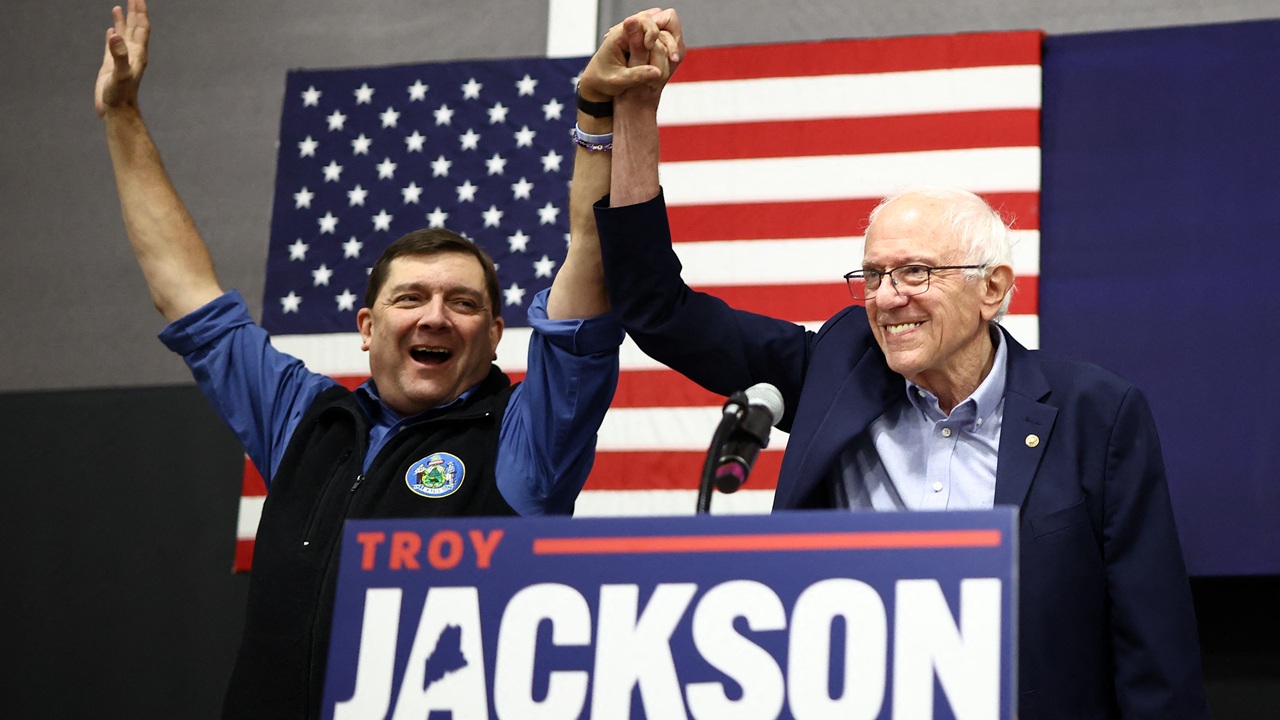
Troy Jackson has a compelling story to tell Maine voters. He grew up poor in a remote logging town, worked long hours in the woods, and promises to take on the wealthy interests he says have abandoned ordinary Americans.
The Democrat nominee challenging Republican Sen. Susan Collins is a fifth-generation logger from Allagash, and his television advertisements make sure voters know it.
But there is another side to Jackson’s biography that deserves considerably more attention: roughly 20 years in the Maine Legislature, including six as president of the state senate.
Jackson isn’t some political newcomer taking on the establishment. For years, he was part of it.
This is despite the fact that Jackson has built much of his campaign around attacking Collins for her ties to corporate donors and wealthy special interests.
Yet in September, The Washington Post reported that Jackson helped lead the Maine Senate Democratic Campaign Committee while it accepted tens of thousands of dollars from pharmaceutical companies, tobacco interests, and gambling businesses.
Among its donors were Merck, Johnson & Johnson, tobacco giant Altria, DraftKings, and FanDuel.
Jackson maintains that fundraising decisions were shared among Democrat leaders and emphasizes that his current Senate campaign rejects corporate PAC contributions.
Nonetheless, isn’t it a bit odd that he attacks corporate money as a corrupting influence in his opponent’s campaign even though he was happy to accept it at the organization he once helped oversee?
His positions on major social issues have also shifted considerably since he first entered politics.
Jackson first ran for the Legislature as a Republican in 2000. After losing, he won as an independent in 2002 and joined the Democratic Party two years later.
Early in his career, he received perfect ratings from Maine Right to Life in 2003 and 2010. In 2009, he voted against legalizing same-sex marriage, and in 2011 supported legislation that would have made it a crime to injure or kill a viable fetus in an attack on a pregnant woman.
Today, Jackson champions “abortion rights” and LGBTQ+ ideology. In 2023, he helped enact legislation allowing abortions even after fetal viability as long as a physician says they are necessary.
Jackson says he changed his mind about abortion after listening to women and health care professionals. But that explanation did not prevent his earlier record from coming back to haunt him during an October debate with Collins.
Jackson attacked her for confirming Supreme Court Justice Brett Kavanaugh, who subsequently voted to overturn Roe v. Wade. Collins countered by pointing out that she had consistently supported abortion rights, while Jackson had opposed them for years.
Jackson’s move from his Republican roots toward the progressive Left has also been reflected in his embrace of Sen. Bernie Sanders, I-Vt.
In 2016, he served as political director of Sanders’ presidential campaign in Maine and backed the self-described democratic socialist over Hillary Clinton at the Democratic National Convention.
Their relationship has endured. Sanders endorsed Jackson’s unsuccessful gubernatorial campaign, and the two appeared together at three rallies in Maine earlier this month.
Their political alliance is reflected in Jackson’s current platform, which shares several of Sanders’ signature proposals, including “Medicare for All” and higher taxes on billionaires and corporations.
Jackson also calls for dismantling and abolishing Immigration and Customs Enforcement, a sweeping proposal that would fundamentally alter federal immigration enforcement.
The gap between Jackson’s campaign rhetoric and his subsequent explanations is especially apparent when it comes to Israel.
His campaign website explicitly declares, “No U.S. tax dollars to Israel’s military,” alongside a demand to end what it describes as “the genocide in Gaza.”
But during an October debate with Collins, he characterized his position more narrowly, saying he opposed giving Israel a “blank check” and supplying additional offensive weapons.
Those are not identical positions. Ending all American military assistance to Israel is considerably different from restricting certain types of weapons.
In September, he also attracted criticism when he told a television interviewer that it was “unfortunate” that some Jewish Mainers resisted describing the Gaza war as genocide because of their Jewish identity and the Holocaust.
He subsequently apologized for generalizing about Jewish Mainers, while standing by his characterization of the war.
The controversy is one more part of a political record that Jackson’s carefully cultivated campaign image does little to illuminate. After two decades in public office, he has accumulated a history of decisions, political alliances, and policy positions that deserves far more attention than the story featured in his television advertisements.
A logging jacket fits neatly into a 30-second television commercial. Two decades of political decisions do not. Yet those decisions tell voters far more about what Jackson might do if given six years in the United States Senate.
We publish a variety of perspectives. Nothing written here is to be construed as representing the views of the Daily Signal.
More from this network:
Domains for Sale · GOTPeople.org · TheDSAPlatform · The Truth About Socialism
What's Your Reaction?
 Like
0
 Dislike
0
 Love
0
 Funny
0
 Wow
0
 Sad
0
 Angry
0

I am just an average American. My teen years were in the late 70s and I participated in all that that decade offered. Started working young, too young. Then I joined the Army before I graduated High School. I spent 25 years in, mostly in Infantry units. Since then I've worked in information technology positions all at small family owned companies. At this rate I'll never be a tech millionaire. When I was young I rode horses as much as I could. I do believe I should have been a cowboy. I'm getting in the saddle again by taking riding lessons and see where it goes.
Premium domains for sale




















Comments (0)