

The Smithsonian Will Teach You About Smut But Not The Founders
Premium domains for sale
Freedom Is Back In Style
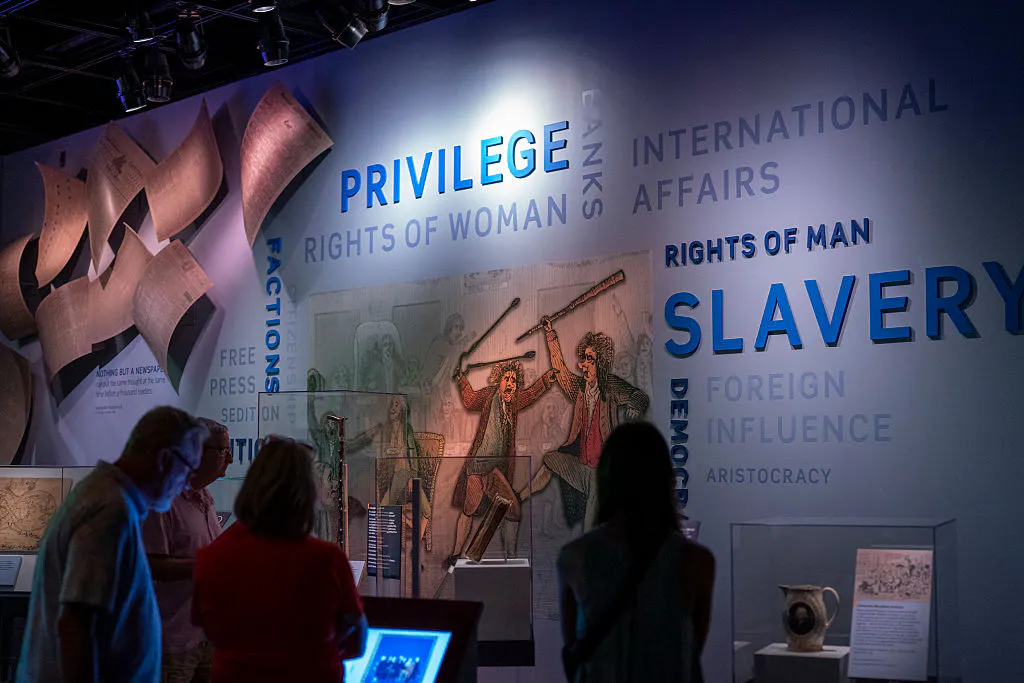
Take your family to the National Museum of American History during the nation’s 250th anniversary year and consider what they won’t find.
Freedom Is Back
In Style
Premium domains for sale
There is no major exhibit telling a coherent story about George Washington, Thomas Jefferson, the Continental Congress, the Declaration of Independence, or the American Revolution.
But in a recent “Girlhood: It’s Complicated” exhibit, your children could read pages from the diary of a six-year-old girl who “pray[ed] to God every night for my penis to grow.” They can also learn about a bisexual blues singer, a lesbian actress, a sexually liberated film star, an LGBTQ icon, a lesbian TV star, a gay major league baseball player, and a queer women’s soccer player. Other museum exhibitions — some physical and some online — have featured video of drag performers, magazine images of nude or partially nude women, and a chrome-and-rubber harness designed for sadomasochistic sex.
In the “Entertainment Nation” exhibit, your family will learn that P.T. Barnum’s circus symbols were about “maintaining white supremacy,” that ukuleles are “a product of U.S. imperialism,” that Wild West Shows were about “the subjugation of Indigenous people,” and that Mickey Mouse represents “vestiges of longstanding traditions of blackface minstrelsy.”
Don’t get me wrong. This Smithsonian museum still contains some of the most iconic artifacts of American history — the desk on which Jefferson wrote the Declaration of Independence, Washington’s uniform as commander in chief of the Continental Army, and the great American flag that inspired the national anthem.
But let’s face it: the National Museum of American History is no longer the nation’s museum of American history.
On Tuesday I testified before a House subcommittee about a new White House report, “Saving America’s Story,” which documents this overhaul in more than 160 pages and 522 footnotes. As always, the devil is in the details. But the details are evidence of a larger transgression.
The real crime here, premeditated and followed through, is that America’s story — the well-established narrative of main characters and key events that has long been at the center of American self-understanding — has been reframed, jettisoned, decentered, deconstructed and “problematized” until it no longer exists in recognizable form.
This wasn’t the museum Congress authorized. Smithsonian leaders argued in 1953 that the museum should provide “a stimulating permanent exposition that commemorates our heritage of freedom.” At its opening, the museum’s director said it was intended to “awaken in citizen and foreigner alike a clear understanding of the inspiring story of the United States, its origins, struggles, development, traditions, strength.” President Lyndon B. Johnson hoped its great artifacts would “foster patriotism.”
The museum’s current leadership has chosen a different purpose. Director Anthea Hartig has said that the museum works “to reframe the traditional celebratory narrative of U.S. history,” that history is for her “a prime tool of social justice,” and that the institution must connect “research and scholarship to activism and advocacy.”
This change was written into the museum’s new mission. Its previous mission was to “explore the infinite richness and complexity of American history” to better understand the past. The new mission is: “Empowering people to create a more just and compassionate future by exploring, preserving, and sharing the complexity of our past.”
“Infinite richness” is dropped, leaving only “complexity.” “American history” is replaced by “our past.” Understanding gives way to empowerment. History becomes a tool to encourage change.
The new exhibits are the fruits of that redesign.
“Upending 1620” reframes the Pilgrims chiefly as colonizers, treats Thanksgiving as a “National Day of Mourning,” and displays a banner urging visitors to “Boycott Plymouth.” “The Electric Dr. Franklin” exhibit asks us to speculate, without any evidence, whether Franklin conducted electrical shock experiments on slaves.
“American Democracy: A Great Leap of Faith” reinterprets the American idea to mean resistance to persistent racial hierarchies and systemic flaws through petition and protest. “Many Voices, One Nation” describes the settlement of America as a “profound unsettling of the continent” and reframes “our past” to be cross-cultural encounters of ethnic, sexual, and racial identity groups seeking restorative justice from an oppressive system.
To be clear, these aren’t efforts to add neglected facts to a familiar, consensus history. They dismantle that history. The key figures are set aside. The key events are decontextualized. Chronology disappears. America becomes an assortment of encounters and social actions that empower a new public identity.
This isn’t history based on established facts and known reality. Indeed, it isn’t history at all. It is ideology: a systematic framework for interpreting society and instigating a political agenda.
The National Museum of American History should tell the American story, warts and all, so that visitors understand how the nation got to where it is today. Nothing integral to that history should be erased or whitewashed. It should tell the history of a nation and a people driven to overcome injustice and live up to their heritage, a story of imperfection but also overwhelming accomplishment, of tragedies but also great triumphs, of hardship but also heroism.
Social transformation should not be the objective.
Each generation should have a knowledge of America’s founding principles, a reverence for their liberties and a love of their country. A healthy attachment to this country is neither blind to its flaws nor fanatical in believing that America is the source of all good. But a national museum focused on claims of systemic oppression teaches national self-loathing. And without the civic foundation supplied by the reflective patriotism of a self-governing people, our republic will perish.
The great artifacts are still at the National Museum of American History. What is missing is the great story that makes them intelligible, and that makes our country worthy of our affection.
Congress and the Smithsonian’s Regents should insist that the ideologically captured NMAH be made the national museum of American history again.
***
Mr. Spalding is the Kirby Professor in Constitutional Government and dean of the Van Andel Graduate School of Government at Hillsdale College’s Washington, D.C. campus.
More from this network:
Domains for Sale · GOTPeople.org · TheDSAPlatform · The Truth About Socialism
What's Your Reaction?
 Like
0
Like
0
 Dislike
0
Dislike
0
 Love
0
Love
0
 Funny
0
Funny
0
 Wow
0
Wow
0
 Sad
0
Sad
0
 Angry
0
Angry
0

I am just an average American. My teen years were in the late 70s and I participated in all that that decade offered. Started working young, too young. Then I joined the Army before I graduated High School. I spent 25 years in, mostly in Infantry units. Since then I've worked in information technology positions all at small family owned companies. At this rate I'll never be a tech millionaire. When I was young I rode horses as much as I could. I do believe I should have been a cowboy. I'm getting in the saddle again by taking riding lessons and see where it goes.
Premium domains for sale


















Comments (0)