

Trump Is Right: DC Needs a Triumphal Arch
Premium domains for sale
Freedom Is Back In Style
The District of Columbia, despite all its imperfections, has much to offer. It is a city buzzing with bright young people hoping to serve the country; featuring world-class museums, cultural institutions, and restaurants; and containing some of the most beautiful works of architecture in North America.
Freedom Is Back
In Style
Premium domains for sale
The city’s buildings span nearly every genre of traditional and classical architecture. The city boasts the stately townhomes of Capitol Hill and Georgetown, the Beaux-Arts Jefferson Building that houses the Library of Congress, and even more inventive works such as Paul Cret’s Art Deco-inspired Folger Shakespeare Library.
Yet for such a distinguished city, something fundamental to the Western architectural canon has long been conspicuously absent: the triumphal arch.
The triumphal arch emerged from the Roman civic-religious rite of triumph, and it is informed by Greek technical achievements. The most complete expression of the form is the Arch of Constantine in Rome.
The Arch of Constantine embodies within its structure the foundations of Western civilization: Greek philosophy, Roman law, and Christian virtue. This arch was erected to commemorate the first Christian emperor’s victory over Maxentius at the Battle of the Milvian Bridge. It translates the metaphysical into the material, “making visible what is invisible,” to borrow a phrase from Pope St. John Paul II.
A millennium after the fall of the Western Roman Empire, a renewed appreciation for classical form emerged. It began with the 16th-century Venetian architect Andrea Palladio, whose works continue to enchant visitors today, and culminated in the aesthetic theory of 18th-century art historian Johann Joachim Winckelmann, whom Daniel Boorstin described as the “prophet and founding hero of modern archaeology.”
This movement reinvigorated classical architectural forms, which ultimately led to the post-classical triumphal arches that dot Western capitals.
The history of post-classical triumphal arches is also the history of modern civic-nationalism. Such arches provide templates for nation-states to honor their heroes. For example, Paris boasts the Arc de Triomphe that was partially erected to honor Napoleon, while London has the Wellington Arch, designed to memorialize the very man who vanquished the “Little Corporal” into exile during the War of the Seventh Coalition.
One of the most famous of these arches is Berlin’s Brandenburg Gate, commissioned by King Frederick Wilhelm II as a peace monument. As Providence would have it, almost two centuries after its construction, the gate came to signify the unraveling of Soviet tyranny over Eastern Europe.
(Even Brussels, the capital of a Frankenstein-esque polity, has a triumphal arch: the Arcade du Cinquantenaire.)
Given all this, it’s surprising that the U.S., with a political regime modeled in part on Rome’s, has long had the sorry distinction of having the only major Western capital lacking a triumphal arch.
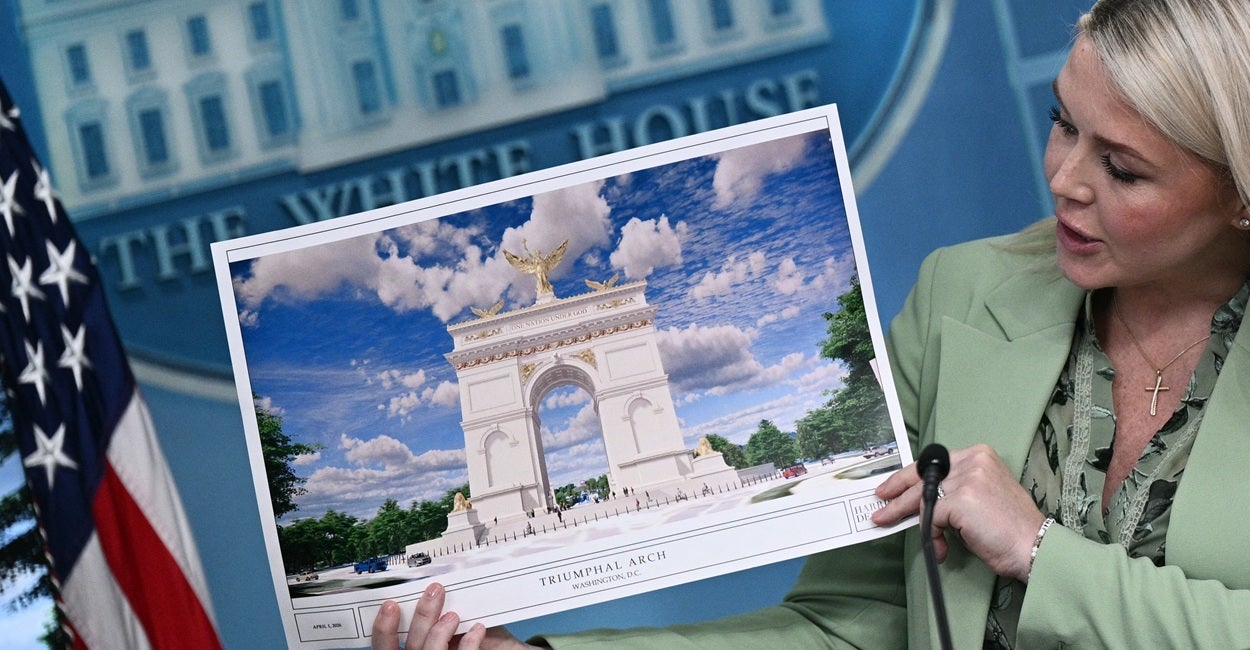
Fortunately, this will soon change. On April 15, White House press secretary Karoline Leavitt, flanked by Interior Secretary Doug Burgum, released renderings of a 250-foot triumphal arch. This fitting tribute to the country and its monumental achievements was soon submitted for review to the Commission of Fine Arts, the federal agency responsible for overseeing the aesthetic quality of the nation’s capital.
Working with lightning speed, the commission voted to approve the arch the following morning at its monthly meeting, with construction expected to begin immediately. Funding for the monument will come from $15 million repurposed from the National Endowment for the Humanities.
The D.C. Triumphal Arch is set to join the monumental ensemble that connects the Lincoln Memorial and the hallowed ground that is Arlington National Cemetery. It is intended to have the same transcendent quality as classical architecture, belonging as much to posterity as to the present and the past.
When unveiling the design, Leavitt stated, “Long after everyone in this room is gone, our children and grandchildren will remain inspired by this monument.”
And indeed, future generations will be. While the president’s personal aesthetic preference is clearly reflected in the gold-clad “Lady Liberty” statue atop the attic and the ornamentation along the planar pier, the arch remains in keeping with the monumental style of restrained yet dignified classicism characteristic of the city’s architectural landscape.
The arch is particularly evocative of the West Building of the National Gallery of Art, which was designed by John Russell Pope. Pope also gave the capital city the Jefferson Memorial, which was modeled after the Roman Pantheon. With that in mind, the arch can be understood as completing the classical canon that defines the National Capital’s landscape, spanning from Pope’s Pantheon through Henry Bacon’s temple-like design for the Lincoln Memorial to Robert Mills’ Washington Monument, a modern iteration of the obelisk.
Perhaps the most important aspect of the arch proposed design is its inscription: “One Nation Under God,” a reminder of who we are as a people and what binds us together in common purpose.
The design for Washington’s soon-to-be newest icon demonstrates that America at its best is a land where citizens give thanks not only to the Lord Almighty for the blessings of liberty and the fruits of abundance, but also to the heroic men and women who have sacrificed to preserve those gifts.
We publish a variety of perspectives. Nothing written here is to be construed as representing the views of The Daily Signal.
The post Trump Is Right: DC Needs a Triumphal Arch appeared first on The Daily Signal.
More from this network:
Domains for Sale · GOTPeople.org · TheDSAPlatform · The Truth About Socialism
What's Your Reaction?
 Like
0
Like
0
 Dislike
0
Dislike
0
 Love
0
Love
0
 Funny
0
Funny
0
 Wow
0
Wow
0
 Sad
0
Sad
0
 Angry
0
Angry
0

I am just an average American. My teen years were in the late 70s and I participated in all that that decade offered. Started working young, too young. Then I joined the Army before I graduated High School. I spent 25 years in, mostly in Infantry units. Since then I've worked in information technology positions all at small family owned companies. At this rate I'll never be a tech millionaire. When I was young I rode horses as much as I could. I do believe I should have been a cowboy. I'm getting in the saddle again by taking riding lessons and see where it goes.
Premium domains for sale


















Comments (0)