

Trump's FCC is finally clearing the path for landline upgrades

Premium domains for sale
Freedom Is Back In Style

Most Americans today use modern, IP-based communications networks. However, 2% of Americans (about seven million people) still depend on legacy copper telephone systems. These networks are increasingly expensive to maintain, inefficient to operate, and vulnerable to both physical degradation and criminal exploitation.
Freedom Is Back
In Style
Premium domains for sale
Retiring these outdated systems and replacing them with fiber, wireless and satellite alternatives would be an easy win for consumers and providers alike, and it is something carriers have been trying to do for more than a decade. However, as is so often the case, progress was blocked by bureaucracy.
The copper-based 911 emergency system was built for an era of voice-only communication and fixed locations.
However, that era appears to be at an end thanks to Federal Communications Commission Chairman Brendan Carr, who advanced a framework that gives carriers a clear path to retire copper networks responsibly while protecting consumers during the transition.
One of the most visible and frustrating failures of today’s legacy communications system is the explosion of robocalls. Scam and spam calls are the No. 1 consumer complaint to the FCC, with hundreds of thousands of reports filed annually and billions of illegal automated calls disrupting daily life.
These calls are not just minor annoyances, they are one of the major vectors for fraud, identity theft, and psychological manipulation — and they disproportionately target seniors and vulnerable populations.
Unlike legacy copper systems, modern IP-based networks can deploy authentication protocols such as AI-driven filters and network-level call verification. These defenses can stop robocalls and scammers before they reach consumers.
Public safety is another driving force behind modernization. The copper-based 911 emergency system was built for an era of voice-only communication and fixed locations. It is increasingly insufficient for how Americans communicate today.
Next Generation 911 replaces this outdated infrastructure with an IP-based system capable of receiving texts, photos, videos, and precise location data — including vertical “z-axis” positioning in multistory buildings.
NG911 enables faster emergency response, more accurate caller location, and better situational awareness for first responders. It also improves accessibility for hearing- and speech-impaired individuals, ensuring emergency services are truly universal.
The importance of upgrading is further heightened by a rising infrastructure security problem: copper theft. Criminals targeting underground and aerial lines have created a nationwide crisis, costing utilities and communications providers more than $1 billion annually.
Copper theft can knock out 911 service, disrupt broadband access, and leave entire communities without reliable communications. Every stolen segment must be replaced at significant cost to ratepayers and providers, perpetuating a cycle of damage that modern networks largely avoid.
For over a decade, providers have sought permission to retire copper infrastructure and transition fully to modern alternatives. Progress was slowed by a regulatory process that often required lengthy filings, public comment cycles, and unpredictable approval timelines stretching months or even years.
RELATED: One crash, one derailment — and Congress still can’t follow the data
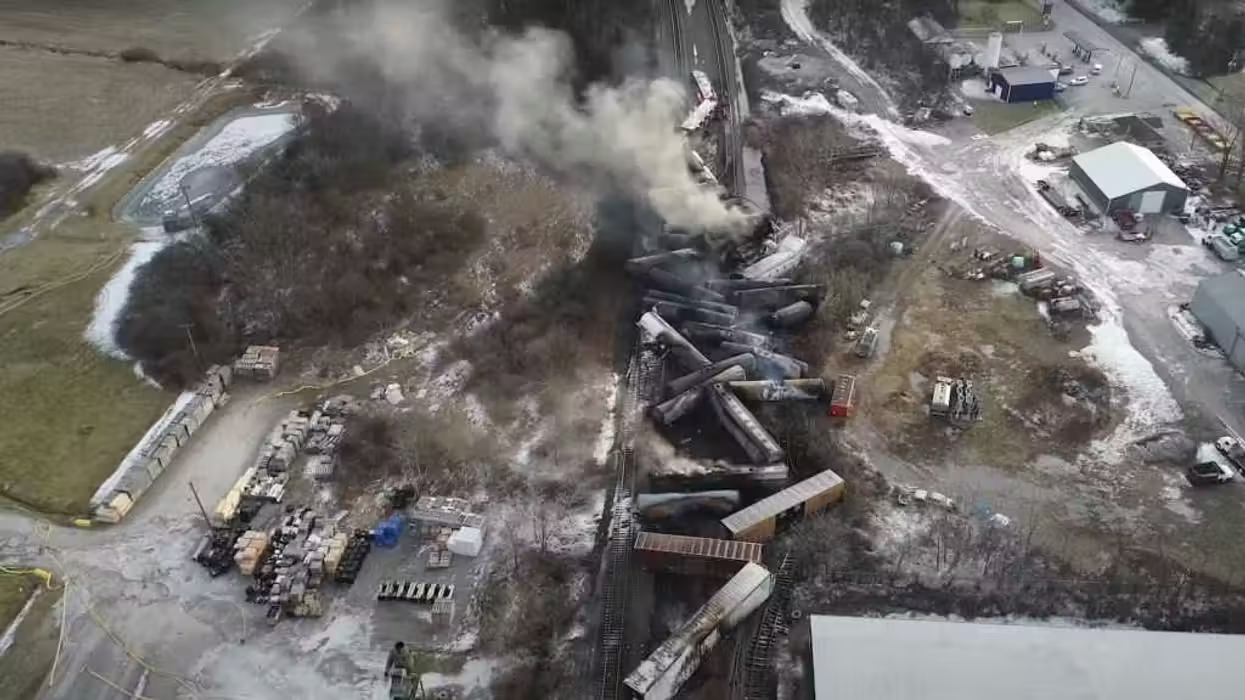 NTSB/Handout/Xinhua/Getty Images
The FCC’s new modernization framework — advanced under Chairman Carr — changes that approach. Carriers may now proceed with copper retirement provided they give at least 90 days’ notice and ensure continuity of service throughout the transition.
Some critics have warned that retiring copper could disrepute service or lead to increased costs.
But these concerns overlook the fact that Americans already have alternatives at scale — fiber, cable broadband, mobile wireless, and satellite services capable of delivering both voice and data.
Even traditional landline-style handsets can be adapted to IP networks, preserving familiarity for users who prefer it. As for affordability, competition across wireless and broadband markets has expanded significantly, with multiple providers offering low-cost voice and data plans.
Prices are down roughly 6% since the Trump administration’s policy push on spectrum expansion and infrastructure investment during his first term helped unlock additional capacity and competition. At the same time, service quality and speeds have improved, making legacy copper increasingly unnecessary and economically inefficient to maintain.
There is also a major environmental and economic opportunity in retiring copper responsibly. Once decommissioned, copper is recovered through certified processes, such as stripping, granulation, and smelting. It is then reintroduced into manufacturing supply chains for wiring, construction, and industrial applications.
Over time, this recovery stream represents billions of dollars in reusable material value, while reducing illegal theft incentives and ensuring environmentally responsible disposal. The tech transition order positions America for generations to come, and there’s not a moment to lose.
More from this network:
Domains for Sale · GOTPeople.org · TheDSAPlatform · The Truth About Socialism
What's Your Reaction?
 Like
0
Like
0
 Dislike
0
Dislike
0
 Love
0
Love
0
 Funny
0
Funny
0
 Wow
0
Wow
0
 Sad
0
Sad
0
 Angry
0
Angry
0

I am just an average American. My teen years were in the late 70s and I participated in all that that decade offered. Started working young, too young. Then I joined the Army before I graduated High School. I spent 25 years in, mostly in Infantry units. Since then I've worked in information technology positions all at small family owned companies. At this rate I'll never be a tech millionaire. When I was young I rode horses as much as I could. I do believe I should have been a cowboy. I'm getting in the saddle again by taking riding lessons and see where it goes.
Premium domains for sale






















Comments (0)