

What ‘No Limits’ Abortion Actually Looks Like
Premium domains for sale
Freedom Is Back In Style
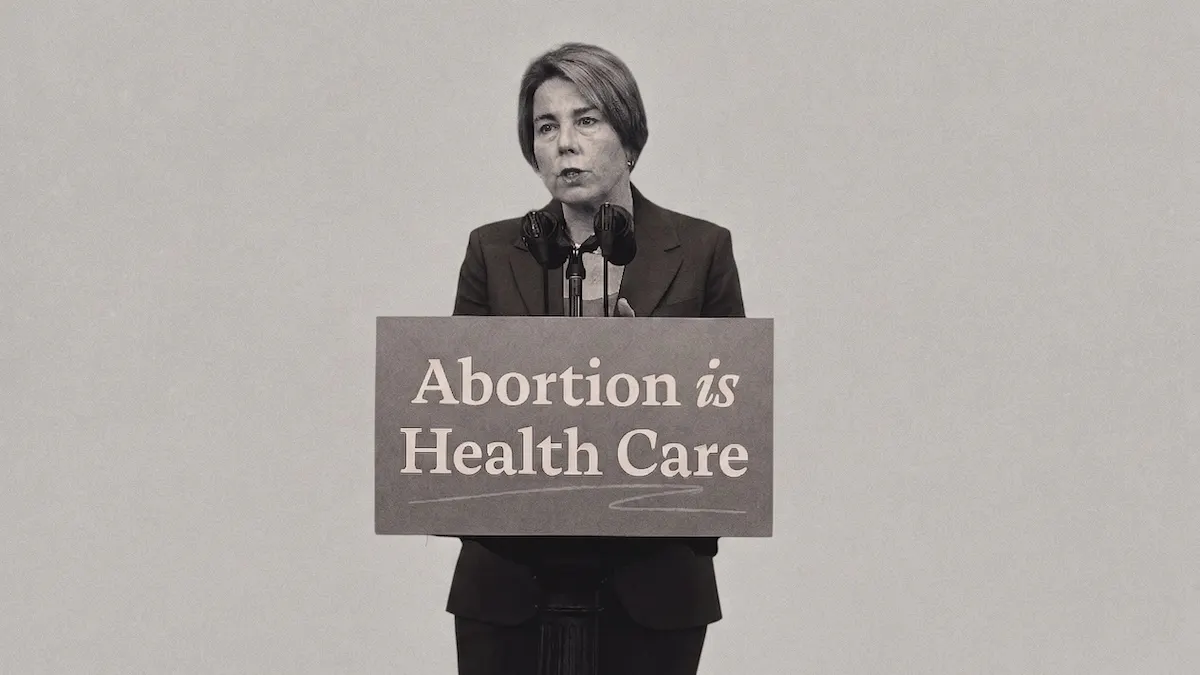
Massachusetts already had some of the most lax abortion laws in the country, allowing it up to 24 weeks — a stage in pregnancy in which over 10,000 babies are born and survive each year in the United States. Gov. Maura Healey didn’t think that was good enough. This week, surrounded by a gaggle of gleeful young women, she signed a law barring any gestational limits on abortion.
Freedom Is Back
In Style
Premium domains for sale
Massachusetts joins nine other states that occupy an extreme position on this issue, even by international standards, where only 15 countries permit elective abortion past 15 weeks. Sixty-five percent of countries that allow elective abortion limit it to 12 weeks or less.
Pro-choice lawmakers and activists like Healey are presumably still angry that the United States overturned Roe v. Wade in 2022. They’ve been working tirelessly to retaliate against pro-life laws, and this is their latest victory.
States like Virginia are considering similar measures. This November, voters will decide on a constitutional amendment that would dramatically expand abortion protections, including a guarantee that the state may never prohibit a third-trimester abortion that a physician deems necessary to protect a woman’s physical or mental health. Interpreted broadly, that means abortion for any reason, since “mental health” is subjective enough to cover nearly any circumstance.
Supporters of no-limit abortion claim such laws are necessary to save women’s lives in emergency situations, but they’re inclined to euphemize the reality with language like “expanded access to reproductive healthcare.” The sanitized phrasing works for them: It disguises what abortion actually is. Mass. Lt. Gov. Kim Driscoll did exactly this when she assured citizens the law was all about “compassion, support and the ability to receive care,” framing it as a route to “medically appropriate care close to home.”
Driscoll, Healey, and legislators may say third-trimester abortions are a necessary safeguard for mothers facing medical emergencies, but some physicians who actually manage high-risk pregnancies disagree. The American Association of Pro-Life OBGYNs (AAPLOG) states unequivocally that late-term abortions are never necessary; in any true third-trimester emergency, whether severe preeclampsia, placental abruption, or maternal sepsis, the standard is to deliver the baby, not abort it. If the child doesn’t survive that process, AAPLOG notes, “The body of the unborn child is treated with respect, recognizing the humanity of the life which is lost.”
Pro-abortion advocates often point to the American College of Obstetricians and Gynecologists (ACOG) for support, but ACOG is hardly a neutral arbiter; the organization explicitly advocates to “increase access to abortion,” has called for the repeal of gestational limits, and insists patients be allowed access to care “at any point during a pregnancy.” ACOG and other pro-abortion groups blur miscarriage care, premature delivery, and induced abortion together under the same sanitized umbrella of “reproductive healthcare.” This creates the false impression that restricting late-term abortion would leave mothers dying in emergency rooms. You cannot respect or dignify an unborn child’s life through poison and dismemberment when an equally valid option — delivery — is on the table.
Some women seeking third-trimester abortions aren’t in danger themselves. They’ve received a difficult fetal diagnosis, often tragic and painful to face. I have deep empathy for any mother told her child has a condition that will end his or her life shortly after birth. But a fatal diagnosis is not ethical grounds for ending that life. These children can still be delivered, swaddled, and held for whatever time they have, or placed in the NICU or palliative hospice care.
The reasoning gets even harder to defend once “severe anomaly” expands beyond fatal conditions. Spina bifida and Trisomy 21 are not terminal diagnoses; many people born with them live long, full lives. Yet the vast majority of pregnancies with these diagnoses end in abortion. That’s no longer a decision about survival; it’s a judgment about whose life is worth living, and it edges toward eugenics — the idea that a human being can be discarded for failing to meet an arbitrary standard. That position depends on refusing to call an unborn child what she is — a human being — even as ultrasound images, audible heartbeats, and kicks from inside the womb make the fact increasingly hard to deny.
So when politicians offer bland statements about how “medical decisions should be between a patient and their doctor,” without accounting for the rights of the second patient — clearly alive by every vital sign — it rings hollow.
Though Massachusetts framed its law as necessary only for emergencies, pro-choice advocates don’t want any such stipulations. Reproductive Equity Now, a pro-abortion group, insists that “at no point in pregnancy” should lawmakers determine when abortion is permissible — emergency or not.
In other states with full-term abortion access, lawmakers have confirmed the real purpose of these laws is to allow abortion through all nine months of pregnancy, no questions asked. When then-New Jersey Gov. Phil Murphy was asked whether his state’s law was meant to protect abortion “at any point in a woman’s pregnancy: all nine months?” he answered, “Correct.”
In debates, pro-abortion advocates center their arguments on rape, incest, or medical emergency. What they won’t acknowledge are the situations in which women obtain third-trimester abortions for reasons beyond these.
As Emma Camp wrote in The Atlantic, they may point out that “these abortions are rare,” implying they’re therefore not worth moral concern. Yet these same advocates center their case for all-access abortion on the rare situations of rape and incest, which occur in less than 1% of pregnancies. Either rare situations matter, or they don’t. Abortion advocates don’t get to pick and choose which ones count.
One study found that women who received abortions after 20 weeks cited reasons like delayed recognition of pregnancy, indecision, financial trouble, difficulty finding a provider, and travel barriers. Others cited relationship status, mental health struggles, drug use, and domestic violence. These circumstances are genuinely difficult, but they are not a justification for ending the life of a healthy, viable baby.
No-limits abortion advocates don’t see unborn children as human beings, but as parts of a woman’s body and an extension of personal autonomy. Erica Millar, a late-term abortion advocate, wrote that legal gestational limits cause women to “terminate pregnancies they would otherwise keep” and “keep pregnancies they would have otherwise terminated” because they’re forced to end a wanted pregnancy “before they are emotionally and psychologically prepared” to do so.
But a pregnancy isn’t a product to keep or return. It’s the biological reality of another human being’s existence, one that will live or die based on the state of an emotionally fraught, vulnerable mother, often coaxed toward abortion without understanding the full consequences of her choice. She’s told it will be easier not to see the child, that he will likely die at birth anyway, that abortion spares him pain. Yet studies find it can benefit a mother’s long-term well-being to see and hold her stillborn child; one found up to 99% of mothers who did so were satisfied with that decision. It seems similar results could occur for women with children who might die soon after birth. Choosing abortion to avoid seeing your child’s body doesn’t make grieving that loss any easier.
Lawmakers can cloak abortion in the language of “termination” and “healthcare,” but that doesn’t silence the suction pump or make the forceps invisible. It doesn’t erase the existence of a person who never was before and never will be again. Too many are more concerned with talking points that lambaste their opponents than with the physical reality of what they’re defending — the stuff of potassium chloride, cardiac arrest, vacuum aspiration, or what the pro-abortion Society for Family Planning itself warns may occur: “unanticipated expulsion of a fetus with cardiorespiratory activity.”
Abortion after 24 weeks is never necessary, and it is always barbaric. Healey scored a political win this week. Virginia may hand the movement another one in November. But every time a legislature calls this “healthcare,” a beating heart gets a little easier to ignore, and that is the real cost no press release will mention.
***
Ericka Andersen is the author of “Freely Sober: Rethinking Alcohol Through the Lens of Faith” (InterVarsity Press, 2026)
This article is part of Upstream, The Daily Wire’s new home for culture and lifestyle. Real human insight and human stories — from our featured writers to you.
More from this network:
Domains for Sale · GOTPeople.org · TheDSAPlatform · The Truth About Socialism
What's Your Reaction?
 Like
0
Like
0
 Dislike
0
Dislike
0
 Love
0
Love
0
 Funny
0
Funny
0
 Wow
0
Wow
0
 Sad
0
Sad
0
 Angry
0
Angry
0

I am just an average American. My teen years were in the late 70s and I participated in all that that decade offered. Started working young, too young. Then I joined the Army before I graduated High School. I spent 25 years in, mostly in Infantry units. Since then I've worked in information technology positions all at small family owned companies. At this rate I'll never be a tech millionaire. When I was young I rode horses as much as I could. I do believe I should have been a cowboy. I'm getting in the saddle again by taking riding lessons and see where it goes.
Premium domains for sale























Comments (0)