

What The Support For Lindsay Clancy Reveals About The Abortion Debate
Premium domains for sale
Freedom Is Back In Style
There is something about the public response to Lindsay Clancy that I cannot stop thinking about.
Freedom Is Back
In Style
Premium domains for sale
It isn’t the question the jury is being asked to decide. I don’t know whether Clancy met the legal standard for criminal responsibility when she killed her three children, and I am not interested in pretending that watching a trial from afar qualifies me to answer that question.
I am interested in us.
I am interested in the enormous movement of sympathy that has developed around this woman.
Supporters have gathered outside the courthouse dressed in pink. Rallies have been organized on her behalf. Social media is filled with women passionately defending her and talking about the failures of maternal mental-health care. A fundraiser for Clancy’s parents — who have reportedly depleted substantial resources relocating and supporting their daughter throughout the case — has raised hundreds of thousands of dollars.
And I keep coming back to one question: Why do so many women seem to identify so deeply with Lindsay Clancy?
I want to be very careful because I know something about postpartum mental illness. After the birth of my daughter Grace, I experienced postpartum psychosis.
I know that it is real. I know that a woman’s mind can become frighteningly unlike her own after childbirth. I know that postpartum mental illness can be far more serious than being tired, overwhelmed, or “having the baby blues.” Women experiencing psychiatric crises after childbirth need to be taken seriously. They need competent medical care. Their families need to know what warning signs to look for. And women need to be able to say, without shame, when something is terribly wrong.
So I have no interest in minimizing postpartum psychosis in order to make a point about Lindsay Clancy.
But we are increasingly unwilling to make a distinction. Mental illness may affect a person’s culpability for an act. It does not change the moral nature of the act itself.
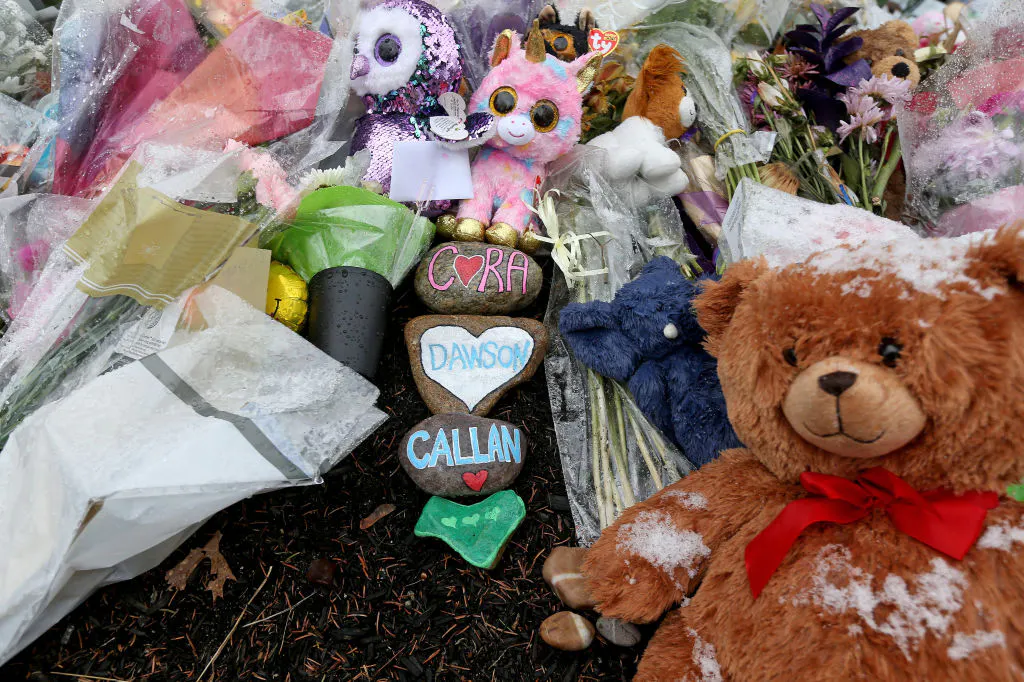
Cora was five years old. Dawson was three. Callan was eight months old. Their mother killed them.
That last fact is not actually in dispute in the courtroom. The question being litigated is whether Lindsay Clancy was criminally responsible for what she did. Her defense argues that severe mental illness, including postpartum psychosis, rendered her incapable of criminal responsibility. Prosecutors argue otherwise. That is the question the jury must answer.
But whatever that jury decides, three innocent children were killed. And somehow, in much of the cultural conversation surrounding this case, those children are beginning to feel almost peripheral.
The rallies are for Lindsay. The pink shirts are for Lindsay. The viral posts are about Lindsay.
The impassioned defenses are about what Lindsay was going through, what Lindsay’s doctors failed to recognize, what medications Lindsay was taking, whether Lindsay was adequately supported, whether Lindsay was sleeping, whether Lindsay was overwhelmed. Those may all be important questions.
But I keep wondering: What about the children?
Perhaps our response should not surprise me. After all, American culture has spent more than 50 years precisely developing this moral reflex.
When a woman is pregnant and frightened, we are taught to begin with her circumstances. Is she financially stable? Does she have support? Is the father involved? Is another child going to derail her education? Is she emotionally capable of parenting? Did she want to be pregnant? Is she overwhelmed? Is she depressed? Is motherhood more than she believes she can bear?
And somewhere along the way, the circumstances of the mother become so enormous that the humanity of the child nearly disappears.
The child becomes secondary to the crisis.
Eventually, we don’t simply say that the mother’s suffering deserves compassion. We say that her suffering can justify the intentional killing of her child.
That is abortion.
And I wonder whether 50 years of making that argument has formed us more profoundly than we realize.
I am not arguing that compassion for Lindsay is wrong. Christians, in particular, should never be afraid of extending compassion to someone who has committed even the most horrifying act. Mercy is not something we reserve for people whose sins are socially acceptable.
What concerns me is something different. We have become extraordinarily practiced at looking at a dead child and asking first what his or her mother was going through.
And abortion taught us how to do that.
For decades, the defense of abortion has depended on shifting the moral center of the story away from the human being who dies and toward the human being experiencing the crisis.
The mother’s suffering becomes the justification. But suffering does not make killing good. Being unsupported does not make killing good. Being frightened does not make killing good. Being poor does not make killing good. Being abandoned does not make killing good. And being mentally ill does not somehow transform the killing of an innocent human being into a morally good act.
Mental illness can matter enormously when we ask a different question: How responsible was this person for what she did? That is an important question. It is one our criminal justice system must take seriously. But it is not the same question as: Was what happened to these children wrong?
Of course it was.
We seem increasingly unable to separate those two conversations. We believe that if we call an act objectively wrong, we have somehow forfeited compassion for the person who committed it. Or we believe that if we acknowledge someone’s suffering, we must soften our description of what that suffering led her to do. We don’t.
Compassion should change how we respond to the woman. It should not change how we describe what happened to the child. That principle matters far beyond the Clancy case.
A woman seeking an abortion may be terrified. She may have been abandoned by her child’s father. She may not know how she will pay her rent. She may already have several children at home. She may have just received a devastating prenatal diagnosis. She may be depressed. She may feel utterly alone.
Every one of those circumstances should move us toward her. Feed her. House her. Sit beside her. Pay her bills. Help her find medical care. Hold her while she cries. Help her raise her child if necessary.
Her suffering should dictate the depth of our response to her. It cannot dictate the value of her child. That is the distinction our abortion culture erased. And perhaps that is why something about the response to Lindsay Clancy feels so familiar.
Women hear about a mother who was struggling, frightened, mentally unwell and overwhelmed, and something in us immediately moves toward her suffering. That instinct, by itself, is beautiful. But we have been culturally conditioned to take another step.
We allow the mother’s suffering to become the center of the moral universe until the child she has lost, or the child whose life she has taken, becomes almost invisible.
Cora, Dawson and Callan cannot become invisible. We can demand better postpartum mental-health care in their names. We can acknowledge that their mother may have been gravely ill. We can pray for Lindsay. We can even hope that the justice system takes every legitimate fact about her mental condition into consideration.
None of that requires us to forget where the greatest irreversible harm occurred. Three children went to bed on January 24, 2023, in the home where they were supposed to be safest. They will never get to grow up.
Whatever happens to Lindsay Clancy now, there will be doctors, attorneys, advocates, family members, and strangers fighting over what should happen to her next.
There is no next chapter for Cora.
There is no next chapter for Dawson.
There is no next chapter for Callan.
Perhaps that is what bothers me most about the extraordinary public identification with their mother.
For more than 50 years, we have been told that compassion requires us to understand why a woman might kill her child. Maybe it is time to remember that compassion also requires us to mourn the child who was killed.
***
Abby Johnson is CEO and Founder of And Then There Were None and ProLove Ministries.
More from this network:
Domains for Sale · GOTPeople.org · TheDSAPlatform · The Truth About Socialism
What's Your Reaction?
 Like
0
Like
0
 Dislike
0
Dislike
0
 Love
0
Love
0
 Funny
0
Funny
0
 Wow
0
Wow
0
 Sad
0
Sad
0
 Angry
0
Angry
0

I am just an average American. My teen years were in the late 70s and I participated in all that that decade offered. Started working young, too young. Then I joined the Army before I graduated High School. I spent 25 years in, mostly in Infantry units. Since then I've worked in information technology positions all at small family owned companies. At this rate I'll never be a tech millionaire. When I was young I rode horses as much as I could. I do believe I should have been a cowboy. I'm getting in the saddle again by taking riding lessons and see where it goes.
Premium domains for sale





















Comments (0)