

Why Indian American Success Should Be A Conservative Victory
Premium domains for sale
Freedom Is Back In Style
A white liberal woman, an Orthodox Jew, and an Indian walk into a bar. What do they have in common? Resentment on the online Right.
Freedom Is Back
In Style
Premium domains for sale
For centuries, the West’s imagination has been captured by the perceived exoticism of South Asia. Today, however, some corners of the online Right have traded fascination for disgust: resentment of its crowded cities, unfamiliar customs, and growing presence in Western life.
Indians, in particular, find themselves at the center of ridicule by the online Right. Across X, accounts openly ridicule Indians, from posts showing Indians crowding grocery stores to ranking Indians among the least desirable immigrant groups — placing them just above the Somalis — and labeling them “smelly, rude, entitled.”
TikTok, YouTube, and Instagram also feature anti-Indian rhetoric, targeting Indians’ culture and accusing them of being the catalyst for all the world’s problems, including economic pressures and housing shortages.
So why the sudden hatred? This fringe group turned against Indians because it felt threatened by their economic and professional achievements. Instead of viewing their success as a threat, however, the online Right should see this prosperity as proof that conservative practices actually work.
But this ire cannot take away from the fact that Indians are one of the most successful immigrant groups in the country. With a median household income of $150,000 and over three-fourths of its population in the U.S. holding a bachelor’s degree or higher, it makes sense that Indians boast high representation in universities and professional fields.
A recent Gallup poll shows that a record high of 27% of Americans fear that technology could make their jobs obsolete. Add to this the very real sentiment that H-1B visa holders are stealing jobs from Americans who deserve first pick at the job market by nature of their citizenship.
H-1B visas must be limited, and companies must justify hiring international talent when capable candidates are available in the American job market. But while many immigrants hold fairly restrictionist views on immigration, don’t expect Indians to vote for a party in which a group condemns them outright.
The irony of the online Right’s anti-Indian turn is that Indians are being punished for succeeding at the very American dream that conservatives have traditionally celebrated.
Earlier this month, a photo of a group of Texas high school students who scored in the top 1% of PSAT test takers went viral because all the students appear to be of South Asian descent, with not a single white student present.
The online Right prides itself on defending a particular vision of Western culture and American success, so when an immigrant group with a distinct culture and religion enters the country and succeeds on a massive scale, some on the Right turn to anger.
This hostility toward Indians is a particularly curious blunder because many of the values associated with Indian American communities — family, education, and hard work — are precisely the values the Right claims it wants America to embrace.
When I was a toddler, I moved to this country with my parents. We arrived in America with $200 and the promise of a job. Over the years, we fell in love with this country and its people. But we also lived with the knowledge that we could be sent back to India at any moment.
It took 15 years of living in America — navigating countless obstacles and spending hours in long immigration lines — before we finally became naturalized American citizens.
Perhaps this cohort feels threatened by Indians because their success in this country challenges the claim that Western tradition brought so much good to the world and allowed people to prosper.
What the online Right gets wrong, however, is that the reason why so many Indians come to the U.S. in the first place is that they see the fruits of the Western tradition and want to contribute to it.
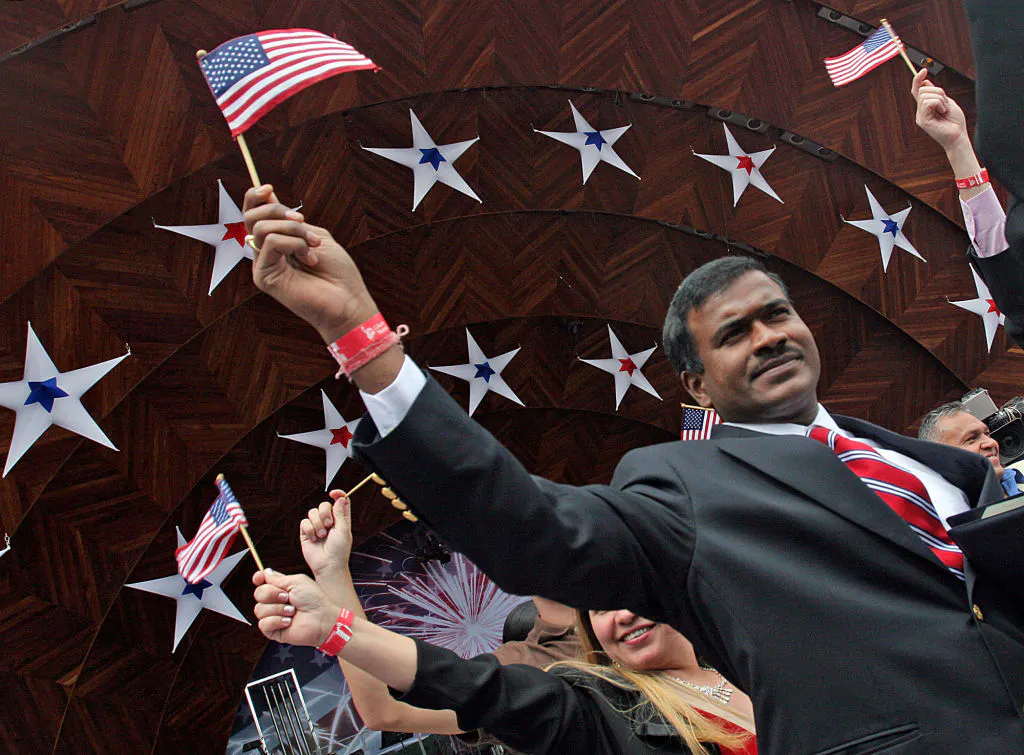
People in India hear how amazing life is in the U.S.: Americans have better work-life balance, spend less time commuting, live in cleaner cities, have more rights, and face less government corruption. So, when Indians come to the U.S., most of them assimilate into this culture. Sure, they may wear their colorful Indian dresses to a religious celebration, but then they go to work in some of the most esteemed positions, from the tech sector to healthcare.
Indian Americans hold major leadership positions across the U.S., including the CEOs of Google, Microsoft, IBM, and Adobe, while over 50,000 practice medicine nationwide.
The online Right spends considerable time lamenting the demise of American education, falling birth rates, and the erosion of family values. If we’re serious about restoring those values, Indians should be welcomed as allies, not vilified as enemies in a racial war.
In many ways, Indian Americans embody the very success story the online Right says it wants for America. The American Dream has long been that hard work and education can open the door to a better life. Indian Americans have demonstrated this. The online Right should point to these stories, rather than bash them.
Earlier this month, President Trump’s assistant attorney general Harmeet Dhillon tweeted: “Happy weekend and good Shabbos to all — yes, even the people who call me a ‘paperwork American,’ who post racist nonsense for clicks, who haven’t read enough books, who don’t know history. God loves all of you and it’s not too late to stop being wrong.”
Later, when she posted a traditional Indian meal cooked by her mother, one user commented: “You should eat that at home, not here in America. Bye.” Another wrote: “Street pooper and poop eater.”
Dhillon doesn’t need my defense, but calling an American citizen a “paperwork American” reveals the absurdity of demanding that immigrants assimilate while refusing to recognize them as Americans once they do.
Dhillon is the Republican assistant attorney general leading the crackdown on fraud across the country. Under her leadership, New York University Langone Hospitals and University of Pittsburgh Medical Center ceased providing “gender-affirming care” to minors, including the administration of puberty blockers and cross-sex hormones, and performing surgical procedures.
Her team also cracked down on anti-white and anti-Asian discrimination at top universities, including UCSF Medical School and UC Berkeley’s law school.
Although Indians account for 1.6% of the American population, even serious Republican candidates voice their dissatisfaction with this group.
Bo French, the Republican nominee for Texas railroad commissioner, posted an image of South Asian students cheering in the stands at a University of Texas football game. He captioned it, “Like body-cams exposed criminals, social media is exposing how many Americans have been displaced by foreigners. It’s everywhere and far worse than any of us could imagine.”
Simply because a group of South Asian students sits together in a game does not mean they have failed to assimilate. The very fact that the students are at a football game shows they are assimilating by taking part in America’s football culture.
The Right’s growing tendency to conflate visible ethnic diversity with a lack of patriotic belonging is a troubling trend — and one Republicans must put an end to immediately if they want a favorable outcome in the upcoming elections.
A 2026 report shows that the percentage of Indians who identify as Republicans and Independents has grown since 2020, while the percentage of Indians who identify as Democrats declined.
The percentage of Indians who intended to vote for Trump in 2024 rose from 22% to 30%, while the percentage who intended to vote for Joe Biden or Kamala Harris in 2020 and 2024, respectively, fell from 68% to 62%. While Indians tend to vote Democrat, this shift is especially telling considering that one of the points that Harris ran on was that she is a woman of black and Indian American heritage. The movement toward Trump proves that demographics do not dictate political outcomes.
When Italian immigrants arrived in the U.S., many Americans feared their language and religion. It was not until 1960 that Americans elected their first Catholic president, John F. Kennedy, overcoming fears that he would defer to the pope rather than the American people.
While the online Right may view Indian immigrants as a threat to American culture, history offers a different lesson. Assimilation takes time. The good news is that the majority of Indians aren’t flat-out refusing to assimilate. Indians’ success doesn’t have to come at the expense of American values. Sometimes, the people viewed as outsiders end up demonstrating just how well those values work.
The next time Indians walk into a bar, let the question not be whether they belong there, but whether the people already inside still believe in their values and are willing to defend them, even for those who don’t look like them.
Perhaps, then, the white liberal woman, the Orthodox Jew, and the Indian never walked into a bar at all. Instead, they walked into a laboratory, each offering a different case study in what happens when American ideals are put to the test. And perhaps the most uncomfortable lesson of the experiment is that sometimes the people you think threaten your values are the very people proving those values work.
***
Christina Lewis is a journalism fellow with the Intercollegiate Studies Institute. She graduated from Hillsdale College, where she studied history, politics, and journalism. You can follow her work on X @By_Christina.
More from this network:
Domains for Sale · GOTPeople.org · TheDSAPlatform · The Truth About Socialism
What's Your Reaction?
 Like
0
Like
0
 Dislike
0
Dislike
0
 Love
0
Love
0
 Funny
0
Funny
0
 Wow
0
Wow
0
 Sad
0
Sad
0
 Angry
0
Angry
0

I am just an average American. My teen years were in the late 70s and I participated in all that that decade offered. Started working young, too young. Then I joined the Army before I graduated High School. I spent 25 years in, mostly in Infantry units. Since then I've worked in information technology positions all at small family owned companies. At this rate I'll never be a tech millionaire. When I was young I rode horses as much as I could. I do believe I should have been a cowboy. I'm getting in the saddle again by taking riding lessons and see where it goes.
Premium domains for sale














Comments (0)