

Why The Birthright Citizenship Decision Was Wrong
Premium domains for sale
Freedom Is Back In Style
The Supreme Court has ruled that if you are born in the United States, you are a citizen.
Freedom Is Back
In Style
Premium domains for sale
If your parents traveled here to drop a baby, you are still a citizen.
If you spend five minutes here your entire life after your parents drop you here and then take you home, you are still a citizen.
Trump v. Barbara, the birthright citizenship case, was decided 6-3, with Chief Justice Roberts writing for the majority and Justices Thomas, Alito, and Gorsuch dissenting.
I warned you about Justice Roberts when he was selected by George W. Bush. I was virtually the only conservative columnist in America who said that Justice Roberts would not be good. This makes yet another terrible Chief Justice Roberts decision; he’s the guy who said Obamacare was totally legal.

Now he, along with the liberals on the court, is claiming that the Constitution of the United States under the 14th Amendment mandates that if you’re born in the United States under pretty much any circumstances, you automatically become a citizen.
We’ve been living with that rule in the United States for a long time. That is how the legal authorities have interpreted citizenship in the United States.
But the real answer here is that the Constitution, the 14th Amendment, and the Equal Protection Clause never contemplated that the Citizenship Clause would be used this way.
The explosion of illegal immigration over the last few decades is absolutely unprecedented in U.S. history, and it underscores how much this bad legal take on citizenship has totally screwed the United States.
Congress abdicated; multiple presidents abdicated. And so when you let in literally millions, possibly tens of millions of people who then have babies in the United States, you radically change the composition of the country because of bad legal interpretations such as birthright citizenship.
The opinion by Justice Roberts is a bad opinion. That’s because it is rooted in a really bizarre interpretation of the 14th Amendment to the Constitution and its history. It’s a narrative that starts in Britain, takes a weird detour into the Reconstruction Era, and then returns to the British view after United States v. Wong Kim Ark in 1898. It doesn’t make much legal sense.
To start at the very beginning, the governing law for citizenship in the United States is the 14th Amendment. It states, “All persons born or naturalized in the United States, and subject to the jurisdiction thereof, are citizens of the United States and of the State wherein they reside.”
The key phrase is “subject to the jurisdiction thereof.” It seems superfluous, does it not? If we just wanted to say that if you are born or naturalized in the U.S., you are therefore a citizen, then you don’t need the phrase “subject to the jurisdiction thereof.” It’s already stated that if you’re born in the United States, you’re a citizen. But then it says “subject to the jurisdiction thereof.”
What exactly does that mean? That is the subject of the case.
Justice Roberts writes:
The story of citizenship in the United States begins with the English common law. Before the Revolution, the American colonists—like all in the British Empire—were considered subjects of the sovereign. … Because the sovereign’s power (and thus his duty) was limited in various respects, so too was the scope of this rule. He could not demand allegiance from—for he could not protect—those born in lands that he did not control.
That arose not from royal fiat, but from what the common law conceived as the relationship between the sovereign and the people. The story of citizenship in the United States begins with the English common law. Before the revolution, the American colonists, like all in the British Empire, were considered subjects of the sovereign because the sovereign’s power, and thus his duty, was limited in various respects. So too was the scope of this rule. …
In all other respects, however, the sovereign’s power—and his claim to the people’s allegiance—was complete. A foreign mother could enter the British Isles, give birth, and leave with her child the very next day, and that child would remain a British subject. Why? Because the child owed an implied allegiance to the sovereign who protected him at his birth—no matter how “momentary and uncertain” his presence in the King’s realms.
There’s one problem with this. As Justices Thomas and Alito note, the American Revolution did not believe in the idea that the King had dominance over his subjects because we are citizens, not subjects. We fought a whole revolution in order not to be British.
Roberts continues, “This view crossed the Atlantic with the colonists — and was adopted with little fanfare after the Revolution, as ‘subject[s]’ of the sovereign became ‘citizens’ of the States. He says that after the revolution, as subjects of the sovereign became citizens of the state, it was the same as being a subject of the king.
That is totally and absolutely wrong.
Every immigration-status question focuses on the status of the parents. If you are born a child of an ambassador, we are not focused on your status; we are focused on your parents’ status.
What the court held in United States v. Wong Kim Ark, according to Roberts, was simple: the Citizenship Clause incorporated the common law and granted citizenship to nearly all children born in the United States.
But Justice Thomas says no. When it says “subject to the jurisdiction thereof,” you have to be domiciled in the United States, and you have to have allegiance to the United States. No foreign allegiance.
The opinion of the Court is that if you’re born in the U.S., you’re a citizen, and that goes all the way back to the British Empire, because we basically just picked up the British idea of citizenship and dumped it wholesale into American law.
As Thomas’ dissent points out, this is a terrible take on the actual history, and it’s a terrible take on the law.
Thomas is obviously super-ticked off — and for good reason. He pretty much says, “Listen, your interpretation here is just crap. This Roberts’ majority opinion is rooted in ahistorical nonsense.”
He says the court’s account makes no sense. He notes that the post-ratification evidence against the court’s view begins not nearly two decades after the 14th Amendment’s ratification, but immediately. All three branches of the federal government had already rejected this view of birthright citizenship. He points out that there are many indicators of original public meaning supporting the domicile requirement. He notes that if the Court were right about birthright citizenship, then there would have been a huge increase in dual nationality, which nobody would have accepted in the 19th century.
Justice Alito follows hard on all of that. He points out that what the court is really doing here is avoiding the real problem, illegal immigration; that they are afraid that if they rule that birthright citizenship is not legal, you’d end up with millions of people in limbo.
Alito says that is not a reason to leave bad law in place and make the law worse in the process. He is raging mad; he writes:
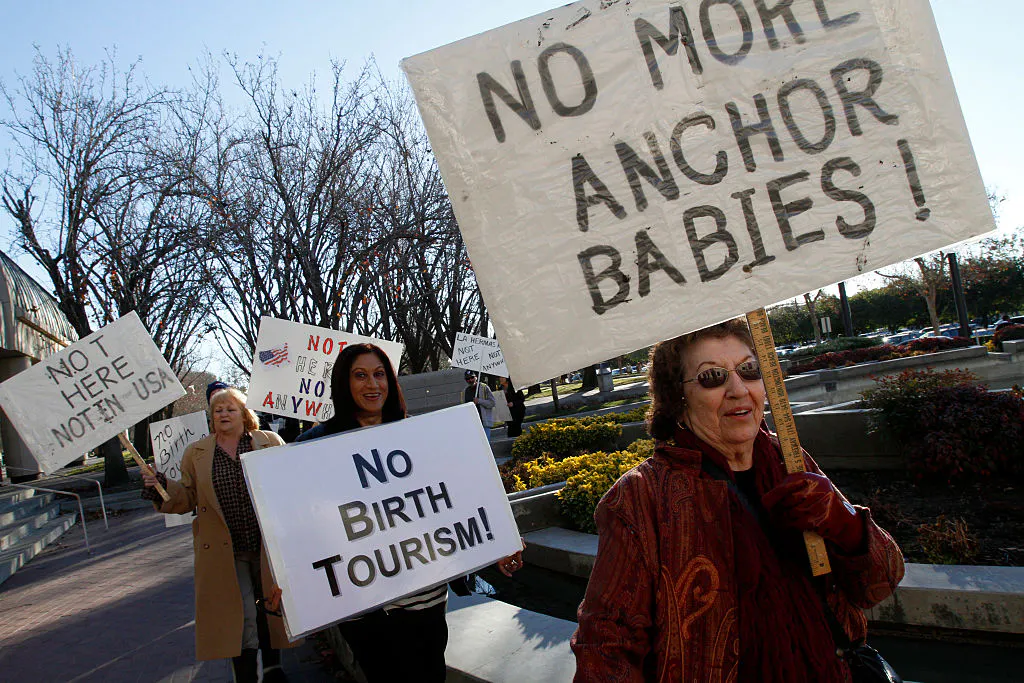
This is one of the most important decisions in the history of the Court, and in my judgment, the Court has made a serious mistake. As interpreted by the Court today, the Fourteenth Amendment confers citizenship on virtually everyone who happens to be born in this country, including the children of “birth tourists,” women who come here solely for the purpose of giving birth to a child and then promptly return home. Careful analysis of the text of the Fourteenth Amendment and the process that led to its adoption shows that it does not degrade the concept of United States citizenship in this way. Instead, the Fourteenth Amendment confers citizenship on only those children who, at birth, owe allegiance solely to this country.
“United States citizenship is precious. Anyone who has attended a ceremony where citizens are naturalized can see that message on the faces of those who take the citizenship oath. Before saddling the Nation with a medieval rule, we had better be certain the Constitution requires it,” he declares.
He continues:
The Court’s account of the birthright-citizenship rule in American law is roughly as follows. After American independence, the British rule of birthright subjecthood was modified in just one way (to take account of Indians who lived under tribal governance), but otherwise the rule was transplanted intact to American soil. As modified, the rule was that a child born in this country is automatically an American citizen unless the child is born to tribal Indians or to a diplomat with immunity from legal process.
During the period before the Civil War, the rule’s status was firm. After the war, Congress codified the rule in §1 of the Fourteenth Amendment. And in United States v. Wong Kim Ark, this Court issued a binding precedent confirming what Congress had done. Every step of this story is incorrect. The Declaration of Independence repudiated the foundation on which the British rule was based.
The outcome of the case is this: Congress and the presidency must handle their business on immigration. The decision makes the immigration issue that much more pressing.
It must happen soon because, for the foreseeable future, birthright citizenship will be the law of the land.
More from this network:
Domains for Sale · GOTPeople.org · TheDSAPlatform · The Truth About Socialism
What's Your Reaction?
 Like
0
Like
0
 Dislike
0
Dislike
0
 Love
0
Love
0
 Funny
0
Funny
0
 Wow
0
Wow
0
 Sad
0
Sad
0
 Angry
0
Angry
0

I am just an average American. My teen years were in the late 70s and I participated in all that that decade offered. Started working young, too young. Then I joined the Army before I graduated High School. I spent 25 years in, mostly in Infantry units. Since then I've worked in information technology positions all at small family owned companies. At this rate I'll never be a tech millionaire. When I was young I rode horses as much as I could. I do believe I should have been a cowboy. I'm getting in the saddle again by taking riding lessons and see where it goes.
Premium domains for sale




















Comments (0)