

With Abdul El-Sayed On The Ballot, Michigan Democrats Are At A Crossroads
Premium domains for sale
Freedom Is Back In Style
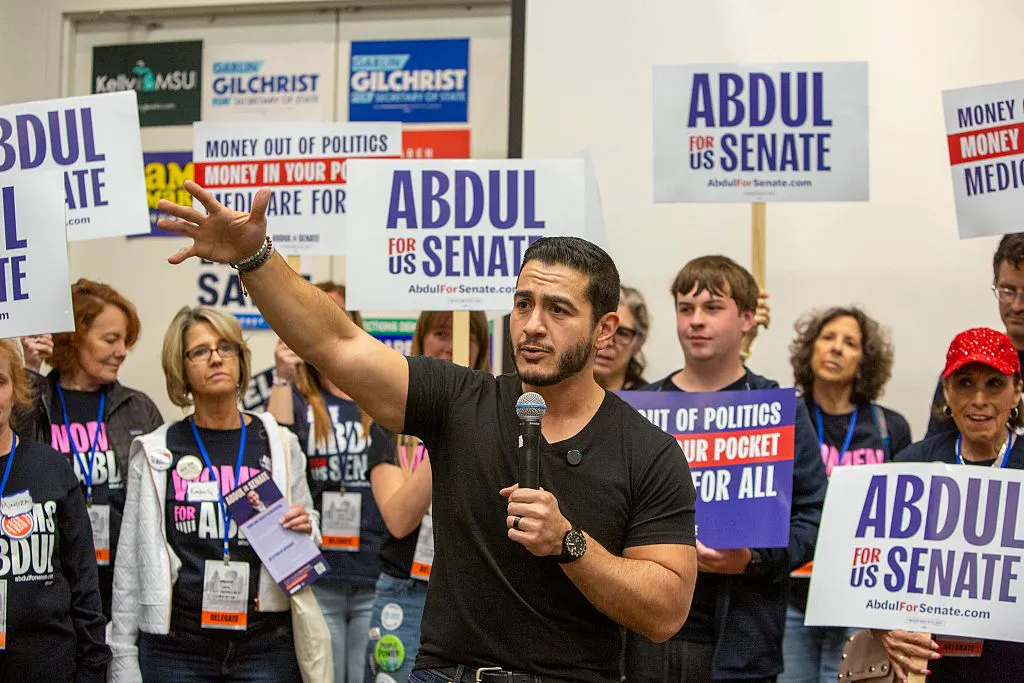
Political and sports commentator Clay Travis recently suggested that Michigan Republicans should cross over and vote for Abdul El-Sayed in the Democratic Senate primary. His reasoning: El-Sayed is a far-left radical who can’t win in November, and his securing the nomination would help Republican Mike Rogers win the all-important seat.
Freedom Is Back
In Style
Premium domains for sale
This is seriously bad advice — not just because it’s tactically risky, but because it asks Republicans to do something they should be unwilling to do: lend their votes, even instrumentally, to a candidate who represents a newly imported and genuinely dangerous ideological project.
Primary meddling is a stupid game that typically produces stupid prizes. Anticipating that some conservatives might start floating this ill-advised idea, I wrote about it recently for this site.
Democrats were eager to see Donald Trump win the 2016 Republican presidential primary, convinced he would be a gift to Hillary Clinton in November. That failed calculation reshaped American politics. Closer to home, primary meddling has occasionally “worked” in narrow tactical terms, elevating weaker nominees who go on to lose. But those cases are the exception that seduces people into ignoring the far more dangerous reality: sometimes the candidate you boost actually wins.
But the bigger issue here is that the Michigan Senate race is not just another contest between interchangeable Democrats. It is a referendum on what kind of Democratic Party emerges in one of the country’s most crucial swing states. Republicans ignore that meaningful difference between the candidates at their peril.
Congresswoman Haley Stevens, who began this race as the polling frontrunner but now lags in prediction markets as a distant third, is a conventional Democrat with a frequently (and somewhat unfairly) mocked Midwestern twang. She ran as a moderate and has governed as something less than that — hardly a surprise in modern politics. As the election of Virginia Governor Abigail Spanberger illustrates, Democrats who campaign toward the center often govern further to the Left once in power, pursuing policies they never fully advertised on the trail.
That bait-and-switch dynamic is real. Republicans are right to be frustrated by it. But frustration is not an excuse for abandoning basic judgment.
Because whatever one thinks of Stevens’s voting record on taxes, regulation, or abortion, she does not represent a fundamental threat to the American political order. She operates within it. She is recognizably part of the long-standing Democratic coalition that, for all its many faults, accepts the basic premises of American life: liberal democracy, civil society, and the legitimacy of the United States as a nation. The same can be said of the third major candidate in the race: progressive state legislator, MS NOW fixture, and Middle America-critic Mallory McMorrow.
Abdul El-Sayed, on the other hand, represents something different: Islamoleftism. This is the uneasy fusion of the radical political Left with the ideology of political Islam — not a religion, but a political radicalization that has found in the far-left Democratic coalition a vehicle for its ambitions. It is what happened to Jeremy Corbyn’s Labor Party in the United Kingdom, where radical Muslims became culture carriers inside a major political party, importing eliminationist antisemitism into the mainstream of left-wing politics until the rot became undeniable and the party paid a historic price.
Michigan is that story in its American infancy. Dearborn — which one Wall Street Journal essay called “America’s jihad capital” — has developed an Islamist political infrastructure whose leaders curry favor from ambitious Democrats. El-Sayed has obliged them. A leaked recording of him speaking with campaign staff revealed he didn’t want to say anything about the U.S.-Israeli elimination of Ayatollah Khamenei earlier this year because, he explained, too many people in Dearborn would be sad about the death of the theocratic butcher who led the world’s top state sponsor of terrorism.
El-Sayed has appeared at Islamist conferences with speakers who praised Hamas terrorism, addressed groups that have been designated as terrorist organizations, raised money from antisemitic PAC leaders, and fought efforts to keep Islamic law out of American government. His response in the days following a Hezbollah-inspired terrorist attack that attempted to murder 140 children by driving an explosive-laden truck into the preschool at Temple Israel — the largest Reform synagogue in my hometown of West Bloomfield — was to post a smiling photo appealing to fans of Hasan Piker, announce joint campaign appearances with him, and minimize and rationalize the near-massacre by declaring: “Hurt people hurt people.”
Piker, for the uninitiated, is a self-described Marxist who has called Jews “inbred,” declared America deserved 9/11, and recently used a filmed New York Times roundtable to explain his moral framework for the various scenarios in which carjacking, shoplifting, and murder are excusable. His approval is increasingly a litmus test for Democratic office-seekers.
The broader picture in Michigan confirms this isn’t just about one candidate. At the state’s Democratic Party convention earlier this month, organized labor — long the kingmaker of Michigan Democratic politics — was routed by the coalition El-Sayed represents. The attorney general candidate who held every major union endorsement, including the United Auto Workers and the Michigan Education Association, lost to an opponent with a single local endorsement. Jordan Acker, the Jewish incumbent University of Michigan Democratic regent whose home and car were repeatedly vandalized with antisemitic graffiti by fanatical-left Palestine obsessives, was denied renomination and replaced by a Dearborn attorney who has praised Hezbollah and the Iranian terror regime. Twenty-four union locals and a former Michigan AFL-CIO president have already defected to endorse an independent candidate running for governor rather than follow where the party is heading.
My Manhattan Institute colleague Charles Lehman recently wrote about the growing disease of anti-Americanism and the expanding patriotism gap between our two parties. In 2001, Democrats and Republicans were a mere three points apart in their pride in being American. Today, the gap is vastly larger — 92% of Republicans call themselves very or extremely proud; among Democrats, that number is just 36%.
The Democratic Party once feared being seen as unpatriotic, but it now rewards politicians for the viciousness of their America-criticism and punishes those who hesitate to go along. El-Sayed is the natural endpoint of that trajectory. Stevens and McMorrow are much less of an accelerant on this front.
Republicans should want to win this race. But as the state party has rightly pointed out, they should not get too cute when thinking about how. Not all Democrats are fungible, and it matters which faction prevails inside their party. A conventional liberal can be defeated and replaced; a radical movement, once legitimized, reshapes the party around it and the country that has to contend with it.
Boosting El-Sayed isn’t a clever tactic. It’s a bet that anti-Americanism stays contained once you help elevate it. That’s a bad, risky bet.
Better to defeat Democrats by making the affirmative case for why Republicans deserve to govern. Don’t evade countering the arguments made by bad Democrats by instead attempting to elevate worse ones.
***
Jesse Arm is vice president of External Affairs at Manhattan Institute for Policy Research. His affiliation is presented for identification only; all views expressed are his own and not those of his employer.
More from this network:
Domains for Sale · GOTPeople.org · TheDSAPlatform · The Truth About Socialism
What's Your Reaction?
 Like
0
Like
0
 Dislike
0
Dislike
0
 Love
0
Love
0
 Funny
0
Funny
0
 Wow
0
Wow
0
 Sad
0
Sad
0
 Angry
0
Angry
0

I am just an average American. My teen years were in the late 70s and I participated in all that that decade offered. Started working young, too young. Then I joined the Army before I graduated High School. I spent 25 years in, mostly in Infantry units. Since then I've worked in information technology positions all at small family owned companies. At this rate I'll never be a tech millionaire. When I was young I rode horses as much as I could. I do believe I should have been a cowboy. I'm getting in the saddle again by taking riding lessons and see where it goes.
Premium domains for sale







Comments (0)